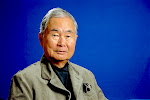
After arriving at the Washington Canal City Hotel last night, I finally went to sleep way after midnight Kyushu time, and woke up at 5:30 in the morning to begin my arduous day, which will last through dinner, hopefully only at 8PM or so.
Breakfast at the hotel is fabulous, only $15, but free if you stay here. I took a little bit of a lot. I gain weight in Japan mostly because of this temptation.
There are four HNEI staffers staying at this hotel, and we were picked up at 7:45AM and taken to the Ito campus, a distance of almost 16 miles. Coincidentally this is also day 2 of Energy Week, which really started yesterday.
The site of most of the presentations is Shiki Hall, a truly fine concert/lecture hall, outside and inside:
The first three plenary presentations were supposed to represent China, U.S. and Europe. I'll skip over the other talks, but I replaced the current director of the Hawaii Natural Energy Institute, Rick Rocheleau, for the U.S. portion, while Jean St. Jean of Hawaii told us what HNEI is doing today. I first gave the
history of HNEI and ended with the future, but more so, how Kyushu University and the University of Hawaii might best cooperate. My foci were on the politics, relationship-building and selection of topical pathways, and, further, how important changing events, needs of the community and fresh concepts were in determining objectives and goals.
I began with a few slides about my roots, starting with my father's father, Kenjiro Takahashi, who was sent from Utashinai, Hokkaido to America sometime in the 1890's, and learned something. No details have been found. However, on his way back to Japan, he stopped off on Kauai, met and got married in Kilauea, and was instrumental in the construction of a hydroelectric power plant at Wainiha. He unfortunately fell and died at site a few months before commissioning of the facility. It produced 3 MW then, and I showed a photo of me at the power plant more than a century later, where the equipment still generated around 3 MW. Thus, my family has been involved with renewable energy for more than a hundred years, plus, this explains why I grew up in Hawaii rather than Japan.

I then skipped to the early 1970's when I first joined the University of Hawaii's College of Engineering and, for my initial research project, was funded by the National Science Foundation to be the reservoir engineer for the Hawaii Geothermal Project. We succeeded in finding the hottest geothermal well in the world and there is now 38 MW of geo-power being generated in Hawaii.
Then in 1973 came the first energy crisis. The dean of engineering, John Shupe convened a meeting of ten faculty, gave us a list of ten topics to choose, starting with the most senior member, and the tenth one left for me as the newest hire, was wind energy. So I became the wind power expert for the state. Note two things that happened. With a PhD in biochemical engineer I became a reservoir engineer and the leader of wind energy. There was no justification for me to lead these fields, but here is what happened.

In 1974 I took a trip to Washington, D.C. to meet with the wind person in the Energy Research and Development Agency. The Department of Energy had still not been created. Lou Divone kind of laughed at me and said Hawaii has no wind. I asked him how did he know. He reached back and pulled out an almanac of wind averages from throughout the U.S. Turned out these were from airports. So I said airports tend to be built in low wind locations. Hawaii has mountains that amplify the wind, and wind energy increases with the cube of the speed. Notice that the best wind regimes in Hawaii are in the ocean. He conceded that was a good point, and indicated that the Wind Energy Division of the American Solar Energy Society would be meeting the following week in Denver, and I should ask them for help.
In the meantime, I was already scheduled to attend the first gathering of hydrogen enthusiasts at the University of Miami hosted by Nejat Veziroglu (
left, today). Why, I think had something to do with my interest in the use of hydrogen for aviation, for this gas provided the greatest energy/weight.

Flight schedules could then be changed without penalty, so I did show up in Denver and walked into an already darkened room of the wind experts, at which I made a short comment about seeking their assistance for a future Hawaii wind power program. An hour later I was elected chairman of the Wind Energy Division of the American Solar Energy Society. How did this happen? I learned an important lesson, that kept repeating in different ways throughout my career. What was that lesson? Not sure, but being confident while asking for help might be a clue.
I then skipped to 1979 at the heat of the second energy crisis when I found myself working for U.S. Senator Spark Matsunaga in Washington, D.C. In the three years I spent with Sparky I drafted the hydrogen and ocean thermal energy conversion (
OTEC) bills that pretty much led to national programs on those subjects. I was also the Senate staff link for the wind energy bill which initiated this technology in the U.S., leading to formation of the American Wind Energy Association. I was also chief staff for passage of the Hard Minerals Act, for manganese nodules, cobalt and rare earths
This initial work led to:
- wind energy now being more cost-effective for electricity than natural gas and geothermal
- geothermal next to wind in production cost/kWh
- the Hawaii Natural Energy Institute becoming national centers for
- the Blue Revolution
- companies I helped form for
The final third of the presentation was a suggestion on future research areas of potential importance to Kyushu University, Japan and the world:
My presentation said a lot more, including three slides by Richard Rocheleau on HNEI's collaborative energy program in the Orient, seeking the involvement of Kyushu University. I indicated that much of what I said can be found in the three recent books I had written. I provided a copy of each to Akari Hayashi, who was the key force behind Energy Week.
There were many questions, a follow-up discussion panel in the afternoon, ending with a reception. Some highlights during information exchange:

- I stressed building relations over accomplishing personal goals, making friends not enemies (for they can someday come back to bite you), embracing the political process, and the importance of proceeding with confidence and integrity.
- I talked about how Paul Yuen and I formed the Pacific International Center for High Technology Research (which was grossly mis-named by a governor who I will not mention) to serve as the bridge between academic research and industry, and integrating international cooperation, where two major $25 million projects we initiated were:

- the 210 kW open cycle OTEC experiment at the Natural Energy Laboratory of Hawaii, where one third the funds came from Japan
- the Maui biomass to methanol project (where we would develop the direct methanol fuel cell for vehicular applications--we never succeeded, mostly because of the incompetence of Westinghouse, our partner)
- On a question posed during a panel on whether one should stop at the master's level instead of getting a PhD, my response was:

- get any degree, and a PhD if you can
- this will expand your horizons and optimize your ability to take on larger objectives
- I would not have gone on to work for the Lawrence Livermore National Laboratory on laser fusion nor the NASA Ames Research Center on the Search for Extraterrestrial Intelligence nor the U.S. Senate if I did not have a PhD
- the degree gives you a special badge of respect and opportunity to Save Planet Earth and Humanity
I walked around a bit on campus:
The reception at the end of the day was excellent:
- The cuisine and drinks were exceptional, and they kept coming.
- As an invited guest I was asked to give any impression I might have had that day:
- I indicated that Kyushu University has significantly changed from the first lecture I gave here almost a third of a century ago.
- This has become the most progressive Japanese university for international cooperation, links to industry and education.
- This new campus, interacting with the surrounding environment, provides an ideal setting to expand their quest of sustainability.
- They have also embarked on a major long-term effort for the Hydrogen Economy.
- Below, the two conference leaders, Masato Wakayama, executive vice president of the university, and Akari Hayashi, professor of hydrogen energy systems:
I'll end with a photo of the other three Hawaii Natural Energy Institute staff members in attendance here, Tatyana Reshetenko, Godwin Severa and Jean St. Pierre:
Tomorrow, the four of us have a the day free, so we plan to tour Fukuoka. I will leave everything up to them.