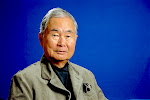
. The two pictured (from Wikimedia Commons) individuals were very influential. Without either one, there would have been no Chapter 1. I worked for U.S. Senator Spark Matsunaga (left), who was the driving force behind the U.S. Peace Institute. R. J. Rudy Rummel (right), is a retired political science professor from the University of Hawaii, who first wrote on the solution to be provided.
A Simple Solution to WarsIs total peace just a simple matter of controlling nuclear power and neutralizing China? It is said that the waging of peace will take many turns and be accomplished in small steps. George Shultz, William Perry, Henry Kissinger and Sam Nunn, a bipartisan team of super decision-makers, wrote an op ed (opinion of the editor, and also opposite the editorial) article for
The Wall Street Journal in 2007, calling for a world free of nuclear weapons.
118 They remarked that the Non-Proliferation Treaty of 1967 established the foundation for their plea, but the vision of Iran and emergence of global terrorists have changed the rules of the game. Certainly, the control of the atom will be a necessary early step to pave the way to peace.
Second, what about China? The Ford Foundation and Rockefeller Brothers Fund sponsored a study on “Scenarios for the Future of United States – China Relations,” looking ahead to 2010.
98 The policy choices recommended were that:
o The U.S. and China needed to go beyond economic engagement and identify common security interests, such as seeking a common ground on Taiwan and sharing capabilities in environmental protection and sustainable energy.
o The U.S. policy should get off their current incoherent mixture of containment and engagement, and instead work mutually towards China as a global power, after all, it has been predicted that the Gross Domestic Products of the two countries will be equal by 2025.
o The U.S. should carefully support human rights reform in China.
o The relationship should not be one of friends, but of family.
But these are lower order requirements to maintain order and progress. Is there a more definitive, and simpler, means of insuring for future peace? I started writing this chapter without a solution.
Early in 2006 I was thumbing through the latest issue of
Honolulu, and amazingly enough, there was the simple solution to ending wars forever. Emeritus Professor Rudolf Rummel of the University of Hawaii Political Science Department wrote an article entitled, “Iraq: was Bush right?” He says yes, but more so, pointed out that of all international wars with at least 1,000 casualties from 1816 to 2005, almost two centuries, there have been no wars between two democracies.
268 There were 166 between democracies and non democracies and 205 between non democracies and non democracies. Let me repeat:
NO MAJOR WARS BETWEEN TWO OR MORE DEMOCRACIES OVER THE PAST TWO CENTURIES.
Is that a clue to end all wars or what? Maybe President George W. Bush, too, knows this. Maybe that is why he and his aides jumped headlong into the Middle East. Certainly, their proposing the establishment of the UN Democracy Fund is philosophically consistent. To boot, their Iraq surge in 2007, as faulty as it was because more troops could have been sent if the politics allowed, actually worked, and there is hope now that not winning has become not losing, all for the long-term establishment of a workable democracy.
I subsequently went to
GOOGLE, and there was a
Wikipedia section just on Rudolph Joseph Rummel. Then I remembered that his wife, Grace, was a high school classmate of mine, but that I had not seen her in half a century. Emeritus Professor Rummel has published 24 scholarly books and over 100 professional articles. He also coined the term democide, or murder by government, claiming that six times as many people died of this act in the 20th century than all wars. His book,
Power Kills, published in 1997, was largely available on the internet, so I read it and began communicating with him. He said his hearing was going, so it was best for us to converse by e-mail.
The CATO Institute published their Ninth Annual Ranking of Economic Freedom in 2005, stipulating that economic freedom is almost 50 times more effective than democracy in restraining nations from going to war. Professor Rummel reacted with sadness, pointing out in blogger
Democratic Peace, that not only was this wrong, but incompetent. The basic argument: if the study uses data showing zero wars between democracies over almost two centuries, how can economic freedom be 50 times better? The point, of course, is not to refute Professor Rummel’s contention, but, only so, to underscore that our present government’s policy to promote peace in the Middle East and other regions through democratization is of questionable worth. It should be remembered, of course, why these organizations push a cause. The CATO Institute happens to be a libertarian public policy research foundation. Libertarians want to limit the role of government and they love free markets. Rummel, a libertarian on domestic issues, still felt compelled to respond.
So I now had a solution to end wars, courtesy of Professor Rummel. Clearly, the U.S. is only a necessary participant in the process, and is not in any position to coordinate the larger peace.
Searching my soul, the only final stage solution I could formulate was for the United Nations to be provided enhanced powers to insure for the phase-out of wars by:
o Creating a World Peace Institute (WPI) to train peacekeepers. While every major country has academies to train warriors, the time has come to produce the leaders who have the mentality, attitude and capability to engender peace. (
This is straight from Spark Matsunaga.)
o Set up a peace equity fund by assessing companies/governments exporting war equipment of any type. It is reported that the U.S. alone sold abroad more than $142 billion dollars worth of weaponry in 1992. This amount has dropped since then, but, world-wide, remains in the range of $50 billion/year. This fund will be used to establish and operate the WPI. The rate can be determined by need. This so-called investment (
also known as a tax) for peace should serve an enhanced role by reducing the market demand, sort of like how significantly increasing gasoline taxes would lower consumption.
Well, Reagan’s Star Wars strategy bankrupted the Soviet Union, so we conveniently were able to win the Cold War for the cause of freedom. About China, well, let’s see what we can do to steer them towards a democracy. Step one has been successful, which was to introduce free enterprise into their economy. Of course, Taiwan, a splinter we support, is a representative democracy. Where is Chiang Kai-shek or the next one, to unify the entire country? Or, more sensibly, future leaders of China might someday succeed in courting Taiwan into accepting some form of governmental partnership, which could well provide the Trojan Horse to long-term democracy. Macau and Hong Kong are already partly serving this function, as is Shanghai.
Or, there is the theory that China will go the way of the Soviet Union and split into a bunch of smaller nations. Whatever, the SIMPLE SOLUTION strategy is clear: to end all wars for a long time, steer China into democracy.
Thus, the simple solution to ending wars forever is simply to:
1. Establish the World Peace Institute under UN auspices.
2. Broaden the UN Democracy Fund to convert all countries to democracies.
3. Financially support the above by placing a peace incentive surcharge on exported armaments. The rate will be determined by the amount required to progressively carry out tasks #1 and #2. This fund will over time drop to zero because of the following monumental breakthrough.
4. Whether they be world conditions or inspired leadership by the major countries, it is conceivable that the G8 Nations can someday simply agree to total disarmament over, say, a 10 year period. This time, all nuclear weapons should be immediately and terminally dismantled. If at the height of the Cold War the U.S. and USSR found it possible to agree on philosophical disarmament, it should be easier and almost predictable for the G8 to take this grand step for the future of humanity. Can you imagine the benefits if the entire budget of all countries can subsequently be focused on benefiting people and our planet? This is partly why Japan and Costa Rica can be so economically competitive already, for the former has minimal defense expenditures and the latter has no military. If crime and drugs can also become obsolete, allocations for police, the judiciary, prisons and the like can also be shifted to the 7 R’s of education, the environment and a sustainable world.
How long will this all take? Maybe never if you’re a pessimistic, or realist. But only three generations would be about a century, an infinitesimally minuscule period considering that we have 5 billion years left before the Sun expands and engulfs Planet Earth.
Yet, to be truly simple-minded, it is not impossible for all this to occur in a decade. How? Say Peak Oil and Global Warming (
details are provided in Book 1) begin to show cataclysmic reality. The only solution possible to minimize global economic and political collapse would be for the G8 Nations to provide emergency powers to the United Nations to solve the problem.:
o In the 2009 G8 Summit, President Clinton or Obama (
remember, this book was published in March of 2009--see Huffington Post article entitled, "Well Barack, We have a Problem") calls for immediate and total world disarmament, starting with the U.S. halving (
in that article, I adjusted to only reducing by 10% as more reasonable) our defense budget, and other nations, likewise. A Republican will philosophically not be able to take this colossal step. We can afford to be so magnanimous because we are so dominant that this first step should not cripple our ability to defend our nation, if other countries also comply. The defense budgets would then be applied to fix the energy/environment problem, plus engineer the peace. The military units themselves would be re-assigned to the task at hand, then phased out over time. They are already trained to do so in natural disasters. The military-industrial complex would merely shift their thrust to renewable energy and environmental remediation.
o Pick 2020 as the year in which hydrogen would be made free. GoCo’s (government-company partnerships) would be formed to insure that the technologies and infrastructure would be available to provide for free renewable hydrogen by that date. Of course, the tax structure will likely need to be adjusted to actually pay for this FREE energy. (See Chapter 3 in Book 1,
Simple Solutions for Planet Earth. (
Unfortunately, the U.S. Department of Energy just decimated the hydrogen budget.)
o As it might be difficult to develop an all-hydrogen system in a few short years, it would be wise to provide for a parallel pathway: biomethanol. Methanol is the only bioliquid that can be directly processed through a fuel cell, so a comprehensive effort should also be focused on the direct methanol fuel cell, gasification and catalysis of biomass into this fuel and retrofitting of supply lines. (See Chapter 2 of
Book 1.) As windpower has more recently become competive, a major effort should be focused on offshore windpower, where bladders in the ocean can be fed electrolyzed hydrogen for export. As utility companies today do not trust the winds supplying more than 20% of their demand, this bulk storage also can be tapped to provide electricity when winds are low, thus eliminating this handicap from wind power. Details can be found in Chapter 2 of Book 1.
Can all this be accomplished in a dozen years? Well, the Hoover Dam was built in five years (
early 30’s), the Atomic Bomb took five years (
early 40’s), Man on the Moon was pronounced by JFK in 1961 (with
Neil Armstrong monumental step occurring in 1969), and the largest aquarium in the world was built in Georgia in four years (
2001 to 2005). Mankind, or individuals, when challenged, can meet difficult goals. Ironically enough, the fortuitous double hammer of Peak Oil and Global Warming could well be that “Attack of the Aliens” requirement for humanity to set aside conflicts to arrive at a simple solution to end all wars.


 I guess the primary reason why I came was to participate in a special luncheon sponsored by Neil, President/co-founder of

 The flameangel and yellow tang:

 We also visited Big Island Abalone (above). Their Kona abalone is now the Japan Ezu awabi, for the market is sushi bars in that country. As with this company, and some others here, there seems to be a lot of international takeovers and rumors about new marine products, including blue fin tuna.


 The following is excerpted from Chapter 1 of