This blog site initially focused on renewable energy and the environment. But that was SIMPLE SOLUTIONS for Planet Earth. My next book, SS for Humanity, opened the subject area to everything else, including SETI, the afterlife, travel and cuisine. However, I still provide, now and then, SIMPLE SOLUTIONS.
The New York Times this morning published 8 charts comparing President Donald Trump's performance with that of this predecessors. Here are three of them:
Doing very poorly.
I am the only person I know in Hawaii with a roots link to Hokkaido. My father's father, Kenjiro, came from here. I have made several trips to Akita in northern Honshu, Otaru (where Kenjiro was born), Sapporo (where the population was only 1,256 in 1872 when he was born) and Utashinai. One thing I learned in this effort is that Kenjiro is a name given to a first son. I am named after him with Kenji, which stands for second son, which I am.
The story of this search is provided in my 31March2009 posting of THE SEARCH FOR KENJIRO'S GRANDMOTHERS. In that article, I also explain the colored symbol I have used for my books.
On another, I actually started in Akita, from where Kenjiro's parents came, caught a ship to Otaru, took a train to Sapporo, where the family stopped for a while, then a train to Asahikawa, then bus to Utashinai, where they settled, Can't imagine how they got from Otaru (3) to Sapporo (1) to Utashinai, for the first railway line connecting Otaru and Saporro did not occur until 1880. On this map, Utashinai is a long taxi ride to the east (left) and slightly south (lower) from Asahikawa (6).
Otaru in Ainu means river running through the sandy beach. There are seven rivers running through the city.
Current population of 107,432.
Is a 25-minute drive from Sapporo.
Sapporo.
With nearly 2 million people, the largest city in Japan north of Tokyo.
City began in 1869,
Hosted the 1972 Winter Olympics, the first held in Asia.
Annual Snow Festival draws more than 2 million.
With that, our ship arrived in Otaru, here it is, just about May, and there was snow on the mountains.
We left on the tour of Otaru and Sapporo at 8AM, and did not return until 3PM. Saw a lot of Sakura trees in blossom on our way to our first stop, the Sapporo Okurayama Ski Jump Stadium, which remained from the 1972 Winter Olympics. We caught the Ropeway to the top and back. I've been to Sapporo numerous times and did not know this attraction existed, It was, with lunch, about the only highlight for the entire tour. We were told that the cherry blossoming had recently started, so the peak was yet to come.
There is also the 1972 Winter Olympics Museum here
Some Sakura up here,
Scary escalator that takes you up and down,
Something about the traffic of Saporro, but it took us a long time to finally get to our lunch site. Called Kirin Beer Garden, it is an all you can eat and drink Genghis Khan restaurant, for around $35, if we paid, but this came free with the tour.
It's a grill your own place. Running out of food, order more. Same for drinks.
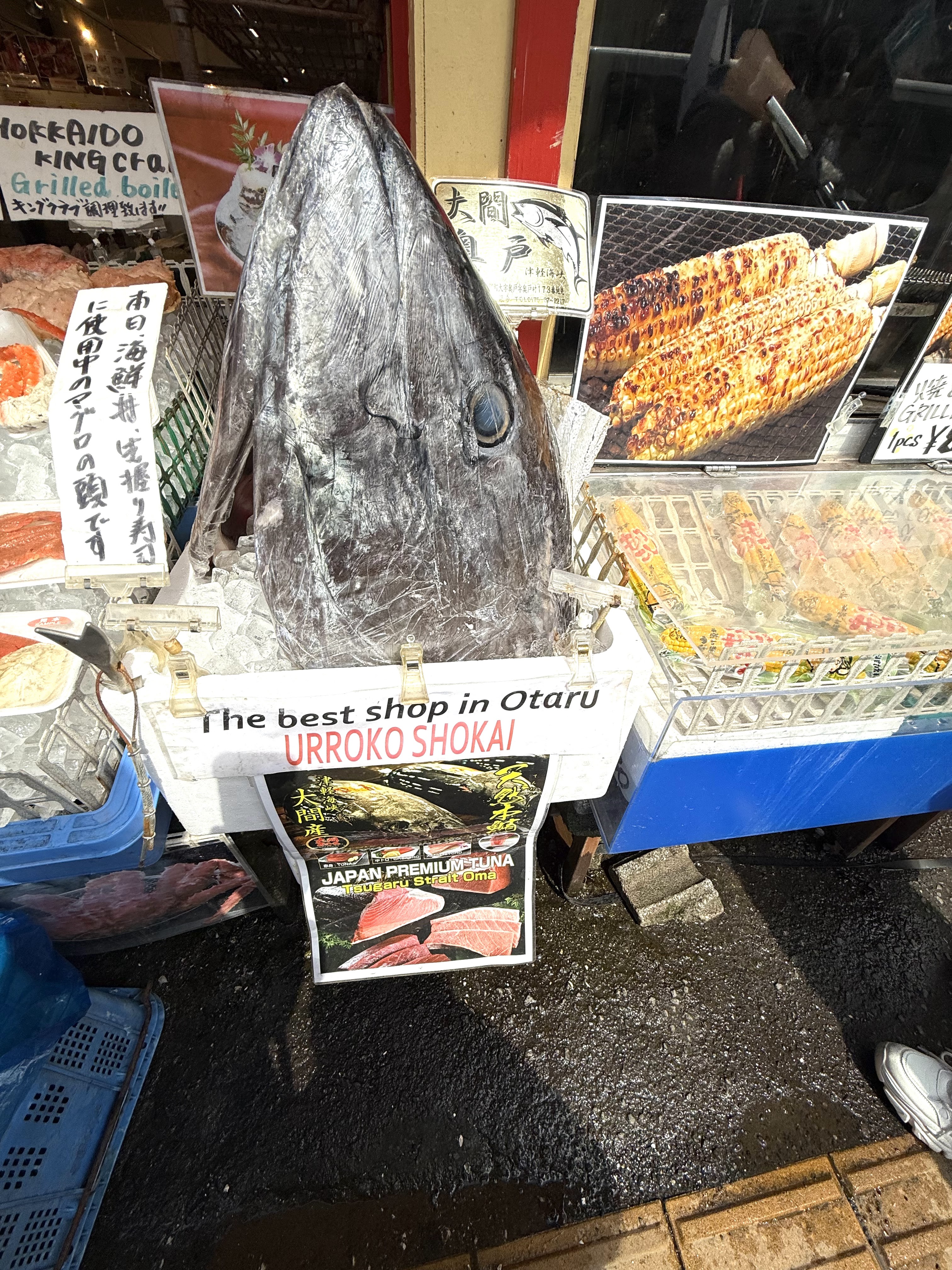
Absolutely great. We were finished by 12:20PM and had more than 3.5 hours remaining, with half a dozen sites I've previously been to that would have been worthwhile. Nope, they immediately drove us back to Otaru, and sent us off shopping at an enclosed neighborhood. No doubt Oceania got paid a fee to do this. What a waste. Worse, I couldn't find my Pocket 3 video camera in my coat pocket. Found the tour guide, and called the restaurant. Nothing there. So we walked back to bus, hoping the camera had fallen around my seat. A few photos, where the seafood market was the only place of real interest. Most startling was a black asparagus,
A $16 meal.
Note the black asparagus.
Got back to the bus, and my camera was sitting on my seat. What a relief. Back to the Riviera.
Soon after we returned, lecture on Japanese Cinema, and how Hollywood kept copying Japanese films, mostly by Akira Kurosawa,
Next Enlish Tea Time, featuring the Amadeus String Quartet.
Came back to my room, and took nap from 5PM. Finally got out of bed at 10AM. I have never slept 18 hour in one day in my life. At this point, only had walked 6058 steps for the day. Of course missed dinner and breakfast, so went to an Italian lunch.
Tomorrow, at sea. We got as close as 100 miles from Russia, so tomorrow, I might focus on that country, for the lecture series continues with Adam Tanner and his experiences in the Soviet Union.
This is Day 14 of our trip. Some background about Hakodate.
Was originally populated by the Ainu.
Founded in 1454 by Kono Masamichi, but the family was driven out of Hakodate during the Ainu rebellion in 1512.
There was another uprising around 1670, led by Ainu warrior Shakushain. Note that the Ainu look Eurasian.
It was on 8July1853 that American Commodore Matthew Perry led his four warships into Tokyo Bay, seeking re-establish for the first time in 200 years, regular trade between Japan and the western world. The first two ports to open were Hakodate and Shimoda (67 miles south of Tokyo). Yokohama Port did not open until 1859.
Was the biggest city on Hokkaido until 1934 when it suffered the Great Fire of Hakodate, making 145,500 homeless.
Today, with 239,813 people, it is third largest on Hokkaido, to Sapporo's 1,965,823 and Asahikawa's 356,612.
The Hokkaido Shinkansen line to Shin-Hakodate opened in 2016, for the first time linking Honshu to Hokkaido. This station is 12 miles from Hakodate.
Note that tomorrow, the Oceania Riviera will be in the Port of Otaru, where we will tour that city and Sapporo. Unlike Hakodate, where we saw rain and a lot of clouds, the Otaru/Sapporo region should be relatively sunny.
The city's ramen is shio (salt), with a pale, clear broth made of chicken, pork Bone, vegetables, fish and seaweed. The seafood of note is squid. Also famous for Japanese snow crab.
Our tour was leaving at 1PM, so we had a quick hot dog and hamburger pre-lunch.
The tour was a bus ride with two stops. Note that this is a Takahashi bus, although ours was orange. Note the rain,
Our first stop was a look at three churches. This would have been totally a lost, except that we finally saw Cherry Blossoms in Japan.
After some walking, we reboarded our bus to the top of Mount Hakodate, 1100 feet tall.
When we got to the top, it looked awfully foggy.
However, the view wasn't bad at all.
More photos on our way down and back to the ship. Maybe some these blossoms could have been plum trees, not sakura.
The theme of the dinner in the Terrace Cafe was Japanese. Here were the buffet stations.
RADIO GARDEN is a fascinating link. You might need to activate the page, by clicking on it. Then click on any green dot to hear a radio from that location. In that lower-left box, click on EXPLORE or SEARCH to open up a whole new world of choices. Find San Francisco, for example, and you can click your way to 89 different stations from that area, or New York City for 202 stations. There is a feature where you click on the heart symbol to save that station and form your own list of favorites. There is a London station (under Weird Stations, find Birdsong Radio) that only plays a bird singing, or one from Switzerland (also under Weird Stations for Ambi Nature Radio) that plays ambient nature to put you to sleep. You'll bookmark this page and play with it for the rest of your life.
Most Popular Posts
For the longest time, the day when the most visitors (3,356) clicked on this blog site was 27February2010 on THE CHILE EARTHQUAKE. Why? Probably because this posting was linked to my Huffington Post article of that day reporting on HAWAII TSUNAMI. Natural disasters tend to increase readership. However, on 6March2017THE WONDERS OF ALCOHOL drew 6498. Further, too, on 6June2017, the one-month tally of visitors was 70,219, or 2340/day. However, on 18December2018 a record 27,775 people read that posting. On 22April2019, after 13,000 and 19,000 pings the previous days, a second all-time high of 27,318 was reached. The daily average has been about 500/day.
Interesting to note that not one of the top 20 postings reports on natural disasters (not sure what those numbers stand for, but they indicate a kind of relativity), the newest of this list goes back five years, and the highest rated this year is just over 300. Clearly, people are reading my older postings, but there is no sense to which subject areas are popular.
2024 surpassed 2023 as the highest global temperature on record. Global sea level also rose to a new high, 4 inches higher than in 1993, when record-keeping began. Tropical cyclones were 25% higher than the average. The Arctic is melting, severely.
Go to:
https://www.covers.com/editorial/HowToBet/OddsConverter
to access a betting odds converter for
- Moneyline/Amercan Odds
- Decimal/European Odds
- Fractional/UK Odds
- Implied Probability
CALCULATE THE CURRENT VALUE OF MONEY
Measuring Worth - Relative Value of US Dollars
....One ballpark estimate of what it cost the U.S. for World War II was $288 billion (in 1940 dollars). If you had inserted 1940 / 288 / 2016 into those boxes, the equivalent value today would be $4,870 billion, or close to $5 trillion.
CONSUMER PRICE INDEX AND THE INFLATION RATE
The CPI is based on 1984 at 100. Thus, 241 means a 241% inflation since 1984.
There are various ways to look at this, but one is to subtract 100 from 241, getting 141, so the effective inflation today, nearly a third of a century later, is 141% higher. Another comparison is that the CPI in 1916 was 10.9, and is at 240.853 today, a hundred years later. Thus, the average commodity that sold for a buck then, today goes for $22.
WHAT WILL BE THE FUTURE PRICE OF OIL?
Click on:
FUTURE PRICE OF OIL
to gain a sense of what the financial community thinks will be the future price of crude oil. When I last viewed this Chicago Board of Trade (a NYMEX company) future contracts page on 110March2014, the futures price of oil in December 2022 was $78.59. This makes no sense to me.
I more recently (10July2019) checked the Chicago Mercantile Exchange, where they quoted the price of petroleum for February 2030: $55.33. Note the price/barrel above for today.
I am Director Emeritus of the Hawaii Natural Energy Institute at the University of Hawaii and co-founder of the Pacific International Center for High Technology Research.
I have published three SIMPLE SOLUTION books and have written more than 100 articles for the HUFFINGTON POST. I am working with an enlightened team to pioneer the BLUE REVOLUTION (http://bluerevolutionhawaii.blogspot.com/),
beginning with the development of the Pacific International Ocean Station.