Total Pageviews

Friday, June 30, 2023

FINALLY, HONOLULU SKYLINE READY TO ROLL

Before Skyline, a few noteworthy news items:

  • The conservative Supreme Court acted again, twice, one on LGBTQ+ rights and a second disallowing President Joe Biden's decision to forgive student loans.  Repercussions?  Further damages Republican chances in the 2024 presidential election.  SCOTUS might have saved American taxpayers $400 billion.  I think we are giving away too much to others not me, so the second one is fine with me.  I'll wait a few days to see if they do any more damage (to Republicans) on women and gun rights.  These might wait until their next session because they will soon (by early July) go into recess until the first Monday in October.

This is a big day for Honolulu.  It has taken half a century, through eight mayors and seven governors, for mass transit to become a reality. Everyone has some kind of gripe about this system.  I've always thought this city needed a rail system of some type, but I still have two beefs:

  • Skyline , the name, seems out of place in the middle of the Pacific.
  • The Star Advertiser mentioned that Dale Takanishi of Palolo thought the name should be The Rail.
  • If anything like that, it should be Da Rail.
  • So should have been TheBus.  Change that to DaBus, and Skyline to DaRail.  As they link to each other, there should be some brand similarity.
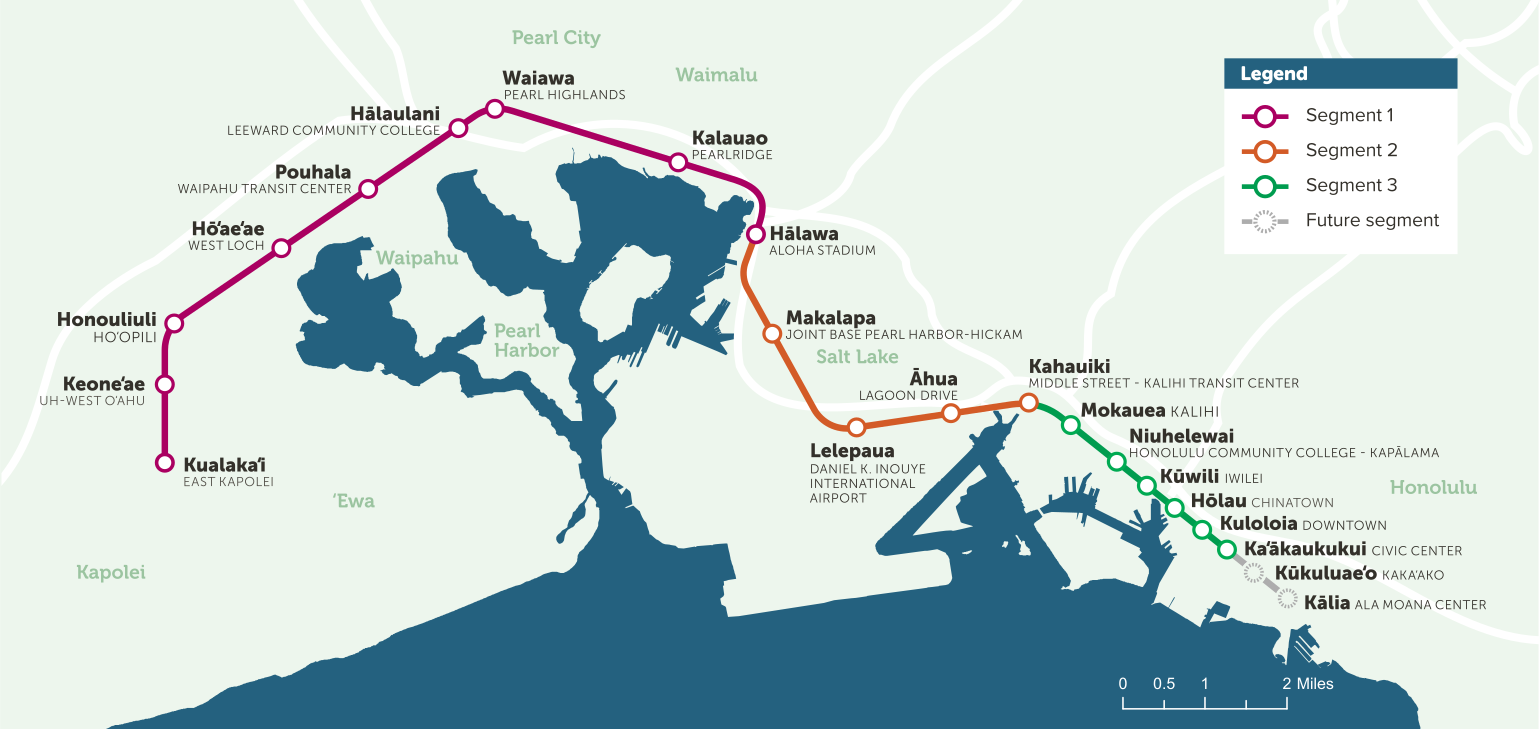
  • My second gripe has to do with the station names.  Tourists (and many locals) will not be able to pronounce many of them:  Hōae'ae (West Loch), Niuhelewai (Honolulu Community College Kapalama) and Ka'ākaukukui (Civic Center), among them.  They're taking Hawaiian rights to seriously.
Skyline (now 10.8 miles long) features the Manu o Kū, or White Tern.
Holo is the name of the card to enter.  Probably so called because holo holo is the Hawaiian term for going out and having fun, or more accurately, to go for a walk, stroll or sail...but not rail because it had not yet been invented.

Skyline officially began operating from today, and the public can get free rides from 2-6PM for no charge.  Just walk on.  However, beginning tomorrow you need to use a Holo card, which you can buy in many convenient stores and all stations.  Well, I hear they are sold out at some locations.  This gratis service will be from July 1 to 4, 5AM to 7PM on weekdays and 8AM to 7PM on weekends.  Third gripe.  Why close so early?  

Riders will be charged $3 for the first ride, and up to $7.50 maximum per day.  I'm not sure how my senior Holo card will work, for I only pay $35/year for The Bus, and it has no actual value.  Someday I'll learn the details, but we will be charged much less that non-seniors under any condition.  For those fearful of kiosk machines:

To purchase a HOLO Card:
  1. At the kiosk, press the gray button labeled “1″ to get started.
    1. As a word of caution, the kiosk screen is not touchscreen.
  2. To purchase a new card, press the button labeled “new card.”
    1. The card without any funds costs $2.
  3. To load the card, select either “stored value” or “day pass.”
    1. Stored value: allows passengers to load their new HOLO card with funds between $2.75 to $50.
    2. Day pass: will cost passengers $7.50 – the same price as a day pass for TheBus.
  4. Then, complete the purchase by paying with either card or cash.
    1. If paying in cash, make sure to use exact change.
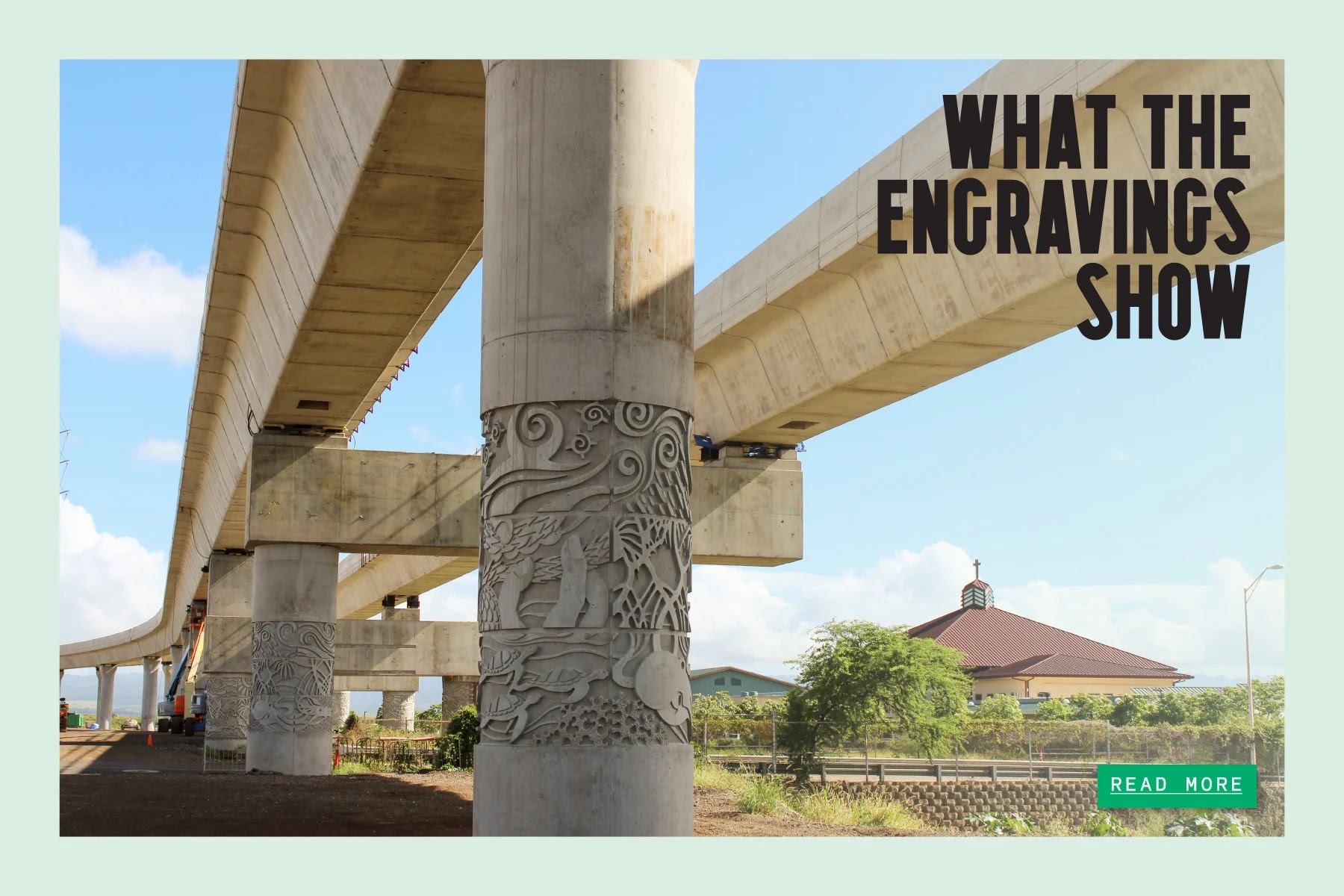
Incidentally, you will see engravings on the columns:
  • The top row reflects the sky and heavens.
  • The middle one of plants and animals.
  • The bottom shows earth and the sea.
Fourth gripe, sure, this system is for the future, but it starts on the west end at a station that is too far away from anything.  Why didn't they just go a few more yards next to Ka Makana Ali'i, the shopping center in Kapolei?

Oh heck, fifth, the final official station at the other east end is also one future stop from a shopping center, Ala Moana.  Without that shopping center to shopping center connection, Skyline is destined to fail, or do so poorly, that it will be an embarrassment.

So for now, go back to the graphic above and note that only nine (10.8 miles, red color line) stations will open today, from Kualaka'i Station to Halawa Station, the one at Aloha Stadium.  
  • And, of course, that sports complex is permanently closed, and a replacement could come in 2028, but that would be dreaming.  I've lived here all my life, and 2030 is more probable, with 2033 likely.  Unless the state changes its mind again, kills that project, and decides to further upgrade the Manoa Campus facility, which last sat 9,300, but has been approved for 17,000 seats.  When?  Maybe on September 1 for the game against Stanford.  Hawaii's football schedule begins on August 26 in Nashville against Vanderbilt, with game #4 at Oregon on September 16, with Stanford and the Albany Great Danes (they have a football team?), at this facility...can't really call it a stadium.  See that tallest building at the base of the photo below?  That's where my campus office is located.  Great for tailgates.
  • Four more (orange) stations for an additional 5.3 miles could come in the summer of 2025.
  • The final segment of 6 stations is targeted for some time in 2031.
  • There is a hopeful 20th station, Kālia at the Ala Moana Shopping Center (AMSC), sometime in the future, if money is found.
  • Then, of course, as a minor miracle, to the University of Hawaii Manoa Campus, two miles away.  
  • Why not also Waikiki, 1.6 miles from AMSC.
  • Then, as a major miracle, Hawaii Kai, but that's a dozen miles to AMSC.
Notice the FINALLY in the title above?  Here is why.

  • Concept first advanced in 1966.
  • Mayor Neal Blaisdell proposed in 1968 a 29-mile rail line from Hawaii Kai to Pearl City for completion by 1978.  53 years have since passed.
  • A 22-mile rapid transit line was estimated to cost $700 million in 1972.
  • Honolulu received a $2 million federal grant for a 14-mile fixed rail system from Kahala to Aloha Stadium in 1977.
  • The Honolulu Authority Rapid Transit (HART) project was a bus-rail system at a cost of $900 million, with 80% federal funding in 1979  The problem was that a highway, H3, was being built, and the odds were low that this city could get funding for both.  As it was, it took 37 years from beginning to completion in 1997 at a cost of $1.3 billion.
  • In 1981, Mayor Eileen Anderson scrapped HART for a lack of $1 billion.
  • Mayor Frank Fasi in 1985 revived the effort with a $2 million federal grant.
  • In 1990, Governor John Waihee called for a 0.5% general excise tax increase for the $1 billion HART project.
  • The federal Urban Mass Transportation Administration in 1990 approved Honolulu's $1 billion transport system, with only one of 11 alternatives being rail.
  • The Honolulu City Council endorsed a 17-rail line from Leeward Community College to University Avenue (Manoa Campus) also in 1990.  Cost was now estimated to be $1.425 billion, but $1.9 billion if some developer picked up 30% of the tab, and $2.2 million with no outside help.
  • In 1991, Honolulu was awarded $618 million of federal funds for the rail project.
  • In 1992, reports were that a 15.6 mile line from Waiawa to Manoa would cost $1.7 billion, for completion in 1997.  
  • Also in 1992, federal participation increased by $90 million to $708 million.  This is was the best opportunity we ever had, and that point passed 23 years ago.
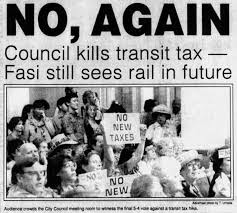
  • But we blew it because on 23 September 1992 a Honolulu City Council committee voted 5-4 to reject adding 0.5% to Oahu's 4% general excise tax to pay for this rail project.  The lady who screwed everything up was Councilwoman Rene Manson, who at the last moment shocked everyone by voting negative.  The same 5-4 vote on 30 September 1992 killed the project.  Honolulu would have been a far better, and richer, city if rail was approved.  Operation might well have been 25 years ago, and 20 for sure.  The time and dollar wasted were monumental.

The history of Skyline:

  • We have something called light metro.
  • Funding was approved in 2005.
  • Construction was approved by a direct vote of Oahuans, 53%, on 22February2011.
  • Debate over development was a major point of contention for mayoral elections in 2008, 2012 and 2016.
  • pain in the neck of city planners was Panos Prevedouros of the University of Hawaii.  He was one of the founders of Stop Rail Now.  We were colleagues in the same Civil Engineering Department, and I long ago actually worked with him on a proposal for mass transit on Kauai.  Read this link.  You will find this almost humorous, but visionary.
  • In 2010 I wrote a Huffington Post article entitled, The Sustainable Expo for 2020.  This was a failed attempt at suggesting that the best future for Honolulu was everyone working together to build an internationally funded rail system for Honolulu to host a World Expo.  One of my grander ideas that also went nowhere.
So with all my griping and fussing, let me in closing say that I'm glad we made it this far.  Public support will grow for finding the funds to complete the project at least to the Ala Moana Shopping Center.  Then there will be pressure to continue on to the University of Hawaii and Waikiki, maybe separate links from Ala Moana.  By then it will be a dozen years from now.  Someday to Hawaii Kai.  So by 2050 Honolulu will be looking fine.  And if I'm alive, I'll be 110-years old.  Sure, the cost of living is high here, and the next study by the University of Hawaii Economic Research (UHERO) will show we pay 2.7 times more for housing than the national average.  But the weather, lifestyle, relative safety and other factors make it a joy to be here if you can afford it.  And Skyline will become indispensable.  Imagine living in Tokyo without their transit system, or Washington, D.C., or any metropolitan city.
-

Thursday, June 29, 2023

COVID AND BLOOD TYPE

Over the next couple of days, I will more closely cover several Supreme Court decisions, including one today which cast aside Affirmative Action in college admissions.  On the surface you will think that Blacks lost and Whites won, but, what really occurred is that Asians won, Blacks lost and some Whites also were negatively affected.  President Joe Biden strongly disagreed, while former President Donald Trump called it a great day.

So what blood type do you have, and thus more or less susceptible to contracting covid?

  • To begin, what blood type are you?  I don't really remember, but I think mine is A+ or AB?, but not sure.  Will now need to check.  But where?
  • Early studies from China suggested that type A was more prone to being infected, with type O giving some protection.
  • Other studies elsewhere were mixed.
  • A study from Brigham and Women's Hospital and Harvard Medical School more recently learned that finger-like projections jutting from this covid virus were very similar to some types of blood.  This would allow for closer binding.
  • And indeed, type A linked better with the SARS-CoV-2 virus, and type O did not, now making it an even better universal donor.
  • If you have blood type A, there is a 25% to 50% higher risk of getting covid, especially with the Omicron variants.  Some studies also showed that there is nearly a 50% higher risk of type A's dying from COVID-19.
  • But it's not as simple as that, for there are angiotensin-converting enzyme 2 (ACE2--shown to the right, and they are not these colors) receptors also somewhat involved.
  • All this does not mean type O individuals should cavalierly take chances, for they too can get infected, just not as likely.  They are only partially protected.
  • Scientists are now looking more closely at differentiating among these non-O types to more closely find the differences.
There are now two ocean storms off Mexico, Adrian, up to 85 MPH heading towards Hawaii, but should soon weaken, and Tropical Depression Two-E, likely to attain hurricane strength, but probably remain offshore of Mexico, then weaken.

Wednesday, June 28, 2023

WILL THIS BE THE SUMMER WHEN THE WORLD REALIZES GLOBAL WARMING IS TRULY REAL?

The continuing saga of the Russian mini-revolt is well-explained by Leonid Bershidsky, a former columnist of Bloomberg Europe.   He is a 51-year old Russian journalist now based in Berlin, having moved there in 2014 after Russia annexed Crimea.  Has previously worked at Newsweek and The Moscow Times.  He has written several books.  

But to the topic of the day, is this that impactful summer that will finally convince decision-makers to take global warming seriously?  Possible, but unlikely, for a key reason to be provided.


The New York Times yesterday said (if you want to actually read the whole thing, switch to my other blog site):


Today, New Orleans will reach 113 degrees in the heat index. Houston will reach 111. Mobile, Ala., and Jackson, Miss., will also surpass 110. And those are only a few of the places that will experience dangerous heat this week.

Summer technically just began, and parts of the U.S. are already seeing the unusual heat that experts warned about and that is becoming more common as a result of climate change. About 45 million people — or 14 percent of the U.S. population — live in areas that are expected to reach dangerous temperatures in the coming days.

Today and tomorrow, the heat will be concentrated in Texas, Louisiana and parts of the South. By the end of the week, it is expected to spread in the South and to the West, as these maps show:

Last week India got up to 116 F, and people began to die.  China is sweltering:
  • Between 1990 and 2020 Beijing averaged 10.6 days where temperature got up to 95 F or higher.
  • June is not over and the city went past this temperature for the 11th time.

Texas has a heat dome, and this week 45 million Americans live where some level of heat alert is in effect.  Several Texas cities were in the range of 115 F, and Corpus Christi might have reached 125 F.  A heat dome occurs when a persistent region of high pressure traps heat over an area.  Keep in mind that crops and animals also are suffering.


The following heat index factors in relative humidity to indicate the danger point.

Death Valley reached 134 F, but that was in 1913.  Officially the highest world temperature ever.  And, incidentally, 1913 is the year when this area dropped to 15 F, its coolest ever.  But death valley in 2001 reached 110 F or above for 154 days in a row.  The ground temperature at Furnace Creek in Death Valley had an air temperature of 128 F in 1972, but the ground temperature was 201 F!  They had no rain in 1929 and 1953.


The 12 hottest places on Earth:

  • #1  Death Valley
  • #2  Kebili, Tunisia
  • #3  Mitribah, Kuwait
  • #4  Turbat, Pakistan
  • #5  Dallol, Ethiopia
  • The rest are in the Middle East and Africa.  Only been to Death Valley, in the summer, and you worry, a lot, if your car will die on the road getting there and out.

The list of the ten hottest cities in the world is rather surprising, as I have regularly traveled to most  of them, and didn't realize they were so.

  • #1  Jazan City (right), Saudi Arabia, with a population of 2 million.
  • #2  Bangkok, Thailand, where the temperature routinely rises to 104F.
  • #3  Las Vegas also regularly gets to 104 F, and higher.
  • #4  Hong Kong, where the humidity makes the difference.
  • #5 Mexicali, #6 Melbourne, #7 Kuala Lumpur, #8 Phoenix, #9 Athens, and #10 Cairo.  
  • 2022 was Europe's warmest, surpassing the previous all-time high, which was in 2021.
  • Last year the U.S. surpassed the heat from the 1936 Dust Bowl summer.  But 2022 was only the third-warmest.

So is this the summer that the world finally realizes that global warming is truly real?  Still got two months to go, I think not.  Why?  Only perhaps a hundred died in the recent India heat wave.  Decision-makers won't take note unless millions, and maybe it will need tens of millions, perish.  Until that happens, humanity will be testing Mother Nature awaiting a possible crescending doom.


Don't want to alarm anyone in Hawaii, but our first hurricane of the season, Adrian, just formed off Mexico and is headed our way.  However, the prognosis is for an early weakening.

-

Tuesday, June 27, 2023

LOUISIANA STATE UNIVERSITY: A Blast from the Past

I've lived for at least three years in Hawaii, Washington DC, California and Louisiana.  

  • Born in Honolulu and, aside from college, three years working for the U.S. Senate and travel, spent most my time in Hawaii.
  • Had whole summers in California with the Lawrence Livermore National Laboratory (twice) working on laser fusion and NASA Ames Research Center on the Search for Extraterrestrial Intelligence.
  • 3 years and 7 months at Stanford University.
  • 3 years and 7 months at Louisiana State University.  With close friends.
Today, my nostalgic Tuesday topic will be LSU, for they just won the 76th college world series championship, in what might have been the best ever.
  • Started with 64 teams in tournament play.
  • #1 rated was Wake Forest, #2 Florida and #5 LSU.
  • 8 teams survived the super regionals, those teams above, and Stanford, TCU, Oral Roberts, Virginia and Tennessee.
  • The first time LSU and Wake Forest played, the Demon Deacons won, 3-2.  They faced each other two more times, and LSU won both.  The final game was tied 0-0 into the 11th inning, when a walk-off homer by LSU eliminated Wake Forest, and sent LSU into a 2 of 3 series with Florida.
  • LSU won the first game, 4-3, while Florida impressively prevailed in the second, 24-4, breaking all kinds of records, including getting 23 hits.
  • In the final game yesterday, LSU got 24 hits and beat Florida 18-4 for the championship.
  • Way back on May 1, Major League Baseball had LSU's Dylan Crews, an outfielder, and Paul Skenes, a pitcher, #1 and #2 in the draft. 
    •  The question today is who will be #1, for Skenes was named the most valuable player in the world series.  He was the first college pitcher in 12 years with 200 strikeouts.  However, the all-time season strikeout record is held by Derek Tatsuno of the University of Hawaii with 234.

Among my highlights of my stay at LSU:

  • Pearl and I drove cross-country in January of 1968 to Baton Rouge.  We had a car full of our stuff, and we still did not know where we would live.  
  • The star on campus was Pete Maravich.  What a basketball player.
  • The main events on campus occurred Saturday nights when the LSU Tigers usually beat another football team.  Ladies wore gowns and men sport coats to games.  They usually came from a nearby party.  Lot of barfing at the game.  The Chemical Engineering Department building was adjacent to the stadium.
  • Louisiana has a different festival every weekend.  Went to many of them.  As a matter of fact, 587 annually, and each features a different cuisine and/or fashion.
  • There is, of course, Mardi Gras in New Orleans.
  • Cajun music.  Quite a history, which starts with Arcadians (French colonists) coming in the late 1700s.
  • There was much discrimination, which continues today, but only barely now.  Saw black/white drinking fountains, etc.  But where do Asians fit?  I think White, for I recall going to an Army Reserve summer camp and a Caucasian came up to me and said, you come with us.  I honestly don't remember even one incident during my entire time in that region.  And we drove everywhere.

After graduation, I recall returning to Louisiana for an engineering conference, but left early because of an incoming hurricane.  Then in 2007 Hawaii played Georgia in the Sugar Bowl.  That was an experience.  I'd like to go back to Baton Rouge one more time.  Perhaps a riverboat cruise on the Mississippi.

Elton John's final performance

-