Total Pageviews

Saturday, February 16, 2013

WHAT IF SOUTH KOREA LOST THE WAR?

Yesterday at the Punchbowl National Memorial Cemetery of the Pacific a granite stone memorial donated by the South Korean government was unveiled as part of the 60th anniversary commemoration of the war armistice (actually signed on 27July1953).  Note that the Korean War is not yet over.  Armistice means temporary cessation of hostilities to discuss peace terms.  Incidentally, while not called an armistice, the Iraq and Afghanistan Wars are also still "not over."

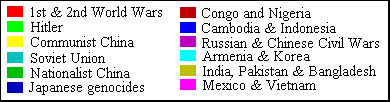
This was a significant war, as up to 2.5 million might have died, although the most scholarly number places deaths, including civilians, at 1.2 million.  The numbers are pure guesses.  Same for the Vietnam War, which showed total dead between 1 and 4 million. WWII, in comparison, was estimated to have killed between 50 and 70 million.  From Wars of the 20th Century:


The total Iraq-Afghanistan Wars over the past decade killed anywhere from 100,000 to more than a million, depending on who you ask, while the Afghanistan portion accounting perhaps for 30,000.

But back to the Korean War, it was North Korea, Soviet Union air power and Chinese ground troops against South Korea, the USA and United Nations.  The Russian MIG-15 Fagot versus the American F-86 Sabre.  While the Sabre downed Fagots at a 10:1 ratio, this comparison was not fair, as the MIGs went after bombers, and might have destroyed as many (perhaps a thousand) as they totally lost.  

In only a few weeks from the initial attack, the South was squeezed down to Pusan when General Douglas MacArthur turned the war around with the Incheon landing.  The city was decimated, but the region is now home to a state-of-the-art international airport.  However, MacArthur never spent a night in Korea, operating out of Tokyo, was difficult to control, and contemplated using nuclear weapons, when he was fired by President Harry Truman on 11April1951 (war began on 25June1950 and went on for 3 years).  The great fear was escalation into a nuclear war.  This and the Cuban Missile Crisis a decade later were the closest Humanity was to destroying ourselves.

So from almost losing the war in August of 1950 to today, what a difference for South Korea, as the country has become a world leader in consumer electronics and is with China the leading world shipyard (they keep changing #1 status).  A 21-year old from the South is 2.4 inches taller than from the North.  Per capita, South Koreans:
  • consume 64 times more oil,
  • make 16 times more money
  • live 15 years longer
  • have 40% fewer babies and
  • produce 17 times more in economic output.

In comparison,  most of North Koreans are in poverty, 200,000 are politically imprisoned in gulags and their young leader, Kim Jong Un, seems mostly interested in testing missiles and nuclear weapons.  

Yet, it is of interest to note that while South Korea (left) has the second HIGHEST suicide rate in the world (31.7 per thousand--Lithuana is at 45.6 and the USA is #34 with 12.0), North Korea (right) has the LOWEST (Syria is #102 with 0.1 and Egypt #103 with 0.1) Why?  Suicide is considered as treason in the Hermit Kingdom (South Korea is the "Land of the Morning Calm"), and the whole family is purged, whatever that means.  But AlphARelief reports that the suicide rate is skyrocketing in North Korea.  Well, so what if South Korea lost the war?  They would have a lower suicide rate, but such is the price of success.

When I visit South Korea, something I have almost annually for the past two decades, and will be there in a few weeks again, I remain a tad at edge for fear of some irrational act, as Seoul is but 31 miles from the border.  Only eight months ago I had my most memorable (and expensive) lunch in my life.  I might return to Paul Gagnaire at the top of the Lotte Hotel.


For the record, there is another Lotte Hotel in Seoul, located across the river in Gangnam, which is a good excuse to, for hopefully the final time, foist on you Psy and his Gangnam Style (which is up to 1,328,725,396 views):


Note, that is more than a billion, and I must  have been responsible for at least a million of them through this web site.  I confess I finally watched the whole thing for the first time today, all 4 minutes and 13 seconds.  The tally:

PSY - GANGNAM STYLE (강남스타일) M/V

officialpsyofficialpsy·47 videos
2,965,612
1,328,725,396 
Like      Dislike 634,653
-

Friday, February 15, 2013

THE FINAL PHASE OF MY LIFE

A year ago I reflected on my past in decadel increments.  While I'm not a fan of astrology and don't believe the fact that I was born a Dragon means anything, I have tracked my life, more specifically in twelve year periods, and now that the Snake replaces the Dragon this year, it seems convenient to review these cycles and speculate on the final phase of my life:

0-12     I was born in Honolulu and must have considered dentistry at an early age.  I once thought there was a real Santa Claus and ended up not believing in God.

13-24   Did well at McKinley High School, went on to Stanford University, joined the sugar industry, got married and spent six months in the U.S. Army.  

25-36   Earned my PhD in biochemical engineering from LSU and joined the University of Hawaii faculty.  Worked on laser fusion at the Lawrence Livermore National Laboratory for Edward Teller and Search for Extraterrestrial Intelligence (SETI) at the NASA Ames Research Center, where my proposal for directly detecting extrasolar planets was bypassed in favor of indirect techniques, mostly having to do with star wobbles.  I still think the Planetary Abstracting Trinterferometer (PAT) makes more sense, for you not only find the planet, but also determine the atmospheric composition.

37-48   Spent three years with the U.S. Senate and assisted Carl Sagan get their initial funding for SETI.  I also assisted in drafting the original bills on Ocean Thermal Energy Conversion, Wind Energy and Hydrogen, all becoming law.  Dean Paul Yuen and I, with the involvement of UH presidents (Fujio Matsuda and Al Simone), Hawaii Governors (George Ariyoshi and Ben Cayetano) and three U.S. Senators (Spark Matsunaga, Dan Inouye and Dan Akaka), invented the Pacific International Center for High Technology Research, which succeeded in gaining net positive for OTEC at the Natural Energy Laboratory of Hawaii Authority and built a facility on Maui to attempt to produce methanol from biomass. 

49-60   This was by far the most productive period of my life, where as director of the Hawaii Natural Energy Institute we became the National Science Foundation Marine Bioproducts Engineering Center, U.S. Department of Energy Hydrogen Education and Research Center and Department of Interior Marine Minerals Technology and Environment Center.  The concept of the Blue Revolution was created.  I am standing  here in front of a bioreactor at our Look Lab test site.  I gave talks in more than a dozen countries and reached 2 million miles with United Airlines.

61-72    My most enjoyable period, for I was fully retired, golfed an average of twice/week (even at the Old Course at St. Andrews, followed the next day at Carnoustie), went to about a movie a week and maintained an office at the Manoa Campus of the UH, where I wrote three books (SIMPLE SOLUTIONS for Planet Earth, SS for Humanity and SS Essays) and posted more that 100 articles in the Huffington Post.  


Pearl and I took several trips and three cruises:


My favorite wife and favorite tie.  After Pearl passed away I traveled the world several times, dropping her ashes off at 43 sites, including the Taj Majal, Mount Kilimanjaro and Machu Picchu.  

73-84   For the coming year I have scheduled my ultimate global journey next month and am planning a second world trip to enjoy the Fall colors in Japan, board a Tauck River Cruise in Europe and participate in an OTEC conference in Sweden for Africa.  This will be the Autumn version of my Spring adventure last year.   By the end of that trip I will have laid Pearl's ashes at 50 locations, and should publish my fourth book, an electronic version of PEARL'S ASHES.  By the end of this phase Pearl's Gold Tree should be blooming on the Mauka side of the Ala Wai Canal.  My fifth book could be a novel on THE VENUS SYNDROME.  I have already volunteered my retirement from the Huffington Post and could well soon end this daily blog the day of my fifth anniversary, 29April2008.  One needs to move on and find new things to do.  My final and best phase of my life is now beginning.

-

Thursday, February 14, 2013

EVERYTHING YOU NEED TO KNOW ABOUT SEQUESTRATION

On 7November2012 I titled my posting "What Fiscal Cliff?"  Well, there was none.  Our two-party political system compels the opposition to oppose.  There is thus eternal posturing.  The media, to gain attention, then exaggerates the truth.  

So here we go again, this time on something called sequestration.  Here is everything you need to know:

  1.  This all began in 2010 when President Barack Obama and the Congress created a bipartisan National Commission on Fiscal Responsibility and Reform (more popularly known as Simpson-Bowles, the co-chairmen--Bowles is to the left), which failed to reach any consensus to issue a final report to the White House and the U.S. Congress.  Here is what was projected by the Commission:


  2.  With the U.S. at 73%, my blog on 8February2013 showed the following comparison of debt as a percent of GDP (gross domestic product):


  Japan          208%
  Italy            121%
  Singapore    118%
  UK               89%
  France          87%
  Canada         84%
  Germany      82%


  3.  Faced with nothing official from the Commission, a Congressional Panel (Super Congress 12 members to the left--you can't recognize them, but just as well) was formed in 2011 to reduce our national debt by $1.2 trillion over the next decade.  Amazingly enough, they actually reached agreement in the Budget Control Act of 2011 to annually make automatic across the board equal cuts in our defense budget and entitlements if Congress failed to take appropriate action themselves.  So 2January2013 came along and our Congress kicked the can to March 1 by raising taxes for the "rich" to gain some revenues while providing them two months to arrive at a more sensible means to reduce the national debt.  On March 1 the Federal budget will be reduced by $85 billion, except for items like Medicare and Social Security.

4.  Thus the term sequester, which in this case means across-the-board cuts (or sequestration) to the Federal budget, save for those mentioned entitlements, which means that only between 30-35% of the actual Federal budget will take the hit, for Medicare, Social Security, and similar programs make up the difference.  Cartoon from truthdig. 

  5.  A couple of days ago in this blog site I said:

 The White House and U.S. Congress are doing absolutely nothing to help, but the U.S. budget deficit is dropping:


  2009    $1.4 trillion
  2010    $1.3 trillion
  2011    $1.3 trillion
  2012    $1.1 trillion

and as predicted:

  2013    $0.85 trillion
  .
  .
  .
  2017    $0.54 trillion

So it's best for them to continue to do nothing!


  6.  At any time, the Congress can rescind the Budget Control Act of 2011.  However, there does not seem to be any interest in doing so at this time.  The latest Republican strategy is to place the blame on President Obama, for they now want him to come up with a compromise.  Speaker John Boehner yesterday repeated that there was little hope for the Democratic-controlled Senate and Republican House to avoid sequestration.  Boehner also voiced doubts about preschool education, immigration reform, increasing the minimum wage and gun control.  Climate change is not even in his vocabulary.

My position?

     a.  Rescind the Budget Act of 2011 and don't cut anything.  Effectively, kick the can down the road, for our national deficit is already dropping.  This diminution occurs after every major war.


     b.  Keep borrowing as necessary if long term interest rates remain around 2% or less, where the 10 year treasury bond is at today.  My HuffPo explains why:

  The Simplest Solution for Our National Debt...

Spend the money on rebuilding our infrastructure, global warming remediation, early childhood education, etc.

     c.  If sequestration occurs, even though this is unnecessary, don't worry about any defense cuts, for our national security will not be threatened and the Nation will survive this one-time sequestration.  Why one time?  Congress will then rescind the Budget Act of 2011 and continue to do nothing much else.

     d.  What we should do is raise the retirement age to 70, legislate for zero growth of our economy into the future and insure for a soft landing when the world economy seriously stumbles, as it will, and probably soon.

-

Wednesday, February 13, 2013

IS THE LITHIUM BATTERY THE LAST BATTERY?


I've been saying for some time that the lithium battery was the last battery.  Sure, perhaps nanotechnology or some clever enhancement could improve the performance, but a whole new type of battery?  Nah.  Until now, when more and more I keep hearing about next generation options.

But first, let me tell you about my first encounter with the future of batteries.  I went to work at the Lawrence Livermore National Laboratory one summer in the 1970's primarily to link with their efforts on the aluminum-air battery.  Why?  It turns out that Hawaii has some bauxite resources.  Bauxite is refined for aluminum.  Our deposits are attractive because rain on the windward side washed this mineral to the base of the mountain, where it is concentrated.

Is there any hope of mining bauxite in Hawaii today.  No.  It was possible half a century ago when environmental sensitivities had not yet formed.  For the record, the USA has meager bauxite reserves.  Papua New Guinea, Australia and Vietnam have more than half of the world supply.  Interestingly enough, aluminum is back as a mentioned future battery prospect.

Secondly, I've always been interested in some organic flow battery.  No toxic materials and fluids can constantly be recharged.  A few weeks ago the U.S. Advanced Research Projects Agency (ARPA) provided to Harvard University a $600,000 grant to develop a rechargeable flow battery where the chemistry is based on organic molecules derived from plants.  PolyPlus Battery Company got $9 million from ARPA for an aqueous rechargeable lithium-sulfur battery, and other technologies, such as a lithium-water system.  But these are still lithium.


Why is lithium perhaps the final battery?  If you look above at the progression of battery development and the Periodic Table of Elements, you can't go any lower than lithium.  Well,  you can, #1 is hydrogen, another reason why there might yet still someday be a Hydrogen Economy with fuel cells.

Here is a quick PowerPoint tutorial on future batteries prepared by Mike Perry of United Technologies.  So what are some possible future batteries?

1.  Got to start with a sugar battery, for I once worked for the sugar industry and Bor Yann Liaw (left) of the Hawaii Natural Energy Institute is working with colleagues on the sugar-air flow battery.   Two patents have been filed.  Tokyo University of Science reports that the sodium-ion battery with sucrose at the anode can become a more durable and cheaper alternative to lithium.

2.  Toyota is looking at the magnesium-sulfur battery to replace lithium.

3.  In Germany, the fluoride battery.

4.  France has a fluorine battery being investigated.

5.  Flow batteries.

6.  Thin film batteries.

Anyway, there are many more ideas out there and the Next Generation Batteries Conference to be held from April 30 - May 1 this year in Boston would be worthy of your consideration.

-

Tuesday, February 12, 2013

A FEW MORE INTERESTING FACTS


1.  500 million birds are killed by cats in the USA every year.  Tweety was right.  There are 10-20 billion birds (200-400 billion on Planet Earth), so the kill rate is around 3%, which is not insignificant.   Wind turbines are only responsible for less than half a million birds.

2.  The White House and U.S. Congress are doing absolutely nothing to help, but the U.S. budget deficit is dropping:

  2009    $1.4 trillion
  2010    $1.3 trillion
  2011    $1.3 trillion
  2012    $1.1 trillion

and as predicted:

  2013    $0.85 trillion
  .
  .
  .
  2017    $0.54 trillion

So it's best for them to continue to do nothing!

3.  The Islamic Hajj to Mecca in Saudi Arabia draws perhaps 3 million per year, with thousands known to have been killed by stampedes, fire, violence and  just plain health problems.  Pickpockets are especially active.  However, the Indian Hindu Kumbh Mela, which occurred today, to the banks of the Ganges and Yamuna rivers this year drew 80 million, with many losing their lives, usually by being run over by other people.  I guess drownings must also be concern too, for bathing in these waters is a must:


This has been happening for nearly two millennia, as Hiuen-Tsang of China gave reference to his participation in the seventh century.  Good thing this occurs only every 12 years, but the size of every one exceeds that of the previous pilgrimage, the largest gathering of humanity on Planet Earth.  Christians are a third of the population, but they have a long way to go to match this kind of agglomeration.  The Philippines tries, but their events still bring together fewer than 10 million.  Eighty five percent of Filipinos are Christian, of which 81% are Catholic.

4.  The USA could by 2020 surpass Saudi Arabia as the biggest oil producer,  but we are by far the largest consumer of petroleum:


5.  How long can you keep an egg in your refrigerator?  This is kind of a trick question because it has little to do with what date was placed on your carton, which apparently has very little relation to when  the egg was laid.  The following, though, works when in doubt:


-

Monday, February 11, 2013

2013 GRAMMYS

The Gramophone Awards, now called GRAMMYS, reflect the music of today.  Last year Adele won all six major awards.  The biggest winner last night was a group,l The Black Keys, with four.  There were 81 trophies bestowed.  Hawaii got shut out.

My initial reaction was that a tectonic shift is happening with acts like the The Black Keys (Dan Auerback and Patrick Carney):


and Mumford and Sons, which got Album of the Year for "Babel":


Who are they?  Four of the five Best New Artists/Groups were white, and the awardee was fun..  yes, a lower case f with a period at the end:


Where did they come from?  Well, they are an American indie pop band from New York.  Their "We are Young" won "Song of the Year."  Record of the Year was "Somebody I Used to Know" by Gotye (yes, he too sings indie pop and is also known as Wouter "Wally" De Backer), featuring Kimbra (right):


What is the difference between Song and Record?  Okay, did some research, and record has to do with performer and producer, while song recognies the songwriter.

Look back again at those photos.  Do you notice anything odd for recent GRAMMYS?  Well, they're all white.  There were still four rap, six religious and eight classical Grammys, but none was shown.  There were only four country and western trophies, but my sense was that, if what I saw was representative, black music is being replaced by white country plus this retro American indieish sound that leans towards the former.  Anyway, the combination of major winners and programming gave that impression.

In any case, I did not recognize even one song winning an award, showing how out of touch I am with the reality of today.    I posted on the 2012 GRAMMYS and kind of enjoyed that one. Not this year.  But hear are some photo highlights with  Taylor Swift:                                                                                                                                                                               


Frank Ocean:


Did he steal from the Eagle's Hotel California for his American Wedding?  No suit yet.

A mash of Bruno Mars, Sting and Rihanna with two Marleys, Ziggy and Damian, in a tribute to their father:


And Justin Timberlake must have really been owed something from the National Academy of Recording Arts and Sciences of the USA for giving him center stage for his sneak preview of a new JT next month:


When I awoke this morning I saw this enormous rainbow which was three-fourths of a full circle.  I rushed to get a camera, but by the time I took the photo below only a few seconds later, all I got was this typical Honolulu rainbow:


I know a full circle is possible because I saw this a couple of times a year from my Coronet penthouse in the 80's.


-

Sunday, February 10, 2013

TWO BUCK CHUCKS NO MORE

The end came this week to Two Buck Chucks, the $1.99/bottle of wine sold at Trader Joe's in California.  The Charles Shaw brand is now going upscale, all the way up to $2.49/bottle.  There is a Charles Shaw (who happens to have graduated from Stanford University--I give credit to all my alumni) winery in Napa Valley.  However, the grapes themselves come from the central valley.  

In most Trader Joe's across the country, the price is $2.99/bottle.  In Hawaii, no Trader Joe's, but Whole Foods has their $2.99/bottle :  Three Wishes Vineyards (right, based in Livermore, California).  Reviews were good.  Longs Drugs now and then sell their "exclusive" Tisdale (Modesto) California wines, $10 for three bottles.  I personally have never had a bad bottle of Charles Shaw, Three Wishes Vineyards and Tisdale, although in the back of my mind I wonder how they can do it so cheaply.

Forbes has a recent article of on good, cheap wines, but none came in under $10/bottle.  Food and Wine an The Wine Curmudgeon have a few bargains, all around $10/bottle.


Of particular fame is Thunderbird wine, made by Gallo.  While once about the cheapest, a bottle now goes for $5.  I once thought it was made from pear, not grapes.  It is fortified, and can go up 18% alcohol.  It has a screw cap.  I got to almost like it in the early '60's when the bar across the street from the Hutchinson Sugar Company factory (where I worked) only served  Budweiser beer and Thunderbird wine, usually over ice.  It is here that I learned you can get a lot more cooperation from your staff if you drank with them.  I've used this wine (in another bottle) in a couple of wine tastings, and some who "know" wines picked it out as the most expensive of the lot because they thought it was a late harvest riesling.

What about boxed wines?  R. Muller has been touted as drinkable.  Their Riesling sells for $24, but that is only for three liters, or about $6/equivalent bottle.  Here is one list, but they're still too expensive for me.   Epicurous.com has their top five, but, still on the high side.  My all-time favorite is Peter Vella Chardonnay.  Five liters for $16, but sometime on sale at Long's for less than $10.  That would be the equivalent of a two buck chuck's.  The beauty of this system is that the wine never contacts air.  You open it, close it, and it's good in a refrigerator for a month or more.

I have yet to find a really excellent red boxed wine that is cheap enough for me.   There is "champagne" in a can:  Francis Ford Coppola 6 ounce Blanc De Blancs named Sofia.  But I'm still on the search for a really terrific and low cost 5-liter box red wine.


-

Saturday, February 9, 2013

PYTHONS, DRAGONS AND SNAKES

Just about a month ago I reported on the Great Florida Python Hunt.  The final day is tomorrow, and the good news is that the 150,000 Burmese Pythons are now down to between 5,000 and 10,000.  Does this means they caught  somewhere between 140,000 and 145,000?  Well, no.  They only killed 50.  It's just that the 1567 hunters from 38 states saw so few of them that the new estimate was cut by a factor of 20.  I told you this was a Florida tourism ploy.  Florida Fish and Wildlife Conservation Commission (FFWCC) Vice-Chairman  Ken Wright (to the left), a practicing attorney, was so delighted that he said they plan to do this is again next year.  Oh, the deadline is not until tomorrow night, so maybe they'll get another couple of snakes.  The official announcement at an awards ceremony will be made on Saturday, February 16, a long week away.

Here's what makes the next hunt so, relatively, intriguing.  First, by general consensus, most of the pythons are in the Florida Everglades.  Guess what?  The Indiana Joneses were prohibited from doing their stuff there, for the 1.5 million square mile Everglades National Park is a safe haven for all snakes.  But Park Superintendent Dan Kimball (left) has not yet agreed to this expansion.  This is part of the reason why National Geographic called this adventure a cheap stunt.  Many are concerned about cruelty to slithery monsters.  However, the FFWCC remarked that:

The purpose of the Python Challenge, according to the event's website, "is to raise public awareness about Burmese pythons and how this invasive species is a threat to the Everglades ecosystem."

So nothing wrong with that, I say.  And the miracle of this all is that there has not been a reported swallowing of a hunter this past month in Florida, nor any serious injuries, nor people getting lost in this effort.

My year of the dragon is also coming to an end tomorrow, when  the most detestable of symbols, the snake, will reign over the Chinese Lunar New Year.  Actually, this is not all true, as the snake is looked upon as a small dragon, and in some parts of China, like Fujian Province, worshipped.  Two cycles ago, though, was the slaughter at Tiananmen Square, while the Great Depression of 1929 occurred in the Year of the Snake.  As this past year was that of the Water Dragon, this coming year will feature the Water Snake:


-

Friday, February 8, 2013

WILL OBAMA TAKE ON GLOBAL WARMING?

President Barack Barack Obama always seems to have a full plate.  Gun control, immigration, national debt, defense cuts, reduction of entitlements, Israel versus Iran, North Korea, China...  Will he take on global warming, which could some day perhaps become an even larger legacy than Obamacare?

Tam Hunt of Noozhawk, had an excellent article in the latest issue of Renewable Energy World.  He complimented Obama during his difficult first term:

  • Succeeded in new fuel economy CAFE standards for cars and light trucks to attain 54 miles per gallon by 2025, which will reduce our domestic oil consumption by four billion barrels from 2017 to 2025.
  • Maintaining tax credits and loan guarantees for renewable energy and energy efficiency.
  • Proposed new rules for the Environmental Protection Agency regulating greenhouse gases from new power plants.
So in Obama's second term, Hunt suggests:
  • Reconsider opposition to a national carbon tax
  • Phase in regulation of greenhouse gases from existing power plants
  • Enact a national Renewable Electricity Standard (RES)
  • Require states to implement existing law (PURPA) that allows private developers to sell renewable energy to utilities at cost-effective rates
  • Require all federal agencies to reach 50% electric vehicles in their fleet by 2020, if this can be done cost-effectively 

Tom Friedman had a particularly apt analogy, courtesy of John Holdren, that we were heading for an environmental cliff, this one through a fog of misinformation.  Worried about a national debt?  What about the carbon debt?  For those who forgot the facts, two centuries ago, Planet Earth enjoyed an atmosphere of 280 parts per million.  We are now upon 400  PPM, with 450 PPM the potential tipping point for OUT-OF-CONTROL ACCELERATION.  

Like me, he warns about methane, which, in case you forgot, is 25 times more deadly than carbon dioxide.  He limits his analysis to the tundra.  My imagination moves on to marine methane hydrates at the ocean bottom, where there is more, and maybe twice as much energy, than from all the known coal, oil and natural gas on land.  Read THE VENUS SYNDROME.

Friedman and I differ, though, on the seriousness of the national debt.  He is troubled that the debt to GDP ratio in six years has doubled from 36% to 73%.  But note:

  Japan          208%
  Italy            121%
  Singapore    118%
  UK               89%
  France          87%
  Canada         84%
  Germany      82%

But no matter, for he points out that while liberals indicate there is no urgency on this ratio because interest rates are low, similarly, conservatives say global warming is a non issue because the temperature rise has been small.  Friedman's solution:

A carbon tax would reinforce and make both strategies easier. According to a September 2012 study by the Congressional Research Service, a small carbon tax of $20 per ton — escalating by 5.6 percent annually — could cut the projected 10-year deficit by roughly 50 percent (from $2.3 trillion down to $1.1 trillion).

-