Total Pageviews

Showing posts sorted by relevance for query hiram bingham. Sort by date Show all posts

Wednesday, May 31, 2017

PEARL'S ASHES: Chapter 14--Machu Picchu

After Brazil, I passed through Buenos Aires where I enjoyed a particularly excellent meal for less than $100, incredible when you include the following drinks:
  • I created BOCA, for Bitter Orange aperitif with Champagne in Argentina, as Boca Juniors is their famous soccer team with Maradona
  • Sur de Los Andes Chardonnay
  • Sur de Los Andes Malbec Grand Reserva
  • Finca Domingo Torrentes
  • Luigi Bosca Gewurztraminer Seleccion de Giznos Nobles, an almost Chateau d'Yquem
The grouper with Morel Mushrooms (prune looking morsels) was the  highlight, for the mushrooms concentrated the essence of dish juices as I've never had before.

You can't leave the country without beef, which is lean, a bit tough, but tasty...and tango.  The dance is performed in a manner which makes you feel like a voyeur.  The wines tend to be red and free and generous.

Next, on to Peru, where the plane landed in Cuzco at an elevation of 11,000 feet.  As I had recently been to Mauna Kea, which goes up to 13,800, that should not have been a problem.  However, maybe it was  the Pisco Coca Sour--where the Coca goes on to become cocaine--but I did get a headache.  We visited the Sun Temple, and I show this piece of art because on Machu Picchu I did something related to a national sun monument, which could have been disastrous for me.

Let me start with Hiram Bingham the first, who was the leader of the initial group of American Protestant missionaries sent to the Sandwich Islands in 1819.  He was said to be responsible for the local government banning prostitution and drunkenness, and was involved with the creation of the spelling system for writing the Hawaiian language.  He designed Kawaiahao Church.  

Hiram Bingham II also became a missionary to the then Kingdom of Hawaii.  His son, Hiram Bingham III, was born in 1875, graduated from Punahou and went on to Yale, Cal-Berkeley and Harvard, where he earned a PhD in 1905.  He went on to work under Woodrow Wilson at Princeton, then joined the faculty of Yale in 1907 as a lecturer in South American history.

While, yes, other Westerners might have previously visited Machu Picchu, Bingham is credited with bringing the site to the attention of the world in 1911, a century before I arrived in 2011 to drop Pearl's Ashes.  The road that carries tourists buses to the site is called the Hiram Bingham Highway. 

He became a lieutenant colonel in the Army Air Sevice during World War I, and was influential in creating our Air Force after WWII.  He became Governor of Connecticut in 1924, but only served one day because Senator Frank Brandegee passed away in the interim after Bingham's election, so he won a special election to the U.S. Senate (that's him as a senator), where he served for 8 years, for he was later re-elected to a full term.  He was known as the Flying Senator.  He passed away in 1956 at the age of 80 and is interred at Arlington National Cemetery.


His book, Lost City of the Incas, became a bestseller in 1948, and Indiana Jones is mostly what Hiram Bingham III was.  In 2007 an agreement was reached between Yale University and Peru for the return of 40,000 objects brought back to America by him.

The first shipment of artifacts left New Haven without fanfare, but its arrival in Cusco on June 22 was another story. A crowd of dignitaries, a company of national police, and 15,000 people turned out to cheer on the parade of trucks that transported the artifacts from the airport to their new home in the center of town. An actor dressed as an Inca king greeted their arrival with the words "The people from Cusco and the world celebrate that the archaeological pieces of Machu Picchu, which were once gone, have returned now. Everyone in Cusco must feel happy.

So with that backdrop, here is where I first dropped Pearl's Ashes, now up to #25:


PA #26 was placed here:


At the very top of the the tourist area is the Sun Dial, a sacred monument with a muscular guard.  I scouted around and thought no one saw me drop PA#27 into that crack:


But staring at me was the guard.  He returned a few moments later with a long stick that was like a spear.  As I walked away he peered into the crack.  I hastily hiked down to the entrance as fast as I could.  I could imagine the headlines:

     Hawaii Professor Jailed for Defaming the Sacred Sun Dial of Machu Picchu

On the way out I said goodbye to a llama:


Having safely escaped to Lima, I enjoyed two of my better meals of this entire around the world trip.  This city has two of the 100 Pellegrino Best World Restaurants.  Rosalia and Leonid joined me at Astrid Y Gaston, located only a block away from the Casa Andina hotel where Globus put us.  Giant Peruvian corn to the right.  Here above is Rosalia contemplating which dulcement to select.

My lunch the following day at Malabar might well have been the best of my life.  I walked in at 1:30PM and was the only diner.  I wondered if I had missed the Board of Health sign outside.  However, by 2PM there were fourteen others dining, with the men all in jackets and ties.  I had a Pisco Sour, plus a Chilean Sauvignon Blance and Argentinian Malbec.  The highlight of the meal was grilled pacha (left and below):


I'll end with a Peruvian dance:


-

Tuesday, August 18, 2026

MY LIFE: PART 3g Pearl's Ashes--Machu Picchu

The cruise continues with two days at-sea, getting into St. John's, Newfoundland on Thursday, August 20.  I'll be including activities on board, but this period allows me to provide further episodes for a couple of series I earlier began.  Today, Part 3g of My Life.


The story of My Life began  as a post on 31May2026, after I realized that, from the age of 5, my life could be represented by three periods of 27 years:  education, work and retirement.  To summarize:

  • The average person spends the first 20 to 25 years growing up and going to school, the next 40 years working, and the final phase in retirement, generally only around 10 years.
  • My life:
    • I was born in 1940, and my life expectancy was supposed to only be 45.  
      • This comes from Google AI citing Our World Data.
      • I was born in Hawaii, not then yet part of the USA, but if I asked Google AI, what would my life expectancy be if I were born in the U.S. in 1940, the answer was 61.4.
      • Were I to ask, since my ethnicity is Japanese, what was the life expectancy of a baby born in Japan in 1940, the answer would be 50.
      • This question for someone born today would be:  Japan 85 and USA 79.
      • In other words, in 1940, a baby born in the USA would be expected to live 11.4 years longer than a baby in Japan.
      • However, today, this expectation is reversed.  A baby born in Japan is expected to live 6 years longer than a baby in the USA.
      • What has happened?  
      • Incidentally, today, anyone born in Africa has a life expectancy of 61.5.   Just about what it was in the USA in 1940.

Today, I continue my effort to place my wife's ashes (in gel caps) in places she desired to visit, but did not because of my reluctance.  This particular ceremony at the sun dial of Machu Picchu turned out to be almost something out of Indiana Jones (who, as you might know, is most based on the life of Hiram Bingham III, a person from Hawaii).

My 31May2017 posting provides the full story:

  • I go on to say:

Hiram Bingham II also became a missionary to the then Kingdom of Hawaii.  His son, Hiram Bingham III, was born in 1875, graduated from Punahou and went on to Yale, Cal-Berkeley and Harvard, where he earned a PhD in 1905.  He went on to work under Woodrow Wilson at Princeton, then joined the faculty of Yale in 1907 as a lecturer in South American history.

While, yes, other Westerners might have previously visited Machu Picchu, Bingham is credited with bringing the site to the attention of the world in 1911, a century before I arrived in 2011 to drop Pearl's Ashes.  The road that carries tourists buses to the site is called the Hiram Bingham Highway. 

  • Here is where I made three ash drops, #25, #26 and #27:
  • I would have been fine if I did not at the last moment make my 27th ash drop into this crack of the Sun Dial, a sacred monument watched over by a muscular guard.
  • Notice that large crack?  An unarmed large warrior was guarding it.  When I thought he wasn't watching, I dropped one of Pearl's Ashes gelcap into a crack.  A minute later, now holding a large long bo staff he began peering down the crack.  He was about to question me, but at the same time, my tour group showed up, so I was able to avoid him, and as unobtrusively as possible, swiftly made a beeline for the entrance (it was about a 15 minute fast-walk away).  In my mind was a headline indicating, American professor arrested for defacing the Machu Picchu Sundial.  I was able to leave the premises, and found our bus, which was close by.  A couple of others were sitting, so I slouched in a seat so I couldn't be seen from the outside.  I escaped from Machu Picchu, my only possible incident during the 50 or so ash tossings.

  • Called Intihuatana, the hitching post of the sun.
Moreover, Intihuatana likely held spiritual significance for the Inca people. It was believed to be a sacred site where the sun was ritually “tied” to the earth, ensuring its continued journey across the sky. Rituals and ceremonies may have been performed at Intihuatana to honor the sun god Inti and to seek his blessings for a bountiful harvest and prosperity.
  • The knob at the top casts a shadow that aligns with various carved marks on the stone platform.  These marks are believed to have been used by the ancient Incas for determining astronomical and agricultural events.
  • While Machu Picchu is open daily from 6AM to 5PM, the Intihuatana can only be visited from 7AM to 10AM.
  • Apparently, the crack was caused by a camera which accidentally fell at that point.  Anyway, that's what I read.  It is is a huge crack.

To close, I can report that a tropical depression 17 just formed in the West Pacific.  Now only sat 30 MPH, it will become a typhoon in two days, and could well strengthen into a Category 3 or stronger in only a couple days.  The eye is headed for Okinawa.

-

Tuesday, June 17, 2025

WAS HAWAII THE LAST STATE IN THE U.S. TO ABOLISH SLAVERY?

Before the nostalgic topic of the day, the latest on what is happening in the Israel-Iran War.

  • The fact that Israel actually had the audacity to bomb Iran was a shock.
  • The Iranian response came, but was weaker than expected.
  • So far, after four days.
    • Iran:  220 deaths, with 1,000 injured.  Don't believe what they report.
    • Israel:  24 deaths, 600 injured.
  • This is not a war for territory.  Israel just wanted to eliminate their most serious existential threat, that of extinction, and felt this time had come.  Not that Iran was a few days from having a nuclear capability, but that it was getting too close for comfort.
  • Israel has dominated this war, and now has air supremacy over Iran.  This is almost like saying they have won the war.  But not quite.
  • There is now a new risk.  Iran might be forced to take desperate measures.  About the only thing left to do is assassinate enemy leaders, something Israel has already accomplished.  The Ayatollah has be purposefully kept alive, but even President Donald Trump is now hinting....so far.
  • There are two steps Israel now needs to accomplish.
    • Get the bunker-busting superbombs the U.S. and European nations have to more completely take out nuclear facilities.  This is what one looks like below, weighing 30,000 pounds and only U.S. B-2 stealth bombers are configured to carry it.  In other words, the U.S. Air Force will need to participate for bunker-busters to be used.
    • Send their militia to these sites to more completely do the job.
  • While Trump bragged that he could end both the Ukraine-Russia War and Israel-Hamas War in one day, it has been almost five months, and counting, with this Israel-Iran War now a third, and most concerning, conflict as an added burden.  Why is it that everything he does only makes things worse?

So now into my posting of the day.  It took my whole life to finally understand and appreciate racial relationships in Hawaii.

  • Growing up, and this would be from 1940 to 1958 in my youth, I accepted racial discrimination as a way of life.  From the annexation of Hawaii in 1898 through most of the 1950s, the local society was paternalistic and white-controlled, with sugar plantations, to be later mentioned, as iconic examples.  Asians born in Hawaii who went away to universities, for example, had difficulty securing a good job when they returned home into the 1960s and even beyond.
  • Previously, while the Kingdom of Hawaii had outlawed slavery, there was a system of indentured servitude that prevailed in the sugar plantation system until 1900.  Formalized by the Master and Servants Act of 1850, conditions were created where laborers brought in from foreign countries were bound to plantations with limited rights and harsh working conditions.  This was a system of bondage, or, in other words, slavery.
  • To provide background, some earlier history.  American Protestant missionaries arrived in Hawaii in 1820.  They were led by Reverend Hiram Bingham (left) and Reverend Asa Thurston (right).
    • The Thurston lava tube in Hawaii Volcanoes National Park is named for his family.  Son of Asa, Lorrin Thurston, was a leader of the 1893 overthrow of the Kingdom of Hawaii, and great-great Grandson Thurston Twigg-Smith, owned the Honolulu Advertiser, a local newspaper.
    • Hiram Bingham I designed Kawaiahao Church.  Hiram Bingham II became a professor at Yale, then a U.S. Senator and Governor of Connecticut.  He "discovered" Machu Picchu.
  • Sons and grandsons of these early missionaries largely began and controlled the Hawaiian sugar industry, which was run by Castle & Cooke, Alexander & Baldwin, C. Brewer, American Factors and Theo H. Davis.  Into the 1930's, the board of directors were heavily influenced by missionary descendants.
  • This Big Five group of companies also gained control of other aspects of the Hawaiian economy, including shipping, warehousing, banking and importing.
  • They pretty much played the most significant roles in the overthrow of the Kingdom of Hawaii and subsequent annexation of Hawaii by the U.S.
  • After graduating from Stanford University in 1962, I spent seven years in the sugar industry working for C. Brewer, which sent me to LSU, where I subsequently earned a PhD in biochemical engineering, which led to my working for the University of Hawaii from 1972.  53 years later, I still have an office on the Manoa Campus.  
    • When I started at Hutchinson Sugar Company on the Big Island of Hawaii, I knew very little of the history of sugar plantation life, for I grew up in Honolulu and was unaware of that society.
    • When I first arrived back home from college in 1962, this was three years after Hawaii had became a state, and the local politics were were shifting away from a Republican-run paternalistic society, which still was prevalent in all the sugar plantations, where the manager was king, there was a competing labor union of an Asian/Philippine workforce and a management of almost all Caucasians.  Read the details here.
    • It was the sugar industry, which from the 1800s brought in workers from the Orient and Pacific, leading to the diverse ethnicity we still largely have today of 37% Asians, 22% White, 10% Pacific Islanders., 8% Latino, 2% Black and 25% multiracial.
    • Republicans ran the state for a long while, until 1954, when a transition began, led by Japanese American veterans from World War II.  In 1959 Democrats took over the State Legislature.  This racial shift was also experienced in education and other fields.  From total Republican control to Democratic dominated still today, for the 2024 presidential election had Kamala Harris getting 61% of the votes to Donald Trump's 37%.  All four congressional representatives today are Democrats.
Here is an animation showing the free/slave status of U.S. states and territories:
Slavery within the continental U.S. officially came to an end on 14June1866.  
Hawaii has a particularly interesting history regarding "slavery."
  • In 1852, the Hawaii constitution included a clause abolishing slavery, which went into effect in 1856, ten years before the Civil War.
  • That Masters and Servants Act of 1850 that allowed sugar companies to collude with the government to treat recruited laborers from China, Japan, Korea, Portugal and the Philippines as slaves, however, was tolerated.  Those who ran away were hunted down, and when found, jailed.
  • A Japanese only known as Mioshi challenged the law in 1891.
    • The sugar industry fought this.
    • The Hawaii Supreme Court rejected Mioshi's argument, which thus continued this form of slavery in Hawaii.
    • However, the court opinion written by Sanford Dole (right) indicated that, even though Mioshi was paid, the contract was unconstitutional.  Confusing, but this later led to Dole, who was part of the group that overthrew the Hawaiian monarch in 1893, becoming president of the provisional government, and first governor in 1900.  Sanford's second cousin, James, founded Dole Food Company, which dominated the local pineapple industry.
    • When Hawaii became a territory in 1900, it had to follow the national abolishment of slavery.
  • The prior year in 1899, however, the Hawaiian sugar planters had just imported 26,163 Japanese as contract laborers, the largest number brought to the islands in any single year.
    • These laborers demanded that the contracts be cancelled because of territory status.
    • There was a strike on Maui in 1900, and 200 Japanese workers rioted.  It worked, contracts were thus cancelled.
    • So I guess this was the end of slavery in Hawaii.
  • However, on 10October 2010, a report called Neil Abercrombie's slavery problem, surfaced.
    • Governor Linda Lingle (the last Republican governor of Hawaii) vetoed a gay civil union bill.
    • Congressman Neil Abercrombie claimed that civil rights cannot be compromised.  Not sure how this topic gained any link to slavery, but civil rights are civil rights.
    • In this brouhaha, it comes to light that the owners of Aloun farm, Mike and Alec Sou, were involved in the "largest human trafficking case in U.S history."  This is an exaggeration of what happened when the Sou's pleaded guilty in 2001 to paying a Thai agent to bring 44 farm laborers at low wages and shabby housing, just as the sugar industry did in 1899, which was disallowed in 1900.
    • Was then this legal result the  real end of slavery in Hawaii?  I'll let you read this Hawaii Free Press article if you wish.  Not exactly all that clear what really happened, nor the legal ramifications regarding slavery.
    • In any case, the Sou brothers are still running Aloun Farms, doing well and now expanding into Kauai.
So which state was the last one to abolish slavery?  It's not as totally clear as you might think.
  • Clearly, Mississippi was the final state to ratify the 13th amendment, and this occurred in 2013.  
  • Hawaii, it turns out, did ratify this law in 1959 when it became the 50th state.  So Hawaii was not the last state to abolish slavery, and even that recent so-called civil rights issue was before Mississippi's ratification.
  • However, there are rumblings about slavery even today, as you shall see.
    • Racist lawmakers exploited this loophole and created Black Codes, allowing states to imprison Black people for sins like walking on the grass or being unemployed.
    • These individuals, thus were forced to work as a slave for minor infractions.
    • Perhaps more than $18 billion in wages/year are thus essentially stolen from these incarcerated individuals in the U.S.
    • How many?  2 million people. To quote:
Although the U.S. Constitution only allows slavery as punishment for crimes, forced labor in correctional settings isn’t limited to people who have been convicted. Far too many people 
await trial behind bars because they can’t afford to buy their freedom through money bail. Indeed, of the more than 600,000 people who were held in jails in 2021, 71 percent were presumed innocent. A lawsuit against the sheriff of the Broome County Jail, located near Binghamton, New York, alleges that the jail enslaved people who were awaiting trial, forcing them to work and violating state labor laws. People who are held in civil immigration detention facilities awaiting the resolution of their immigration proceedings have also reported being forced to work for little to no pay. Vera’s Louisiana Locked Up data tool shows the clear connection between antebellum-era chattel slavery in the fields and forced labor in prisons today. Louisiana State Penitentiary, for example, is located on the land formerly occupied by Angola Plantation. The prison has even been dubbed “Angola,” and the people incarcerated there, who are disproportionately Black, are forced to produce cotton, sugar, and other crops that were produced on the land during the nightmare of slavery.


In the 2022 midterm elections, voters in four states—Alabama, Oregon, Tennessee, and Vermont—wisely voted to amend their state constitutions to end slavery for incarcerated people; prior to that, only three other states had done so. The Kentucky General Assembly is considering a bill that would remove slavery as a punishment for crime. In Michigan, lawmakers are trying to get a “crucial and long-overdue” constitutional amendment to end slavery on the ballot. In Nevada, voters will have the chance this November to vote for the Remove Slavery as Punishment for Crime from Constitution Amendment. And in New York, Vera supports 13th Forward, a coalition working to end exploitation and brutality in the state’s prison labor system by passing the No Slavery in NY Act and the Fairness and Opportunity for Incarcerated Workers Act. It is imperative that lawmakers and voters in these states and others vote to truly abolish slavery.


So the title of this posting should probably have been:  Has Slavery Truly Been Abolished in the USA?  For the reality is that, five years after Juneteenth became a holiday, we still have a form of indentured servitude, as Hawaii had long after the end of the Civil War.  Two million in the U.S. and 50 million globally are still today....slaves.


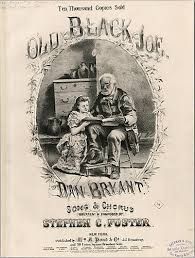
I'll end with a somewhat provocative analysis of early American songs of the slavery genre.  Considered to be the first American songwriter, I summarized the life of Stephen Foster in 2016:

Then came the pioneer that changed everything.  Controversial, and with a sad ending (at the age of 37 with 3 cents in his pocket),  Stephen Foster, born near Pittsburgh in 1826, was the ninth of ten children and lived an upscale life.  At 24 he launched a professional career as a songwriter, and on a delayed honeymoon in 1852 took his only trip to the deep south on a river steamship.  During this period of black-face minstrelsy, he attempted to reform the genre and stressed compassion, ethnic identity and longing for family and home.


He wrote more than 200 songs, including:

Many of his songs were condemned as racist, as for example, Old Black Joe.  Some say not, you need to understand the attitude of those times.


You can also read from Wikipedia, Slave Songs of the United States.

  • List of 136 songs, provided in 1867.
  • You can refer to that link for details, but one song surprised me.  I did not know that the 1960 Michael (Rowed the Boat Shore), by the Highwaymen, came from this group of slave songs.

-