This blog site initially focused on renewable energy and the environment. But that was SIMPLE SOLUTIONS for Planet Earth. My next book, SS for Humanity, opened the subject area to everything else, including SETI, the afterlife, travel and cuisine. However, I still provide, now and then, SIMPLE SOLUTIONS.
Yes, America is doing well today, if you are wealthy and Republican. President Donald Trump continues to reign supreme over the Republican Party. His 887-page Big Beautiful Bill sailed through the House of Representatives. The minor hangup was not pulling back on the tax breaks to the rich nor easing up on the cuts to liberal interests. The Freedom Caucus wanted much bigger reductions to medicaid and liberal interests and was worried about the national debt. Trump will make a big deal of signing the measure tomorrow. Read the details.
About the national debt, this bill will add $3.4 trillion to the already $29 trillion the country owes. Interest on this debt will top a trillion dollars/year and will equal our Gross National Product. From the New York Times:
Further, two-thirds of the federal budget goes to mandatory programs like Social Security, Medicare and Medicaid. The Freedom Caucus wanted to lower this percentage.
Why not, though mostly meaningless, but House Minority Leader Hakeem Jeffries delivered the longest speech in House history today, 8 hours and 45 minutes as a symbolic opposition gesture. The previous record holders were Republican Kevin McCarthy in 2021 and Nancy Pelosi in2018 when they were then the minority leader. Should be useful for campaign commercials to taint Republicans for assisting the rich and at the expense of the working class. Oh, the House has a long way to go to beat Senator Cory Booker's Congressional record, for he spoke on April Fool's Day this year for 25 hours and 5 minutes.
With all now being quiet in the Middle East, next on Trump's plate will be that July 9 tariffs deadline. As you must know, there has been a 90-day freeze. Looks like Vietnam is settled, but there remains the rest of the world, like China and the European Union, which represents 27 countries and accounts for 25% of all U.S. export trades. All the while, the American stock market has been breaking record highs.
The S&P 500 and Nasdaq closed at record highs. Dow went up 0.77% and is only 0.41% from it's own record. If you were worried about your Nvidia shares crashing three months ago when it dropped to 102, it rose today to 159.34, putting its market cap at $3.89 trillion.
There will be 12 of them this year, 8 during auditions and 4 in the early live shows. Frankly, I'm getting tired of those mass dancers, hanging in the air types, dog acts, people jugglers and so forth. However, Howie's and Simon's selections were outstanding.
This site began as a renewable energy and environment blog, and has evolved to just about any subject. I try to keep Wednesdays for sci-tech, with perhaps a monthly focus on energy. More recently, I've drawn from the Energy Matters info sent to me by the American Energy Society. I'm inserting direct quotes this time to eliminate my predilections for more credibility.
This service starts with some broad topics.
- Fossil fuels: Helium is locked in a supply crunch, and prices are surging.
- Renewables: Congress will probably pass new renewable fuel standards for 2026 and 2027.
- Policy: President Trump is now focused on California.
- Markets: The Shell/BP mega-merger? Don't bet on it.
- Universities in the spotlight: BYU, Purdue, and Princeton.
Spotlight: Helium. Due to the rise of AI, demand for helium is surging: semiconductors, fiber-optics, and especially for rapid cooling as an inert carrier. Today, helium is locked in a supply crunch. Prices have tripled in the past decade, to $400/mcf in 2023-24, with some spot cargoes trading as high as $1,000/mcf. (Note: Historically heliumwas primarily used for cryogenics, especially MRI machines (23% of market demand) and as a "lift gas" for floating (13% demand).
A carbon capture and sequestration primer:
CCS is the only available technology that can address carbon dioxide emissions from all stationary sources and across all applications (from power generation to industrial process heat. (Note: In the US, these sectors contribute about half of all greenhouse gas emissions.)
The 45Q tax credit, designed to incentivize CCS, was first established in 2008 through the Energy Improvement and Extension Act, and has undergone several modifications, including the 2018 Bipartisan Bill (which included other emissions in addition to CO2) and the 2022 IRA (for DAC).•Since its inception in 2010, the US EPA has issued permits for only 8 CCS projects, while there are more than 160 CCS projects still waiting for review.
On July 1, the Defense Meteorological Satellite Program (DMSP), jointly owned by NOAA and the Department of Defense and responsible for collecting extreme weather (aka hurricanes, etc.) and environmental (aka drought, flooding, etc.) data, will cease operations due to cuts in federal funding.
The country that exports the most climate misinformation (both sides) is the United States (followed by the UK, Australia, and Denmark). AES Members have access to the report.
The world added 741 gigawatts of renewable energy capacity last year. That’s a new record, but not on pace to triple renewables capacity by 2030. At the current rate, the world will be 6.2 terawatts short of its stated goals — more than all renewables deployed to date.
The Trump administration is limiting the power of individual states to set their own energy and climate policies, with special emphasis on California. For instance, Trump signed three resolutions that will prevent California from setting its own vehicle emissions standards, including the elimination of renewable electricity (aka the "EV mandate"). There is little discussion on either side (Trump vs. California) about federalism and statutory authority (aka state vs. federal powers).
The DOE has 179 clean energy projects with $15B in award funding; the DOE with DOGE reviewed these projects and has cut or reduced $3.7B from 24 of these projects, most of which were focused on industrial decarbonization or are in California, including $284M for sustainable aviation fuels
The Trump administration is preparing to eliminate funding for 4 of the 7 hydrogen hubs; all four are in states that primarily vote for Democrats: California (ARCHES), Pacific Northwest Hydrogen Hub (Washington, Oregon, Montana), Mid-Atlantic Clean Hydrogen Hub (New Jersey, Pennsylvania, Delaware) and Midwest Alliance for Clean Hydrogen (Illinois, Michigan, Indiana).
This Energy Matters edition goes on and on. It is clear that the Trump administration is on a quest to replace renewable energy projects with fossil fuel initiatives. Plus, states not voting for him, as for example California, are being targeted. Of course, all this you already know. The question is, where will the nation and world be in the future?
It could be worse.
The USA is not yet a dictatorship.
I've long predicted that the world will not take significant steps about climate warming until comes a hot summer when tens of millions perish.
You will read that extreme heat is searing Europe, but only two people died in Spain.
The worst so far was the summer of 2022 when there were 62,000 heat-related deaths in Europe. The USA only had 2,325. World? No reliable accounting.
This summer has here and there been hot, but nothing close to calamitous.
Why is President Donald Trump so pro-fossil fuels, anti-renewables and against doing anything to remediate global warming? According to Google AI Overview (to get the following info, go to that site).
Donald Trump has a preference for fossil fuels and a skepticism towards renewable energy and climate change policies.
He has an America First agenda, prioritizing domestic energy production and reducing reliance of foreign energy sources.
Google AI goes on to say:
While Trump promotes fossil fuels and criticizes renewables, the transition to clean energy continues to advance globally, driven by market forces and technological advancements. Some of Trump's claims about the benefits of fossil fuels or drawbacks of renewables have been questioned or refuted by experts. The effectiveness of his policies in achieving all his stated goals has been debated.
Quotes at the end of this edition:
“We officially rescue the US auto industry from destruction by terminating California’s electric vehicle mandate, once and for all.” — Trump at an Oval Office signing alongside House Speaker Mike Johnson, Transportation Secretary Sean Duffy, Energy Secretary Chris Wright, and EPA Administrator Lee Zeldin
“Now we know why Elon doesn’t like me so much.”
— Trump announcing new policies that will restrict EVs in California
The roughly multi-trillion-dollar bill would unlock tax cuts and funding boosts for national security, partly paid for by the biggest cut to the federal safety net in decades.See what’s in the bill here.Another high-stakes battle now looms, as the bill must pass in the House before heading to the president’s desk. GOP leaders are racing to try to get the bill to the White House by July 4.
‘Don’t Bankrupt America’: Musk Vows to Campaign Against Republicans Who Support Trump’s Debt-Raising Megabill
This bill will hurt lower income individuals and anyone assisted by Diversity/Equity/Inclusion government programs, while making billionaires and rich millionaires richer. Democrats are salivating about the upcoming mid-term elections on 4November2026. However, I keep saying that the problem will be President Donald Trump delaying elections that day, and maybe forever. There is nothing Democrats can do to stop him, and Republicans seem inclined to want to remain in power, even at the expense of Dictatorship over Democracy.
This is a city in France, 362 miles south southwest from Paris. In comparison, San Francisco is 383 miles from Los Angeles.
Has a population of 260,000, but the metropolitan area brings the number up to 1.2 million.
Occupied by Germany in World War II.
Historically known as the world capital for wine.
Produces 700 million bottles of wine, mostly Red Bordeaux, but also White Bordeaux and some very sweet Sauternes.
Began viticulture in the mid-first century CE by Romans.
Phyloxera infestations ruined the vineyards from 1875 to 1892, but were saved by grafting native vines onto pest-resistant American rootstock.
Is also a type of wine with vineyards (29,158 acres) around the city on the Garonne River.
In comparison, Napa Valley has 225,300 acres of vineyards.
In England, Bordeaux wine is called Claret.
Bordeaux wine is made by more than 5,660, called chateaux.
Bordeaux is a blend of mostly (70%) Cabernet Sauvignon on the Left Bank and Merlot (also around 70%) on the Right Bank, with a reversal of around 15% of either one in the other. The Left is west of the Garonne and Gironde rivers, while the Right is on the east. A complication is the presence in the Left bank of the Graves area upstream of the city and Médoc located downstream.
Bordeaux wines.
Are mostly red, and also include Cabernet Franc, Petit Verdot, Malbec and Carménère grapes.
White Bordeaux is typically made from Sauvignon Blanc and Sémillon, with a touch of Muscadelle.
Sauternes (pronounced sow-turnz) comes from the Graves section, and is made from Sémillion, Sauvignon Blanc and Muscadelle grapes affected by Botrytis cinerea, known as noble rot. The premiere example is Château d-Yquem, which typically costs around $350/bottle, but vintages can reach up to tens of thousands of dollars.
A Bordeaux blend made in California (and other regions of the world) is called Meritage.
Our group of four spent four days in Bordeaux. Our leader, Elvis. This is the motel he arranged where the toilet was in the same area as the shower. It was very cheap in price, and a good experience in minimalism
You can read the details by click on those links. To summarize.
One of the scientific attractions located here which we did not visit is Laser Mégajoule, because the plan ti to deliver over one megajoule of laser energy to induce fusion. This laser is about half as energetic as the one I worked on in the Lawrence Livermore National Laboratory.
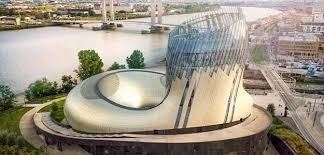
Another attraction is La Cite du Vin, the world's largest wine museum. Very impressive, and, in fact, overwhelming. Came with free wine tasting
Then on to the main reason why we on this mini-tour, Chateau Lafitte Rothschild on the Left Bank.
Our private tour was led by sommelier Nicola, who opened a new bottle of 2004 Chateau Lafite Rothschild. You can get this bottle for $1800. We easily drank it all.
As great as this wine tasted, a couple days later went to a small market to buy three bottles of cheap Bordeaux ($3-$5) and would swear that these were roughly the equivalent of that Chateau Lafitte Rothshild.
The next day our final Bordeaux tasting was at Chateau Lassegue on the Right Bank.
Nicola and his wife Christina run the whole thing. What a love story. Christina was on her way to earning a law degree from Yale, and was also president of the Yale Wine Club. Nicola's family was invited to give a talk, and....they eventually got married.
Two of us then caught a train to Cognac, which will be the focus next Tuesday. We thought this was the highlight of the whole trip. Oh, on the train we had some Lassegue Saint Emilion Grand Cru with Big Macs.
I'll close by announcing the retirement of Dr. Demento.
Haven't heard his radio program for many decades, if not half a century, but he played the weirdest and wildest novelty songs and discovered Weird Al Yankovic. Also Tom Lehrer and Allan Sherman. Helped make famous Shaving Cream, Alley Oop, Grandma Got Run Over by a Reindeerand Monster Mash.
Born Barret Hansen in 1941 in Minneapolis. As early as 12 bought old 78 records for 5 cents each, and had quite collection when he went to Reed College in Portland.
Holds a master's degree in ethnomusicology from UCLA.
Became a roadie for Canned Heat.
In 1970 became a DJ in Pasadena, California, and early on played Spike Jones, Jimmy Durante and Stan Freberg.
After playing Transfusion by Nervous Norvus, was said to be demented to play this song.
Dr. Demento initially aired in 1970, and stuck with his scheme for half a century until 2010, switching to special programs which can be accessed online. Now down to two shows per month.
His show got personal visits from personalities like Screamin' Jay Hawkins and Mel Brooks.
Came on late Sunday night on your FM dial. Initially fours long, but when national syndicated in 1974, only for two hours. For the final few months he will focus on the greatest moments and songs of his program.
He recently decided to retire, but not until 11October2025. This final show will be devoted to the top 40 songs in his show's history.
Has a collection of over 85,000 records, and maybe 300,000. He long lost count.
RADIO GARDEN is a fascinating link. You might need to activate the page, by clicking on it. Then click on any green dot to hear a radio from that location. In that lower-left box, click on EXPLORE or SEARCH to open up a whole new world of choices. Find San Francisco, for example, and you can click your way to 89 different stations from that area, or New York City for 202 stations. There is a feature where you click on the heart symbol to save that station and form your own list of favorites. There is a London station (under Weird Stations, find Birdsong Radio) that only plays a bird singing, or one from Switzerland (also under Weird Stations for Ambi Nature Radio) that plays ambient nature to put you to sleep. You'll bookmark this page and play with it for the rest of your life.
Most Popular Posts
For the longest time, the day when the most visitors (3,356) clicked on this blog site was 27February2010 on THE CHILE EARTHQUAKE. Why? Probably because this posting was linked to my Huffington Post article of that day reporting on HAWAII TSUNAMI. Natural disasters tend to increase readership. However, on 6March2017THE WONDERS OF ALCOHOL drew 6498. Further, too, on 6June2017, the one-month tally of visitors was 70,219, or 2340/day. However, on 18December2018 a record 27,775 people read that posting. On 22April2019, after 13,000 and 19,000 pings the previous days, a second all-time high of 27,318 was reached. The daily average has been about 500/day.
Interesting to note that not one of the top 20 postings reports on natural disasters (not sure what those numbers stand for, but they indicate a kind of relativity), the newest of this list goes back five years, and the highest rated this year is just over 300. Clearly, people are reading my older postings, but there is no sense to which subject areas are popular.
2024 surpassed 2023 as the highest global temperature on record. Global sea level also rose to a new high, 4 inches higher than in 1993, when record-keeping began. Tropical cyclones were 25% higher than the average. The Arctic is melting, severely.
Go to:
https://www.covers.com/editorial/HowToBet/OddsConverter
to access a betting odds converter for
- Moneyline/Amercan Odds
- Decimal/European Odds
- Fractional/UK Odds
- Implied Probability
CALCULATE THE CURRENT VALUE OF MONEY
Measuring Worth - Relative Value of US Dollars
....One ballpark estimate of what it cost the U.S. for World War II was $288 billion (in 1940 dollars). If you had inserted 1940 / 288 / 2016 into those boxes, the equivalent value today would be $4,870 billion, or close to $5 trillion.
CONSUMER PRICE INDEX AND THE INFLATION RATE
The CPI is based on 1984 at 100. Thus, 241 means a 241% inflation since 1984.
There are various ways to look at this, but one is to subtract 100 from 241, getting 141, so the effective inflation today, nearly a third of a century later, is 141% higher. Another comparison is that the CPI in 1916 was 10.9, and is at 240.853 today, a hundred years later. Thus, the average commodity that sold for a buck then, today goes for $22.
WHAT WILL BE THE FUTURE PRICE OF OIL?
Click on:
FUTURE PRICE OF OIL
to gain a sense of what the financial community thinks will be the future price of crude oil. When I last viewed this Chicago Board of Trade (a NYMEX company) future contracts page on 110March2014, the futures price of oil in December 2022 was $78.59. This makes no sense to me.
I more recently (10July2019) checked the Chicago Mercantile Exchange, where they quoted the price of petroleum for February 2030: $55.33. Note the price/barrel above for today.
I am Director Emeritus of the Hawaii Natural Energy Institute at the University of Hawaii and co-founder of the Pacific International Center for High Technology Research.
I have published three SIMPLE SOLUTION books and have written more than 100 articles for the HUFFINGTON POST. I am working with an enlightened team to pioneer the BLUE REVOLUTION (http://bluerevolutionhawaii.blogspot.com/),
beginning with the development of the Pacific International Ocean Station.
 Yes, America is doing well today, if you are wealthy and Republican. President Donald Trump continues to reign supreme over the Republican Party. His 887-page Big Beautiful Bill sailed through the House of Representatives. The minor hangup was not pulling back on the tax breaks to the rich nor easing up on the cuts to liberal interests. The Freedom Caucus wanted much bigger reductions to medicaid and liberal interests and was worried about the national debt. Trump will make a big deal of signing the measure tomorrow. Read the details.