Total Pageviews

Showing posts sorted by relevance for query story of hydrogen. Sort by date Show all posts

Wednesday, June 1, 2022

MY STORY OF HYDROGEN

 If I'm identified with any renewable energy subject matter, it is hydrogen.   Recently, I was inspired to re-focus on this option because of an e-mail I received from one of my colleagues, asking me to read this hydrogen article.  I responded to him:

**************************

Dear Benny:

The key to the hydrogen economy will be the transition, and this article you sent shows a pathway. 

A quarter century after I drafted the first hydrogen bill ever created in the Senate, which became the Matsunaga Hydrogen Act, I thought this was the perfect bill. There is more hydrogen in the Universe than all the other elements put together. All stars utilize this gas to create energy. When combusted on Earth, the only products are energy and water. Surely these are clues that hydrogen will be significant for our future.

In 1979 while on assignment at the Lawrence Livermore National Laboratory on fusion--which, of course, is another hydrogen option--I was asked to work in the U.S. Senate.  Already, my sense was that commercial hydrogen was more than a generation away, as the laser to do it had not yet been invented. Today, it is still more than a generation away, for that laser has still not been invented.  I then felt that inertial confinement (using a laser) makes a lot more technological sense than magnet confinement (as is now proceeding as ITER in Southern France).

That legislation became law, but progress was slow, so more than a quarter century after the U.S. Congress began talking about hydrogen, and this was 16 years ago, I thought: Why not make hydrogen free? I wrote several Huffington Post articles outlining how. Here is Part One. After you read that one, you should be able to find the others if still interested in the subject.

I generally focus on a science topic on Wednesday. You have inspired me to blog on hydrogen this week.

*****************************

So here we are on Wednesday, and I saw that it was only in November of last year that I re-told The Story of Hydrogen.  There is a lot more to this topic than the following, but as a beginning on why I am involved, here are a few passages from that posting:

  • In 1980, I found myself working in the U.S. Senate and recalled what I learned in Miami (thought it would be instructive to explain that this was the inaugural conference when hydrogen dreamers first met).  I was so inspired that I wrote the initial hydrogen legislation for the Senate, which led to the Matsunaga Hydrogen Act in 1989.

  • In 1990 I chaired the World Hydrogen Energy Conference in Hawaii.  Soon thereafter I became chairman of the Secretary of Energy's Hydrogen Technical Advisory Panel, and we prepared The Green Hydrogen Energy Report, which served as the guide for a decade of Congressional hydrogen funding.  This led to selection of the Hawaii Natural Energy at the University of Hawaii to become a National Hydrogen Center for Education and Research.

Amazing how the fate of the world can be so influenced, but about that Green Hydrogen Energy Report:

  • The day before the Hydrogen Technical Advisory Panel met in Honolulu in 1995, I created a straw man budget for discussion.  This was a super optimistic speculation on escalating the funds for hydrogen.
  • Well, the Panel did not change anything, and you can read this quote from the report.

Under the HTAP plan, DOE’s hydrogen budget within the Office of Energy Efficiency and Renewable Energy (EERE) would annually range between $40 and $60 million, compared with recent funding of about $10 million. This core funding should trigger at least equal cost-matching from industry and stimulate an expanded, but more coordinated, response within DOE and other federal agencies involved with hydrogen research and development (R&D). 


The hydrogen budget did in fact reach the higher end of our recommendation, and in 2002, there were more funds in the Department of Energy's budget for hydrogen than solar technologies.  How did this happen?

  • Read that Matsunaga Hydrogen Act.
  • I provided the first draft where:
    • Created was the Hydrogen Technical Advisory Panel.
    • This Panel was unique, in that it reported in parallel to the Secretary of Energy and the U.S. Congress.  There is no other federal panel capable of legally doing this.
    • Thus, we annually officially filed the recommended hydrogen budget to Congress, while the Department of Energy did the same.  The budget was identical.
    • Hydrogen is one of those subjects that was alway bipartisan.  Thus, there was no contention.
In afterthought, I later realized that the transition of hydrogen from dream to reality would be particularly lengthy.  It was too expensive in 2000, and today still too expensive to produce.  If hydrogen is this fuel for our future, though, why not find a way to get to the Hydrogen Economy faster?  So in 2006 I suggested a mechanism to bypass the traditional R&D to commercialization pathway.  From the first of my HuffPo's on the subject:

On March 21, 2006, at the annual luncheon of the National Hydrogen Association (NHA) Conference in Long Beach, California, I received the Spark Matsunaga Memorial Hydrogen Award, usually given to an elected official. However, as I was the individual who U.S. Senator Spark Matsunaga assigned in 1980 to write the first draft of his hydrogen bill, I guess I was considered to be close enough to qualify. The second recipient, in 1992, was U.S. Senator Daniel Akaka, whose letter of congratulations was read by Jeff Serfass of NHA. Other awardees have included Congressmen and Senators, although Governor Arnold Schwarzenegger received this honor in 2004. Walking up to the podium, aside from the assorted obligatory thank you, I wondered what I was going to say. (Pardon me for mentioning all this, but a degree of credibility helps when one leaps beyond the edge of the envelope.) It then came to me in a moment of splendid inspiration, bursting forth from a third of a century of deliberation--MAKE HYDROGEN FREE.

Here is my Huffington Post series on Free Hydrogen:

What About Free Hydrogen? (Part 1)

What About Free Hydrogen? (Part 2)

After a while the feedback I was receiving called for a mid-course correction.  Thus, in this transition, why not make all of renewable energy free at a certain point in the future.  Or, from Part 5:

But traditionalists will state, this is impossible...in fact, crazy. So be it. I provide a hint in my first HuffPo of May 29 entitled, "Well, Barack, We have a Problem..." Then through all my other posts, leading to this series, details about purposefully controversial alternatives are provided. I do suggest that the G8 Nations and United Nations take the lead, but, on afterthought, the USA made an early unilateral decision to legislate for clean air and water, and the world followed. Our next president, Congress and the private sector must set aside their differences, ala Booker T, and take just one magnificent step: make Green Energy free in 2020.


Of course 2020 came and went, but there was progress in developing sustainability.  You have of course noticed that when authorities talk about energy self-sufficiency and 100% renewable, they are only referring to electricity.  There is more to this:
  • Electricity is less than 40% of the problem.  What about air transport, etc.?
  • Some say the future of ground transport will be electric vehicles.  But batteries are expensive.  A fuel cell is more efficient than batteries.  In time hydrogen and fuel cells will overtake EVs.  In the transition, a direct methanol fuel cell will precede hydrogen.
  • Progress on aviation self-sufficiency has been slow, if not non-existent.
    • The Matsunaga Hydrogen Act recommended that the Department of Defense and NASA develop the National Aerospace Plane, which will be powered by hydrogen.  Turns out that many billions were spent to start a program, but there was little obvious progress.  This effort became a Black (secret) Program, and I'm not sure what is happening today.
    • Read my HuffPo on:

So here is my current thinking about hydrogen:

  • The transition will take dedication and time and effort and money.  Here is an article to read:  Hydrogen May be a Climate Solution.  The driver will be global warming.
  • Breakthroughs will be necessary:
    • Another metal to replace platinum in a fuel cell.
    • A catalyst to convert biomass gases into methanol.
    • An efficient direct methanol fuel cell.
    • Using sunlight to more effectively generate hydrogen from water.
    • Aviation applications of hydrogen needs a lot of work.
    • Other technologies such as ocean thermal energy conversion must be utilized to produce hydrogen at sea.
    • Commercialization of fusion needs to happen.
  • The Hydrogen Society will come.  But this could take a century, or more.  Can Humanity afford to dawdle along with global warming so imminent?  Make hydrogen free?

-

Thursday, November 11, 2021

MY STORY OF HYDROGEN

      From Worldometer (new  COVID-19 deaths yesterday):

        DAY   USA  WORLD       Brazil    India    South Africa

June     9    1093     4732         1185        246       82
July    22     1205     7128         1293      1120     572
Aug    12     1504     6556        1242        835     130
Sept     9     1208      6222       1136       1168       82
Oct     21     1225      6849         571        703       85
Nov    25      2304    12025        620        518      118
Dec    30      3880    14748       1224       299      465
Jan     14      4142    15512        1151       189     712              
Feb      3       4005    14265       1209       107      398
Mar     2        1989      9490        1726       110      194
April   6          906     11787         4211       631       37
May    4         853     13667         3025     3786       59 
June    1         287    10637        2346      3205       95
 July   7          251      8440        1595        817      411
Aug    4          656    10120        1118        532      423 
Sept   1        1480    10470          703        505      235
          8        1700      9836          250        339      253
        14        1934      9001          709        281      300
        22        2228      9326          839        279      124
        29        2190      8859          643        309      108 
Oct    6        2102       8255         543        315        59
        12        1819       7544         201        249        37
        19        2005       7528         401        160        80 
        27        1594       8671         433        734        62
Nov   4         1207      7009         184        480        35 
          9         1524      7953         214        480        35
         10        1493      8366         264        362        48

Summary:  The World and USA seem to have plateaued in new deaths.  The countries with the most new cases yesterday were:
  • USA  94,376
  • Germany  45,416
  • UK  39,058
  • Russia  38,058
Today is Veterans Day, a Federal holiday always held on November 11.  First started at the end of World War I in 1918 as Armistice Day, Congress recognized it to become an official federal holiday.  In 1954, the name was changed to Veterans Day.  The Uniform Holiday Act of 1968 moved this day to the fourth Monday in October.  In 1975, President Gerald Ford returned it November 11.  In Europe, this is still Armistice Day, the end of World War I, and is a national holiday.


If you're wondering why we also have Memorial Day, this one had roots going back to the Civil War.  In 1971, Congress made the last Monday in May Memorial Day.  Both honor those who have died in wars.  15 Craigside gave me a lei today for being a veteran.  I was actually in the 442 during the Vietnam War period.

My focus on the Hydrogen Clipper yesterday brought back a lot memories.  Here is My Story of Hydrogen.

First a bit of history:
  • Name comes from Greek words hydro and genes, which together mean water forming.
  • Robert Boyle of Ireland first produced hydrogen in 1671.
  • Almost a century later, British scientist Henry Cavendish recognized it as a distinct element in 1766, and is the Father of Hydrogen.
  • Edward Teller is known as the Father of the Hydrogen Bomb, and I worked under him when he was director of the Lawrence Livermore National Laboratory.
Science of hydrogen:
  • Is at the head of the chemical table of elements with atomic number 1.
  • The lightest element.
  • 75% of normal matter and 90% of all the molecules in the Universe is hydrogen.
  • There were no elements immediately after the Big Bang, with hydrogen first coming into being about 370,000 years later.
  • Is mostly produced today through a process called steam reforming of natural gas.
  • Hydrogen can also be generated through the electrolyis of water and a variety of other ways, including using a catalyst in water onto which sunlight is beamed and biological options.
  • There are at least seven isotopes:  protium, deuterium, tritium and others synthesized in the lab.
    • Protium is 99.98% of all hydrogen, with a half life of 10 to the 34th power years
    • Deuterium has a neutron added to the proton, and is 0.015% of all hydrogen.  It is stable.
    • Tritium is only one billionth of a billionth percentage of hydrogen, with a half-life of 12.32 years.
For the longest time I've been enamored of hydrogen:
  • Being 75% of all known matter, this must be a clue that hydrogen must be the fuel of the future.
  • When combusted in air, the only product, if designed properly, is water vapor.
  • The infrastructure is largely in place.  Pipelines might need to be internally coated, but that expense is trivial compare to having to buy land, gain rights, satisfy permitting requirements and the like.
  • Is the best gas to be used in a fuel cell, which is two to four times more efficient than battery or fossil-powered vehicles.
  • Mind you, I still think a biomethanol fuel cell is the transition to ultimately using hydrogen.  
    • Hydrogen today is too expensive, and biomethanol can be produced from biomass though gasification and utilization of an efficient catalyst for methanol.  This catalyst is not good enough today.  
    • Note that drag racers do best with methanol and space ships are launched using liquid hydrogen.
    • About the danger of hydrogen and memory of the Hindenburg, NASA and the rest of the world have found a way to safely use liquid hydrogen, which should improve with experience.  Remember that there have been 210 serious aircraft incidents and we still use jet fuel.
  • Our Sun and all stars consume hydrogen to produce energy through a process called fusion.
    • Uranium and plutonium for nuclear fission reactors are unsafe:  radioactive wastes with long half lives, potential to make dirty bombs and major catastrophes.  Fusion power using hydrogen, or Star Power, shows huge promise.
    • However, ITER using magnetic confinement and the Lawrence Livermore National Laboratory laser fusion process seem today stymied, it will be a matter of time when the urgency will bring results and utility.
  • Regarding the Search for Extraterrestrial Intelligence:
    • There is a quiet band of the electromagnetic spectrum between 1420 and 1652 megahertz called the waterhole, which radio telescopes use to see out into space.  The reason is that the hydroxyl radical spectral line and atomic hydrogen molecules absorb radio noises, making this band the logical extraterrestrial communication station site.
    • NASA Ames Research Center discovered this waterhole.
As a university professor, I am provided the freedom to do whatever I want during the summer months.  1974 was a particularly providential year, for I got involved with two projects at the University of Hawaii:
  • The First Energy Crisis occurred in Fall of '73, so that I ended up gaining leadership over the academic wind power program.  Funds were found to send me to DC to seek funds the following year.  
    • My interest in hydrogen spurred me to stop off first in Miami to attend the initial gather of Hydrogen Romantics, which led to the field journal and semi-annual World Hydrogen Energy Conference.  Nejat Veziroglu, who is now 97 years old, was the organizer.
    • In 1980, I found myself working in the U.S. Senate and recalled what I learned in Miami.  I was so inspired that I wrote the initial hydrogen legislation for the Senate, which led to the Matsunaga Hydrogen Act in 1989.
    • In 1990 I chaired the World Hydrogen Energy Conference in Hawaii.
    • Soon thereafter I became chairman of the Secretary of Energy's Hydrogen Technical Advisory Panel, which prepared The Green Hydrogen Energy Report, which served as the guide for a decade of Congressional hydrogen funding.  This led to selection of the Hawaii Natural Energy at the University of Hawaii to become a National Hydrogen Center for Education and Research.
  • During the summer of 1974 I co-directed a NASA-sponsored program on Earth 2020, directed by the Ames Research Center.  I got to know the people there, so in 1976 was among 20 faculty members to work at Ames on the Search for Extraterrestrial Intelligence, a subject that most interested me because I thought that beaming in from space could well be the Encyclopedia Galactica, provided by an advanced civilization to engender peace, generate fusion power and so on.  I like to think big.
In 1975, and again in 1979, I worked at the Lawrence Livermore National Laboratory on laser fusion.  More than 40 years ago I felt that the laser to do the job was nowhere near discovery, so I left the field.  I still think Livermore's future in developing fusion makes more sense than the ITER effort ongoing in France.

To repeat, while I was at Livermore in 1979, the world was suffering from the Second Energy Crisis, with gasoline lines throughout the world.  I was asked to work for Senator Spark Matsunaga in DC, so off I went to craft that original hydrogen bill.  I also participated in drafting the initial legislation for ocean thermal energy conversion, which has led to the Blue Revolution.

Moving on throughout the 80's, I closely followed the development of the National Aerospace Plane, which was moved into a black program, so very little information was released.  The Hawaii Natural Energy Research got heavily involved in the national hydrogen program, where we had an annual assessment for universities and companies vying for funding.  Being chairman of the Secretary of Energy's Hydrogen Technical Advisory Panel helped in this competition.  That original hydrogen bill I drafted creating this Panel did something unique on purpose:  we reported to the Secretary, and also to Congress.  This dual pathway enabled us to increase the hydrogen budget so that in the early 2000's when George Bush the Younger was president, hydrogen actually got more funds than solar technology.

By then, I had come to a conclusion that hydrogen was not for now.  Perhaps 2050 was more realistic.  Thus, as shown in a series of Huffington Post articles I wrote, you can track this shift in attitude:

What of the Hydrogen Economy, and when?  The term was coined by a close colleague of mine, John Bockris, just around the time the Romantics first convened in Miami.  And true, most adherents are impossibly optimistic. 

The Society of Electrical and Electronic Engineers is dismissive.  But there is a reason.  Electricity and hydrogen represent two competing energy interfacing alternatives.  I've long felt that both will be necessary and best.  Hydrogen can be complementary and should be more practical than batteries.  For example:

...hydrogen fuel cell buses typically have a range of 
approximately 500 km, versus 200 km for electric buses. With this range, hydrogen has both the potential to decarbonize rural transport and to offer a solution for uninterrupted services.
  

The ETC’s Mission Possible report, Shell’s Sky Scenario, and  the International Energy Association’s below 2 degrees Celsius scenario all show well-developed pathways to decarbonizing the hard-to-abate sectors, and those pathways all require substantial global hydrogen growth.

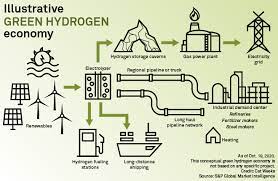
Power magazine reports on the bullishness of Siemens.  Read this for a fair statement about Green Hydrogen.  What are my views?  
  • In all the public hearings I chaired in the 1990's, most of the participants were too hopeful.
  • A quarter century till today, it has not surprised me that there has not been much progress.
  • A core of enthusiasts will always be around to provide a hopeful point of view.
  • Global warming could well provide that catalyst to minimize the transition period for arrival of the Hydrogen Economy.
  • If hydrogen airships and jetliners become prominent by 2050, the lowered cost of hydrogen should also favor fuel cell- over battery-powered vehicles.
  • 2050 should also be around when fusion-power should begin to become available.
  • Cold fusion?  Maybe never, but the concept is worthy of continued investigation.
Some learn best watching videos.  If you are among them, here are a few you can consider.
-

Saturday, January 10, 2026

RITZ-CARLTON LUMINARA: Day 12--History of Hydrogen

I regularly review the state of the Hydrogen Society.  Today, I will focus on the history.

  • I've long been intrigued by hydrogen.
    • 70-75% of the mass in the Universe is hydrogen.
    • 90% of atoms are hydrogen.
    • When combusted in air, the result is water.
    • Isotopes tritium and deuterium are the keys to fusion.

    • Why is hydrogen so abundant?
      • The Big Bang produced mostly hydrogen and helium.
      • Colorless and odorless.
      • Hydrogen's simplicity makes it the primary fuel for the formation of stars.
      • Hydrogen consists of one proton and one electron, making it the lightest and simplest atom.
      • Makes up 63% of all atoms in the human body.
    • Hydrogen's story.
      • In 1526, Paraclesus first observed hydrogen gas.
      • Theodore de Mayerne found the gas combustible in 1650.
      • In 1671, Robert Boyle first artificially produced hydrogen.
      • Henry Cavendish in 1766 formally identified it as a distinct element.
      • Antoine Lavoisier coined the name hydrogen from the Greek words hydro (water) and genes
        (creator).
      • In 1783, Jacques Charles invented the first hydrogen balloon.
      • William Murdoch used a hydrogen-rich gas in1792 to warm his home.
      • Francois Isaac de Rivaz developed an internal combustion engine to generate power in 1807.
      • William Grove invented the fuel cell in 1839.
      • In 1875, Jules Verne published The Mysterious Island, envisioning hydrogen as an inexhaustible energy source.
      • Ferdinand von Zeppelin made a maiden flight of his hydrogen dirigible in 1900.
      • The Hindenburg disaster occured in 1937 in New Jersey.  There were 35 fatalities.  Herbert Morrison's radio eyewitness report can still be remembered.  This is the one-most critical event that has prevented the expansion of hydrogen use.  The more important one is economics.
      • Hydrogen today is primarily used in industrial processes and as a rocket fuel.  Fuel cell applications are increasing.
      • My involvement began in 1974.
    Hydrogen has long been a passion of mine now for half a century.  Read my 
    Story of Hydrogen.  To quote:

    • My interest in hydrogen spurred me (in 1974) to stop off first in Miami to attend the initial gather of Hydrogen Romantics, which led to the field journal and semi-annual World Hydrogen Energy Conference. 
    • In 1980, I found myself working in the U.S. Senate and recalled what I learned in Miami.  I was so inspired that I wrote the initial hydrogen legislation for the Senate, which led to the Matsunaga Hydrogen Act in 1989.
    • In 1990 I chaired the World Hydrogen Energy Conference in Hawaii.
    • Soon thereafter I became chairman of the Secretary of Energy's Hydrogen Technical Advisory Panel, which prepared The Green Hydrogen Energy Report, which served as the guide for a decade of Congressional hydrogen funding.  This led to selection of the Hawaii Natural Energy at the University of Hawaii to become a National Hydrogen Center for Education and Research.
      • The widespread use of hydrogen leading to the Hydrogen Society will happen if global climate change becomes a serious crisis and cheaper hydrogen production rates can become more economical.
    Lunch today in the Beach House.  Bloody Mary and Decoy Cabernet Sauvignon.
    A Greek soup.
    Lamb chops.
    Egyptian rice pudding
    Dinner was at Haesu Bit.  First sashimi with sake and chardonnay.  Note that large piece of cucumber, which I munched on.
    Then a buttered scallops entré with a caviar topped chawan mushi.
    Dessert of a huge fortune cookie.
    Only walked 1061 steps,
    -