Total Pageviews

Showing posts sorted by relevance for query national aerospace plane. Sort by date Show all posts

Wednesday, March 16, 2016

PROGRESS ON CLEAN AIR TRAVEL

Yesterday I reported that 56.5% of people in Hawaii indicated to a Star-Advertiser poll that it was something between very doubtful to no way that the state could achieve 100% renewable energy self sufficiency by 2045.  50% of this group today felt that BOTH the Men and Women Basketball teams would, respectively, beat the University of California and UCLA at the NCAA Big Dance this weekend.  Unrealistic.  Clearly, thus, that 56.5% figure was much too optimistic.

As I've been predicting for some time, renewably powered electricity is a given when global warming taxes are invoked or the cost of fossil fuels skyrockets, and the second will be related to the first.  I've of course already told you what will happen in my Huffington Post article of five years ago on:


In short, I said don't call it a tax and simply find a way to absorb 5 cents/pound carbon dioxide into the economy.  This would increase gasoline from $2/gallon to $3/gallon and electricity from 15 cents/kWh to 25 cents/kWh.  Clearly the general populace won't today embrace this increase, and Republicans would not let it happen anyway.

Ground transport might well become more battery powered, but lithium will be the final battery and fuel cells show a lot more potential anyway.  Comparing a lithium ion powered vehicle with a fuel cell car, the latter makes a lot more sense.  To quote from my HuffPo:

Per unit volume, a fuel cell should be able to provide five times more energy than the lithium battery. 

The problem is that hydrogen will always be too expense, so I suggested a biomethanol and direct methanol fuel cell (DMFC) system.  It has already been surmised that the DMFC will someday replace batteries for portable applications:

Small portable devices are well suited, in terms of storage, safety, and energy density, to use of methanol as a fuel for fuel cells.

Very recently, there has been an uptick in DMFC patents, so something appears to be happening.

So what am I saying?  Development of renewable electricity and ground transport appear to be progressing well.  Not so for clean aviation fuel.  Yesterday I reported on how much the Department of Defense seems committed.  United Airlines appears to be equally progressive.  They are all justifiably concerned about security, availability and emissions.  

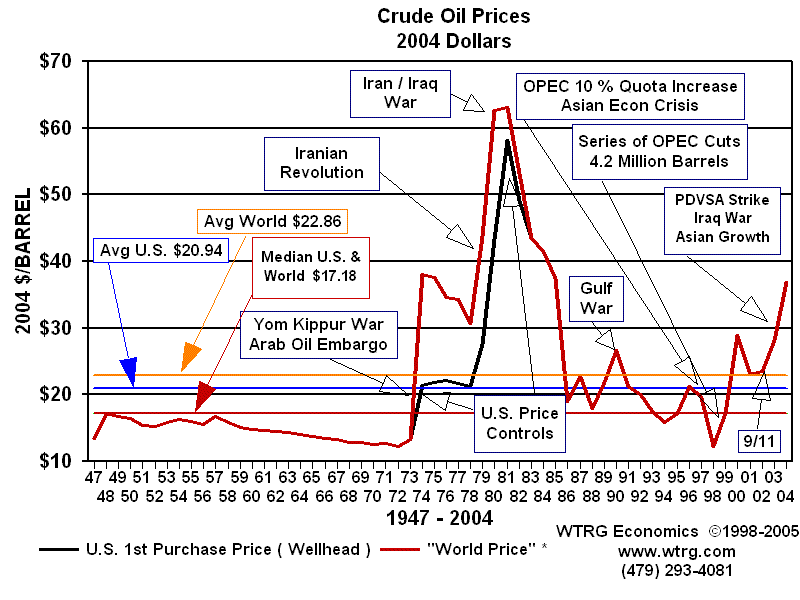
However, where do you draw the line?  Renewable jet fuel would have been more than double the price of conventional jet fuel when oil cost $100+barrel.  Today, that factor is four and higher.  Terrific for attitude and total life cycle cost analysis, but the reality is that the commercial airlines will only use limited amounts of biofuels primarily for PR, as the profits cannot be materially affected.  If oil skyrockets to $200/barrel, then we have a game.  But the Chicago Mercantile Exchange has petroleum at $51/barrel in December of 2024.  Don't expect any great green aviation advances for at least a decade, and the fickleness of oil prices is a good reason why substantive decisions will be avoided into the foreseeable future.

So what about the necessary shift to hydrogen-powered flight?  I tried.  Went to work for the Senate Energy and Natural Resources Committee more than a third of a century ago, drafted the hydrogen bill that became the Matsunaga Hydrogen Act, which triggered interest from NASA and the Department of Defense in advancing the hydrogen-powered National Aerospace Plane, for which $2 billion was expended.  But this effort today is secret and relatively minor.

More than twenty years ago I chaired the U.S. Secretary of Energy's Hydrogen Technical Advisory Panel, and we produced The Green Hydrogen Report.  The scary thing is that we arbitrarily inflated what we thought would not be seriously considered and proposed a ten year budget plant that became largely utilized by the U.S. Congress to establish funding levels for hydrogen over the protests of the U.S. Department of Energy.  At one point a decade after this publication, the USDOE Hydrogen Budget actually exceeded the Solar Technology Budget.  But next generation aviation got zero support.

As I earlier reported, NASA just gave Lockheed Martin $20 million to test out a half-sized supersonic plane by 2020.  The use of biofuels is one aspect of this X-plane adventure, but we return to the high cost of biomass converted liquid fuel.  Hydrogen is not mentioned.

So is anything happening to hydrogen-powered aircraft?
3. Aviation? This has not even been considered, but should. When I drafted the first hydrogen bill for Senator Spark Matsunaga nearly three decades ago, I added a clause for the National Aerospace Plane, thanks to input from Lockheed. To shorten a long tale of delay, we are at least 25, if not 50 years, away from a next-generation hydrogen powered jetliner or cost-effective jet fuel from marine algae. Are we then in deep trouble? Hawaii especially, but I've learned of a new concept, for now, let's call it the Hawaiian Hydrogen Clipper (or H2 Clipper), which the advocates say, can be developed in a decade. While the prudent might be skeptical, I support the idea because there is nothing else on the horizon, and this idyllic spot in the Pacific would, indeed, be the ideal location to pioneer this development, for we have the political clout -- P-E Barack Obama was born and grew up in this State and Senators Daniel Inouye (chairman of the full Appropriations Committee) and Senator Daniel Akaka (on Energy and Natural Resources Committee) represent Hawaii -- natural resources, and definite need, for without a next generation sustainable air travel alternative, when jet fuel prices again skyrocket, tourism will truly collapse, and economic depression will follow.


  • So, well, any progress on that Hydrogen Clipper?  Haven't talked to him in more than a year, but Rinaldo Brutoco will hopefully continue to pursue this option, and make progress, soon.
With oil at less than $40/barrel,  however, there is meager interest in finding a clean option for air transport.  At $100/barrel, nothing much more will happen.  $200/barrel?  Sure, but too late, for it will take longer than a quarter century for anything like a new hydrogen jetliner from conception to commercialization to occur.  On with the Hawaiian Hydrogen Clipper.

-
There has been no ocean storm activity for weeks, so I thought I would at least mention that Tropical Cyclone Emeraude has popped up in the India Ocean, and, while currently at 65 MPH, will attain Category 3 strength, but go south to nowhere:


-

Thursday, November 27, 2008

SIMPLE SOLUTIONS FOR OUR BIOFUEL PROBLEM

On this Thanksgiving holiday I thought I would reflect on the one most critical energy topic to be a challenge: transportation fuel. Much of the following was detailed in Chapter 2 of SIMPLE SOLUTIONS for Planet Earth.

Renewable energy will be used to provide electricity and fuels for ground transportation and aviation. Sustainable electricity is well in hand. As the price of oil again increases, the range of alternatives will gain in prominence, starting with windpower, which is already competitive. Plug in vehicles are poised to make an impressive entry.

Liquid and gaseous biofuels are another matter. Details about this subject can be found in the book mentioned above. The current infrastructure is liquid dominated, so, for this discussion, I will delete biomethane and hydrogen from consideration. In addition, for now, hydrogen is just too expensive to produce.

The Nation and World unfortunately went in the wrong direction when ethanol from corn (plus sugars and other starches) and biodiesel from terrestrial plants were selected for focus. The Farm Lobby no doubt should be congratulated for smartly lobbying Congress and the White House for farmers are in great shape. Job done! Regrettably, grain prices jumped, causing a food crisis for developing countries. The knee-jerk reaction was, of course, all that fibrous cellulose, why not ferment those wastes into more ethanol? So, a second herd of white elephants is now being groomed. Why? Because there is a simpler alcohol called methanol that makes more economic sense. My HuffPo article of June 10 compares ethanol and methanol.

Regarding biodiesel, the notion is almost laughable, as only a very small percent of the plant itself is used. Biodiesel from algae, for example, is ten to twenty times more efficient in converting sunlight into usable fuel. Plus, these land plants grow relatively slowly and need irrigation water.

About the future of cars, one always hopes for nanotechnology making a difference, but it appears that the lithium battery might well be the ultimate. Per unit volume, fuel cells can provide more energy than any battery, perhaps by a factor five or more. This is why the direct methanol fuel cell (DMFC) will in time replace batteries for portable electronic applications. As an aside, this defies common sense, but one gallon of methanol has more accessible hydrogen than one gallon of liquid hydrogen. Thus the logic argues for producing methanol from biomass to power a fuel cell. Whoops, there is no DMFC for vehicles. For the record, while methanol has half the energy value of gasoline, the fuel cell is at least twice the efficiency of the internal combustion engine, so there is a wash here on fuel storage. And methanol is no more toxic than gasoline. You shouldn’t drink either one.

Aviation remains a great challenge. I wrote into the original Senate legislation, known as the Matsunaga Act, a section that did result in the hydrogen powered National Aerospace Plane Project in the 1980’s, which later became a black Department of Defense (DOD) Program. Thus, the only option over the next few decades has to be a replacement for jetfuel. The Defense Advanced Research Projects Agency has a solicitation for a commercial jetfuel from algae, and companies are coming out of the woodwork to do the job. Is this good? Yes and no. Nice that the DOD thinks $3/gallon is possible, and there is industrial interest in delivering, but the basic science and engineering has not yet been attempted. Why not?

First, the National Oceanic and Atmospheric Administration (NOAA) is mostly a monitor and protection agency. Second, the Department of Energy abandoned all ocean energy efforts and the National Renewable Energy Laboratory actually gave their microorganism collection to the University of Hawaii. The National Science Foundation did establish a Marine Bioproducts Engineering Center in Hawaii, but only for high value products. Energy is cheap, and that is the problem with biofuels from algae.

So what are the simple solutions to develop a progressive national biofuels program?

1. Terminate any ethanol from food support.

2. Adjust the existing language for tax incentives to say, “ethanol, biodiesel and other biofuels from renewable resources.” This would make available future funds and permit academics to conduct research on biomethanol, biobutanol, etc., and stimulate industry involvement in these areas.

3. Quickly perfect a direct methanol fuel cell for vehicular applications. A direct ethanol fuel cell will be inherently inefficient.

4. Expand the mission of the Department of Energy to bridge the gap between research and commercialization and permit R&D for areas that link to energy. The economic potential of many renewable energy areas is enhanced with non-energy co-products.

5. As NOAA reports to the Department of Commerce, expand the current research policy to encourage oceanic research to commercialize marine products and closely partner with the USDOE to share common interests.

6. Accelerate the development of next generation aircraft, whether it be a hydrogen dirigible that can be engineered to travel 500 miles per hour or advancing the twenty year old National Aerospace Plane Project, or both.

The Obama energy transition team is now determining priorities for the next four years. With oil prices loitering around $50/barrel, I worry that attitudes have changed about the seriousness of our future energy problems. We, of course, know with a high degree of certainty that oil will zoom past $100/barrel again, if not next year than certainly within five years. The development of sensible next generation biofuels will take a decade, so, in a sense, we are already too late. But the timing is perfect for change, so let’s do it the right way this time.
-
The New York Stock Exchange is closed today, but all world markets fed on the four day run of America and went up. What about Black Friday? Well, hopefully that will only apply to shopping.
-

Friday, June 21, 2013

WHAT ARE THE OPTIONS FOR SUSTAINABLE AVIATION?

To follow-on from my posting yesterday on sustainable ground transport, I coincidentally received an e-mail this week from another colleague on biojetfuel.  You might want to watch the 30April 2012 presentation of Chad Haynes from the Advanced Research Projects Agency--Energy (ARPA-E), for he provides a new paradigm in transformational energy research.  In short, he is directing for the U.S. Department of Energy a pioneering bio-effort for next generation green fuels.  He had a slide on using macroalgae to produce isobutanol, of relevance because when you link three of these molecules, you get jet fuel.  Blue Revolution Hawaii reported on these prospects in 2011.    Click on Chad's updated PowerPoint.

 This was my response to the person who sent me this information:

Dear Michael:

Good work!  Maybe you have stumbled onto your possible legacy regarding Hawaii, for the future of aviation remains our greatest challenge.  Renewable electricity is slowly happening, for this is where 95% of the effort is being expended.  But two-thirds of our energy requirements are non-electricity, especially to bring tourists to Hawaii, which, unfortunately, remains our dominant economic problem.

I watched the whole ARPA-E presentation and, finally, at least one organization is beginning to look at this biojetfuel need.  However, while the funding allocated for biomass to jetfuel remains minuscule, at least there is now some progress.  I'm fixated on a billion dollars, but this is the sum necessary to make a difference.  Unfortunately for this field in general, as researchers and companies begin to get involved, they mostly then gravitate toward higher value products, for that is where the profits can be made.  Energy remains, still, too cheap.  But this is okay, for there is always a transitional need to better develop the science and engineering.  At some point in the future, who knows what will become the price of oil when Israel bombs Iran, and the Middle East becomes an inferno.  Without a catastrophic political stimulant, though, I suspect it will be slow business as usual until it is too late.

By the way, I noticed that there was a comment to the Blue Revolution Hawaii article on marine biofuel, so I responded.  You might want to click on that link.  Keep up your efforts in this area.

Aloha.


To summarize, there are two primary pathways for next generation aviation:

  1.  A sustainable and clean replacement for jetful.

  2.  A completely new flight technology, most probably with hydrogen as the fuel of choice.

Why hydrogen?  It is the lightest fuel with high impulse, which is why space launches use liquid hydrogen.  What is wrong with hydrogen?  It is too expensive.

Some history about hydrogen-fueled aircraft:

  1.  In 1979 I joined the staff of U.S Senator Spark Matsunaga, and was asked to create some legislation for hydrogen.  With the assistance of Willis Hawkins (who started Lockheed Missiles and Space Company and served as president) and Dan Brewer (also of Lockheed, who in 1991 published Hydrogen Aircraft Technology--here he is at the age of 93, taken last year), we created some language on hydrogen jetliners.  This bill spurred the development of the National Aerospace Plane.  The resultant Matsunaga Hydrogen Act stimulated a national hydrogen program that began at zero dollars, but at one point in the 2000's had a budget exceeding that of solar technologies in the Department of Energy.

  2.  In 1988 the Russian Tupolev Tu-155 was the first aircraft to operate on liquid hydrogen.

  3.  A NASA program was created for the National Aerospace Plane in the 80's, but was shifted to the Department of Defense, and is now a black (secret) program.

  4.  The European Union did a study called Cryoplane in 2003:

The CRYOPLANE analysis concludes that hydrogen could be a suitable alternative fuel for future aviation. Based on renewable energy sources it offers the chance to continue the long-term growth of aviation without damaging the atmosphere. Importantly no critical barriers to implementation were identified in the study. Further research is needed, but implementation could take place within 15 to 20 years.

  5.  Nearly four years ago I posted an article in the Huffington Post on The Future of Sustainable Aviation.

  6.  Just last month the U.S Navy broke a drone (right) endurance record using hydrogen fuel.

7.  There are various attempts at dirigibles, some powered by hydrogen.  I've discussed with Rinaldo Brutoco prospects for the Hawaiian Hydrogen Clipper (H2C).  Aeros Aeronautical Systems had Defense Advanced Research Projects Agency (DARPA) funding for:


However, there is no commercial hydrogen jetliner nor passenger blimp into the foreseeable future.  DARPA and the Department of Energy, are making tentative efforts to develop clean fuels.  Thus, biojet fuel appears to be the only viable option for near term (within a decade or two) sustainability.  Various airlines have experimented with biofuels and a range of companies is pioneering the effort:

  1.  BioJet Corporation and Great Plains Oil and Exploration (camellia)

  2.  JATRO (jatropha)

  3.  RenewableJetFuels.org (a web site advocating sustainability)
     a.  Lanzatech
     b.  SG Biofuels
     c.  Alt Air
     d.  Solazyme
     e.  Sapphire

The problem with all the above is the cost of biojetfuel.  Jetfuel today costs $2.83/gallon.  Keep in mind that to sell at $2.83/gallon means you will need to produce at the factory for less than $2/gallon, for there are added expenses like transport, profit, taxes, etc.  This partly explains why jetfuel is much cheaper than gasoline, as the applied tax is less than half.   But jetfuel increases in cost proportionally to gasoline, so what can be expected into the future?


Yet, before you get too depressed, note that the Chicago Mercantile Exchange has petroleum at $78.27/barrel in December of 2021!

Most of the current biofuel efforts struggle to reach $18/gallon, and the U.S. Air Force last year paid $59/gallon.  Algae jetfuel?  The Navy laid out $424/gallon.  Cooking oil has been used, and this is relatively cheap, but this is a joke because a few flights would consume all the fuel available.

Thus, nothing competitive looms unless the price of oil skyrockets...which certainly can happen if Israel bombs Iran, igniting a major war in the region.  Discouragingly, even if oil doubles to $200/barrel ($4.76/gallon), how close is industry to producing sustainable substitutes for $3.50/gallon or less?  Just in case, shouldn't we be taking a closer re-look at hydrogen and next generation flight options? Oh, the bottom line to the question posed in the title is that as theoretically ominous as global warming might be, humanity is particularly screwed when it comes to available options for sustainable aviation.

-

Thursday, January 26, 2023

GREEN HYDROGEN and THE FUTURE OF AVIATION: Part 2

If you have long been following the progress of the hydrogen economy, you probably missed an esoteric piece of history that began with the Matsunaga Hydrogen Act of 1990.  Here is the clause from the Act.

  • Created the Hydrogen Technical Advisory Panel (HTAP) to advise the Secretary of Energy.
  • I searched through the details and could not find language to allow this to occur, but I think HTAP unilaterally decided to report to both the U.S. Department of Energy and the U.S. Congress.  
  • For all I know, this might have been unconstitutional.  That is, a panel that had equal access to the executive and legislative branches of the Federal government.
  • For example, when HTAP submitted the recommended hydrogen budget to the Secretary of Energy, we also sent this same budget request to both houses of Congress.
  • The result was that the Department of Energy tended to annually have the same budget to make approval easier.
  • He, is, by the way on a $10,000 savings bond.
When I chaired HTAP, I called a panel meeting where the members spent a couple of days fashioning an elaborate and progressive (meaning incredibly optimistic) 20-year budget, beginning in the early 90s at less than $10 million/year, increasing in 12 years to almost $80 million/year.  This was all reported in the 1995 Progress Report entitled The Green Hydrogen Report.  Surely enough, during the George Bush the Younger reign as president, the USDOE hydrogen budget one year exceeded the solar technology budget.


Then, over the past two decades, the hydrogen budget declined, until the Biden administration, when, with the spur of Congress, hydrogen again saw increases.


While the hydrogen budget is now lower than solar, hydrogen is higher than wind energy and geothermal energy.

I also mentioned yesterday that when I drafted this hydrogen bill, I combined the focus of renewable hydrogen with another pathway for a hydrogen jetliner.  We thought that NASA was the appropriate department, but also added transportation.


This led to NASA's Rockwell X-30 demonstration project, designed to fly from Washington to Tokyo in two hours.  Our motivation was to initiate the early work leading to something like the National Aerospace Plane for commercialization.  The program went on for four years and was spun off to the Department of Defense black operations in the 1990-92 period.  Can't seem to get budget info, but the program was sent to the skunk works operation of Lockheed Martin in Palmdale, California.  Unofficial reports indicate that perhaps $2 billion was spent, but the project was diminished, whatever that means.  If that figure is true (which then means more money was spent for this obscure effort than the total Department of Energy hydrogen research budget since the beginning of time), then the USA should be positioned to someday move into a future hydrogen jetliner like the National Aerospace Plane.

Watch this video of where commercial flight will someday go.  I wrote The Future of Sustainable Aviation for the Huffington post almost 14 years ago.
-

Tuesday, May 27, 2014

TRANSITION: PART 11--On to the U.S. Senate

I was working at the Lawrence Livermore National Laboratory during the summer of 1979 when I got a call inquiring if I would be interested in a position with U.S. Senator Spark Matsunaga, as Dr. Takeshi Yoshihira (here to the left with his wife Elva and son David, a Navy Captain, in 2001--my recollection is that Tak was the first American of Japanese extraction to graduate from Annapolis), Matsunaga's energy specialist, had indicated he had decided to return to Hawaii.  Talking to Cherry Matano, Senator Matsunaga's Administrative Assistance, if I wanted to be picked up when I arrived, I was told to land at National Airport (it was renamed the Ronald Reagan Washington National Airport in 1998), for the second energy crisis was at peak and gasoline was a scarce commodity.  National is about ten times closer (3 miles - 26 miles) than Dulles International Airport.

Moving a household is always painful.  We leased our apartment in Honolulu and purchased one in Skyline Towers in Falls Church, where across the street one way was Arlington, and the other, Alexandria.  However, parking was a problem, so I had to catch a bus to the Metro in Ballston, then on to Union Station.  

I reported to the main office in the Russell Building, and they showed me to my office across the street, where, of all the pleasant surprises, my officemate was Bill Baldwin, the plantation manager who  had introduced me to Pearl.  He had retired and joined Sparky as his Sugar Man.  In the next office sat general counsel, Ed Ing, who nearly two decades later became Chairman of the Board of the American Wind Energy Association, and later, Harvey Meyerson (who actually came from Representative Cecil Heftel's office), who wrote The Mars Project.


Next to my job at Hutch in the sugar industry, this was my second toughest.  You show up at 9-ish AM, but many times come home at 9-ish PM.  There are receptions to go to two or three nights a week.  You must wear a jacket and tie, with real shoes.  You never catch up responding to constituent mails, but quickly learn how to write really fast.  There were times when a floor speech was needed in half an hour, or less.  And it has to be ABSOLUTELY correct, for this is eternally in the Congressional Records (actually, you can later go back and amend anything).  You seal relationships with "friends" in the U.S. Department of Energy and other departments.  Staff in the U.S. Congress become lifelong partners, and even some Senators.

I was totally intimidated at the beginning, but quickly learned.  My first day at work, Senator Matsunaga asks me how he should vote on a crucial issue.  Turns out that, with rare exceptions, all Senators and Representatives vote exactly how his specific staff tells him to vote on any issue, in committee and on the floor.  I think this was incredible, but I don't once remember advising him in a manner that was embarrassing.  Considering that I was guessing most of the time, I place this performance among my finest.  In fact, I would categorize this as a major miracle.

I helped write original legislation for hydrogen, ocean thermal energy conversion and wind power, all becoming law, setting the stage for these national programs.  I still remember advising Sparky to stop by the Lawrence Livermore National Laboratory on one  of his next visits home, and he did.  Upon arriving in DC, he told me to draft a hydrogen bill.  I asked, how is this related to fusion, and he said, basically...you idiot, a renewable energy hydrogen bill.  Apparently, the people at Livermore wanted something like this to balance their Death-Ray and other exotic nuclear exploits.  Lockheed Martin, it turned out, with former President of that company, Willis Hawkins, and Dan Brewer, who wrote the definitive book on Hydrogen Aircraft Technology, providing expert advice.  The result was the Matsunaga Hydrogen Act.  One major reason I was sent to Congress was that many of us in the '70's realized that Hawaii was so dependent on the tourist industry, that we just had to find a replacement for conventional airliners.  While this legislation resulted in the $2 billion National Aerospace Plane, nothing much has happened since our original success in 1980's.

How our Congress works is that the private sector provides the experience and knowledge to write most of the legislation.  Then they testify to support it, all the while providing campaign funds to make sure their supporters get re-elected.  This is where I got to realize that certain industries almost totally controlled Congress and the White House.  For example, even though the Cold War ended more than two decades ago, we keep expanding our defense budget because of the Military-Industrial Complex.  President Dwight Eisenhower, as you know, in his final speech in 1961,warned us of this danger.

After three years of this rather stressful experience, but balanced with Concerts on the Mall, forays into New York City, tulips, fall colors, cherry blossoms, incredible meals subsidized by lobbyists, and all the pomp and circumstance of DC, where I watched Ronald Reagan on one of his State of Union Addresses in the U.S. House, went to the White House, attended a Supreme Court session, and I can go on and on, the University of Hawaii informed me that, after three years, I had to return or lose tenure, I came home to Hawaii.

Next:  my most productive years as Director of Hawaii Natural Energy Institute and Vice President of Research for the Pacific International Center for High Technology Research.

-
In case you were wondering, Hurricane Amanda is a hurricane no more.

-


Wednesday, March 5, 2014

IS HAWAII ON THE RIGHT TRACK TO ATTAIN ENERGY SELF-SUFFICIENCY?

I am scheduled to appear with Jay Fidell and Sharon Miyashiro (here with Darren Kimura to the right) on "Is Hawaii on the Right Track to Attain Energy Self-Sufficiency" today, which might be accessed through Think Tech Hawaii, at 4PM, with the half hour TV program on OC16 (in Hawaii) later this month.  Click here for a radio version of this discussion.

Let me provide the essence of what I will be saying, but thought I'd first summarize my experience in this field, as half the readers everyday click on this site for the first time.  If you have no interest in this background, skip to the portion below *********** at the bottom.

I was born in Queen's Hospital, grew up in Kakaako, went to Pohukaina, Central Intermediate and McKinley High School.  My first visit away from the Territory of Hawaii was to Stanford University, and when I graduated, most of my close classmates joined the Peace Corps, where they got $95/month suffering in some third world jungle.

So I felt somewhat conscience stricken and decided to earn $500/month as a trainee for C. Brewer at the Hutchinson Sugar Company near Naalehu, the southernmost community of the USA, where there was no radio reception.  So my first job was as a biomass engineer, and you can read a lot more about this period of my life here.

Amazingly enough, after a few years in three plantations, C. Brewer offered to pay my salary to go to Louisiana State University for a master's, which had the only sugar program in the world.  As this was part of the chemical engineering department, after a semester, it occurred to me that in only three more years I could get a PhD.  Alas they said they didn't need PhDs in the sugar industry, but they were kind enough just to cut of my salary and said let them know when I returned to Hawaii so I could pay they back in some way.  Now on a full fellowship with tuition waived and Pearl working as a nurse, life was enjoyable, where Pete Maravich, Tiger football and all those Cajun festivals were being held every weekend somewhere in the state.  My dissertation had to do with building a tunable laser before one could be bought and zapping the DNA/RNA bonds of E. coli in a microreacter.

Armed with a PhD in biochemical engineering, I joined the engineering faculty at the University of Hawaii in 1972.  One summer I produced a biomass report for C. Brewer, and they said that was enough.  I also had the opportunity to spend two assignments at the Lawrence Livermore National Laboratory on laser fusion, my posting of this past Saturday.

I became one of the reservoir engineers for the Hawaii Geothermal Project, and at a depth of 6140 feet, we drilled the hottest geothermal well in the world at 675 C, and produced 3 MW of electricity.  I thought one of the more promising efforts was Noi'i O Puna, the geothermal equivalent of the Natural Energy Laboratory of Hawaii Authority (NELHA) for ocean energy.  Dedicated nearly thirty years ago, I wonder where this technology could have gone under ideal conditions, for artists converted the silica into glass for art forms, we did research on the future of geo-onsens, enhanced the productivity of seedlings, and so on.

Then, when oil was $3/barrel (note that the real cost relative to today is around $15/barrel) and gasoline wars dropped prices to less than 10 cents/gallon, came the First Energy Crisis in 1973.  Dean John Shupe convened ten of his professors to solve the energy problem.  He had ten topics, and as I was the newest, saw that wind energy was the only option left. 

This episode shows how one can become an expert without knowing anything.  Read the details here, but in six months I became chairman of the Wind division of the American Solar Energy Society and five years later helped pass the original wind energy bill in the U.S. Congress.  In the mid seventies, now at the newly formed Hawaii Natural Energy Institute, I led a computer modeling task force to produce energy self sufficiency plans for each island.  Our conclusions then were:
  • Hawaii had sufficient renewable resources that we someday could become energy independent
  • renewable electricity depended on the development of technology and the price of oil
  • our biggest problem was transportation, and the two best options seemed to be:
    • biomethanol from the gasification and catalysis of biomass for ground transport
    • hydrogen to power future jetliners
The added advantage of methanol was that it is the only liquid that can be effectively utilized by a fuel cell without a reformer.  A fuel cell can take a vehicle 5 times further than any battery.  

In 1979 came the Second Energy Crisis, and I was asked to work for Senator Spark Matsunaga, and thus had the opportunity to pass legislation related to the above renewable pathways, and others, three of them being for Ocean Thermal Energy Conversion (OTEC), Wind Energy and Hydrogen.  After three years I returned to Hawaii, and with Paul Yuen, who was the new dean of engineering, created the Pacific International Center for High Technology Research.  Our two largest projects amounting close to $50 million were on OTEC at NELHA and biofuels on Maui.  During the 80's a sum of nearly $2 billion was spent on the National Aerospace Plane, which hopefully was to become a future hydrogen jetliner and Pirelli did the first study on connecting the Big Island and Oahu with an undersea cable to send geothermal electricity to Honolulu.  Looks like we are on the verge of doing this again.

Over the next few years HNEI became the host for the Department of Interior Marine Minerals and Technology Center, Department of Energy Hydrogen Center and National Science Foundation Marine Bioproducts Engineering Center.  The Blue Revolution loomed as the next really big future for Hawaii, as we are surrounded by the Pacific Ocean, and a sustainable pathway to produce marine bioproducts and clean energy on grazing platforms offered the best economic opportunity for the state.

*******************************

Okay, so I guess I should be an authority on whether Hawaii is on the right track to attain energy self-sufficiency.  Now being in my 15th year of retirement, here are my current out of the mainstream thoughts on this subject:
  • There is no right or wrong track.  Spending priorities and crises determine the budget.  We should better support education and allocate far less for war, but the Military-Industrial Complex is formidable.  After three years in Congress, you get a pretty good idea who runs the country.  Can you imagine where the world would be today had we taken that $3 trillion we spent on the recent Middle East Wars and applied that sum to renewable energy and the remediation of global climate warming?  Averaged over the past decade or so, these topics might have received a couple of percent compared to just that war.
  • Most don't realize that we in Hawaii pay 15% more for gasoline than the national average, but 300% more for electricity (36 cents/kWh versus 12 cents/kWh).  Thus, it makes sense to focus on renewable electricity.
  • Further, Hawaii is about the only entity in the nation almost totally dependent on oil for electricity.  This is dangerous.  Reducing the risk by importing liquified petroleum gas (LPG) might seem attractive, but the billion dollar investment for infrastructure means that we will be stuck with this option for a long time to come.    LPG is already twice the equivalent cost of natural gas, and future is unpredictable.  In any case, Hawaii will be dependent of fossil powered electricity for the foreseeable future.
  • There is a deep "Keep Hawaii, Hawaii" attitude across the state, and support seems low these days for wind farms, geothermal fields and biomass to energy projects in anyone's neighborhood.  Plus, no doubt, ratepayers and others will long delay any interstate electric cable program.
  • It would be unwise, actually, to use precious tax dollars to totally subsidize Hawaii into energy independence, for that would totally ruin the economy.
  • Let's say through some miracle, and this could take many many many decades, we become electrically self-sufficient.  Electric cars can begin to replace gasoline-powered vehicles, so we're safe then, huh?  NOPE!  At least a third of our energy use is for aviation.  There is today no effort to take on this challenge.  If the price of oil doubles to $200/gallon, airline ticket prices will skyrocket, tourism could drop by 50% and the Hawaiian economy will be the very first to go into a serious depression.  If oil remains high for a long period, I fear the worst.
  • Why don't we take on this challenge?   Hawaii is too small to make a difference:
    • A serious attempt spurred by the Matsunaga Hydrogen Act was made for the hydrogen jetliner with the National Aerospace Plane in the 1980's, but that effort was abandoned.
    • When Barack Obama became President and Daniel Inouye controlled Senate appropriations, there was a chance to initiate a sustainable aviation program, but that never materialized.
    • Rinaldo Brutoco is attempting to build the H2 Clipper (above), a hydrogen dirigible, but government is not interested, and neither is the airline industry.
  • So the current focus on renewable electricity is about all we can really do.  Connecting the islands with an undersea electric cable makes sense, but will cost more than a billion dollars, to be absorbed by the ratepayer.
  • In the meantime, the Blue Revolution to produce marine biofuels, hydrogen, next generation fisheries, accommodate a Disney at Sea, provide a base for a casino, etc., in  harmony with our ocean environment, is the only attractive future economic opportunity for Hawaii.


-