Total Pageviews

Showing posts sorted by relevance for query hawaii, offshore windpower. Sort by date Show all posts

Saturday, July 3, 2021

THE FUTURE OF WIND ENERGY FOR HAWAII AND THE WORLD

I post a lot about the Blue Revolution and hydrogen.  My early experience had mostly to do with:

  • Biomass in 1962 at the Hutchinson Sugar Company on the Big Island.
  • Then a decade later I joined the faculty of the University of Hawaii, and began a program to grow microalgae in a raceway to both produce biofuels and remediate global warming by feeding the equivalent of stack gases into the system. 
  • Soon thereafter, I became part of the Hawaii Geothermal Project, and in 1976 we succeeded in drilling the hottest (676 F) well in the world, which went on to generate 2.8 megawatts, a baseload power source that could supply electricity for 5000 homes.
  • All those effluents were being discarded as an environmental nuisance, so I helped create Noi'i O Puna, or the Puna Research Center in 1985 to assist the private sector initiate new companies in a variety of agriculture, aquaculture and tourism activities.  This was the geo-equivalent of the Natural Energy Laboratory of Hawaii Authority on the other side of the island for ocean resources.
In the midst of all the above, in 1974 I went on my first University-sponsored trip, which perhaps was my most rewarding effort of this type ever.
  • To quote:
The 
First Energy Crisis of 1973
 triggered a meeting of ten engineering faculty members at the University of Hawaii, where we were asked to pick a topic from a list of ten.  I had the least seniority, and got stuck with wind energy, something certainly beyond the ken of a biochemical engineer.  I'm not sure if I even had ever seen a real windmill in my life.  
  • I saw that the hydrogen romantics were holding the first major hydrogen conference at the University of Miami, so that was my first stop.  This gathering created the International Journal of Hydrogen Energy, leading me to later work for the Lawrence Livermore National Laboratory in laser fusion, and in 1979 draft the original legislation that became the Matsunaga  Hydrogen Act.
  • Next, Lou Divone in DC, even before the Department of Energy was formed.  He served as the federal authority of windpower for decades.
    • He didn't think Hawaii had any potential for this resource and proceeded to show me a table which indicated our winds were not particularly good.  However, these measurements were taken at airports.  I told him that our mountains amplified the wind speed and we had sites that were as good as anywhere.  
    • So with some reluctance he said, okay, the next meeting of the Wind Power Division of the American Solar Energy Society was to occur in Boulder in a few days, so I should drop by and ask for help.
    • In those days you could easily change plane flights, so I did go to Colorado.  Amazing what presence can do:
When I arrived at that session, the meeting had already started, so at one point I mentioned that I had just seen Lou Divone and he asked me to ask you for assistance.  When a field is just beginning, and, remember, this was 1974, no one knows much about the subject.  Half an hour later I was elected to become the next chairman of this division.  The current leader was Frank Eldridge, who had recently published 
Wind Machines.  I don't remember the details, but I somehow convinced Frank to come to Hawaii.  He and his wife did, and they helped us get started.

In 1979 I found myself working for Senator Spark Matsunaga, and, in addition to drafting the original bills for OTEC and hydrogen, one of my first activities was to work with Tom Gray on the national wind energy legislation, which went on to become law, as did those other two subjects.  He went on to found the American Wind Energy Association.  I never did do much with this field after I returned to the University of Hawaii in 1982, but I've long thought that the ocean around us was the best place to generate wind energy.

Six years ago I wrote:

Bewilderingly, our local community has killed the Superferry, diminished geothermal development, suffocated the Thirty Meter Telescope and scared off wind farm developers.  To quote myself:

All in all, though, while I still maintain a sense that I'm lucky to have been born here and can live out my life in this "Paradise," I worry that we have become a community attempting a return to the past rather than advancing into the future.


Hawaii is gaining a reputation of a State that only says NO!

I went on further to say:

According to this source, Hawaii can produce all our electricity just with wind power.  There is no mention that major wind farms were announced for Molokai and Lanai, but local residents successfully scared away investors.

So more and more, any major wind energy project stumbled, mostly because local folks protested.

So why is a significant cross-section of our society against something like wind energy?  There is the Not In My Back Yard (NIMBY) syndrome.  Then you add aesthetics, noise, religious feelings, threat to economy (hotels in the region of announced wind farms are afraid that the impression of high winds dissuades potential customers), bird kills (the Audubon Society is very active in fighting anything to do with wind power).  I was personally involved 40 years ago when all these forces came against us at hearings.  We then prevailed and were able to continue R&D and for early wind farms to be installed, but there is now an enough is enough attitude and people just don't want too much of what should be a good thing.

Would people here rather keep importing oil, or build a nuclear powerplant?  Of course not, and that is my problem with them.  What can be tapped to produce electricity?  Hawaii is blessed with ample winds...and most of this resource is located in the ocean around the islands.  Here are a few wind regime maps, mostly from Hawaiian Electric:


Again from six years ago:

  • Anything green (14 MPH and higher mean speed) is fine for wind farms.
  • As Hawaii's average cost of electricity is around 30 cents/kWh, while that of the nation is closer to 12 cents/kWh, any colored location is more than adequate for commercialization.
  • Orange, Red and Maroon are absolutely fabulous.
  • Purple, Orange and Blue are fantastic.  These power maps accentuate the attractiveness, for power increases with the CUBE of wind speed.*
  • The two Oahu offshore sites will be located in those orange regimes for speed and blue for power. 

* Few realize how important this CUBE factor means.  A 20 MPH site can generate 8 times more power than a 10 MPH site!

The electricity rate for Hawaii is now a bit below 30 cents/kWh, while that of the USA is around 13 cents/kWh.

So earlier this week, the Star Advertiser had on the front page:


Again I quote from six  years ago:

  • So why don't we put all wind turbines in the ocean?  Simple, they cost a lot more, for here are the total systems levelized cost (don't worry about what these numbers stand for...it's the relativity that counts):
    • wind on land           80
    • wind offshore        204
    • solar PV                  130
    • biomass                  103
    • geothermal               48
    • advanced nuclear     96
    • natural gas               66
    • coal                          96
    • cleaner coal            147


The report finds that estimates for the cost of offshore wind energy in the U.S. are declining steeply. At an estimated $89 per megawatt-hour (MWh) reference point for fixed-bottom (not floating) foundation turbines, this year’s estimated cost of offshore wind energy is about 70% of what it was last year ($124/MWh), and about half as much as it was two years ago ($173/MWh).


Thus, it's no surprise that there has been a rapid rise of offshore wind farms.  The current largest is Hornsea 1 in the UK, generating 1218 MW.  A typical nuclear powerplant has about this capacity.  I've long lost count, but I think there are more than 60 offshore wind farms rated at least 200 MW.  The UK continues to surge, with four more of them larger than 1000 MW close to construction.  On average, Oahu uses about 1000 MW.

Where is the USA?  Well, we have two tiny ones near Block Island, Rhode Island, with 162 offshore wind farm projects in planning.  The Biden Administration just last week approved the Vineyard Wind project to install 84 turbines 12 miles off the coast of Martha's Vineyard to generate 800 MW of electricity.

Hawaii?  Notice in the above graph showing how the price has dropped that these are fixed-bottom facilities.  Hawaii has few such sites.  The ocean gets very deep very early when it comes to the Hawaiian islands.


Mind you, this bathymetric profile is great for OTEC.  In any case I've long felt that floating wind farms steered to move within certain gyres were ideal for Hawaii.  Then how do you get the electricity to land? 

The direct beaming of power from point to point is being developed by the space industry.  A long time ago I worked with Peter Glaser, who was the pioneer for this opportunity.   I suspect this option will not be practicable for a long time to come.

I have also suggested that hydrogen could be generated on these offshore wind farms, with a bladder in the ocean used to store the hydrogen, which can be towed to land for use.  One of my ideas is to develop the Hawaiian Hydrogen (H2) Clipper, a fast dirigible, which is actually now a project of Rinaldo Brutoco.  He is a good friend, and I wish him well. This air ship would bring passengers and freight to and from Hawaii, being re-fueled from these floating platforms.  Someday, an airport for hydrogen aviation will be built in Hawaii on one of these floating platforms.

-


Monday, August 1, 2011

OUR NEXT FRONTIER: THE OCEAN--My Personal Impressions

This is Part 4 of my series on "Our Next Frontier:  the Ocean."

I've had a variety of experiences with the ocean around me.  As a child I fished for sayori in Kewalo Basin, caught a giant Samoan Crab from the Ala Moana Boulevard bridge over the Ala Wai Canal (no, that's not me, but my crab was almost as big), and body surfed at Point Panic.  Only when I went away from Honolulu did I begin to realize that the ocean was the solution for the Hawaiian economy, and much later, that, too, for the World.

At the University of Hawaii I tried everything I could to stimulate interest in ocean development.  However, as essentially the campus ecologist in the 70's, someone who interacted with Tony Hodges and Sophie Ann Aoki of Life of the Land, and taught a course I created called "Technology and Society," which regularly drew 100 students each semester from across the campus, I always balanced concern for the environment in my endeavors.

Three years in the U.S. Senate beginning in 1979 working for Senator Spark Matsunaga further allowed me to focus on marine affairs, as I was the staff lead for the Hard Minerals Act (seabed minerals) and Ocean Thermal Energy Conversion (OTEC).  I also helped Tom Gray (left, House staffer--who was less hirsute and 30 years younger then) get the Wind Energy Act through Congress.  Offshore windpower could be a particularly attractive future for Hawaii, as our best regimes are located between our islands, and these winds are not turbulent.  But, in addition to electricity, freshwater and hydrogen, it is the cornucopia of potential bioproducts from upwelled OTEC plantships that show especial promise.


Upon my return to the Manoa Campus, I mostly wore two hats, director of the Hawaii Natural Energy Institute and vice president of development for the Pacific International Center for High Technology Research.  The OTEC team I hired for PICHTR [Luis Vega (left), Steve Masutani (above), and Gerard Nihous (right)] succeeded in building a 103 kW (net) open cycle system at the Natural Energy Laboratory of Hawaii Authority.  Andy Trenka led the team, but, sorry, Andy, I could not find a photo of you.  At the University of Hawaii, HNEI became the national lead for marine minerals technology (Department of Interior, led by Harry Olson, Mike Cruickshank and Charles Morgan), marine bioproducts engineering (National Science Foundation, Oskar Zaborsky, Charles Kinoshita, Michael Cooney and Jian Yu) and hydrogen (Department of Energy, Rick Rocheleau, et al).

The next step, then was to integrate these elements into a cohesive package, and that was the Blue Revolution.  There were two important political steps.  With the staff of Senator Dan Inouye, we built the foundation for funding, while State Senator Richard Matsuura and I in 1991 were the first to present a paper on the subject.  Senator Matsuura unfortunately passed on prematurely, and today gained a distinguished Western legislator award posthumously.  Who knows where the Blue Revolution would be today if he were still active, for he had worked for Norman Bourlag on the Green Revolution and had a PhD in ag technology.

To quote from the original Blue Revolution Hawaii blogsite:


To recap, then, in 1979, the legislation I helped draft on ocean thermal energy conversion convinced me that this was a very special technology. Not necessarily for electricity, as the small temperature differential between the surface and deep waters meant that the realistic efficiency could only be around 3%, one-tenth that of conventional power plants. However, between the 20 degree North and South Latitude bands around the equator is this enormous hot/cold water resource. The Sun heats the surface and the thermohaline circulation brings cold fluids from the Arctic and Antarctic. Just pull up this fluid from 1000 meter depths and you can pass it through what would amount to a perpetual motion machine, the effluent which can also provide free fertilizer to stimulate new growth. Marine biomass plantations and next generation fisheries should thrive. Green chemicals / materials and biofuels can be manufactured from the biomass and hydrogen can also be produced. The plant ships could well become industrial parks, then, floating cities. Perhaps you might also cool the surface to prevent the formation of hurricanes. Plus, who knows, if you can be clever about the chemical balance, possibly also suck up carbon dioxide from the atmosphere to reduce climate warming. This is the BLUE REVOLUTION.

All the above, and much more, set the stage. Six other events were particularly significant. First, in 1988 ……

Second, the Berlin Wall…..

Third, the paper trail of the Blue Revolution originally began in April of 1991 with a presentation Hawaii State Senator Richard Matsuura and I made to the First International Workshop on Very Large Floating Structures……

Fourth, Phyliss Min, Mark Foreman and Margaret Cummisky, staff members of U.S. Senator Daniel Inouye…..

Fifth, and frivolously, two longtime-colleagues and co-authors of many things ocean, Joseph Vadus, Chief Ocean Technologist of NOAA, Takeo Kondo, now chairman of the Ocean Engineering and Architecture Department at Nihon University (Japan), and I were taken out to a fugu restaurant in Kita-Kyushu by an industrial representative….

More seriously, sixth, in 1992, I was the principal investigator for a study commissioned by the National Science Foundation and National Oceanic and Atmospheric Administration (NOAA), called “U.S. Ocean Resources 2000,” to serve as a blueprint for ocean commercialization. Paul Yuen and John Carey of NOAA were the co-chairmen. At a complementary gathering that year, Joseph Vadus and I linked a workshop to the Kailua-Kona Pacific Congress on Marine Science and Technology, where the participants projected that a 100,000 square foot ocean resource incubator platform could be built and operated in the year 2000 for $500 million. It was argued that in view of the $2.4 billion cost of each B-2 bomber, this was an opportunity that could not be wasted. However, regarding item 2 above, no peace dividend appeared after the fall of the Berlin Wall, and the opportunity, indeed, passed by. It was then that I realized the Blue Revolution was not going to be spearheaded by the United States, for, first, we just did not have the will to take charge, and second, American ocean industry was transfixed on defense products. I thus undertook a personal mission to seek assistance from other countries.

That was two decades ago.  The above is, of course, from Chapter 4 of SIMPLE SOLUTIONS for Planet Earth.  An engineering journal article linking the above can be found in the Journal of Energy Engineering.

To be continued.

-
The Dow Jones Industrials, down by 145 at one point, recovered to only lose 11 at 12,132.  You would have thought that "the deal" would cause skyrockets, but France and Germany dropped by more than 2%, while the Orient rose a bit.  Gold fell $7/toz to $1620 and so did oil, the NYMEX at $95/barrel and the Brent Spot at $117/barrel.

-
In the east Pacific, Hurricane Eugene should drop back to being a tropical storm soon, but curiously enough, is projected to regain hurricane status in a couple of days, and who knows what, but all signs point to turning a bit more northwards and weakening from cooler waters.


However, Typhoon Muifa, now dropping to a Category 3 at 125 MPH, is expected to strengthen again to a 4, but weaken to a 3 when landfall is expected around Naha at 3PM on Thursday.  Projections show Muifa down to a Category 2 off Shanghai, when expected is a more northern pathway towards South Korea, probably sparing Zhoushan, too, and China.

-

Wednesday, August 3, 2022

ENERGY WEDNESDAY

     From Worldometer (new  COVID-19 deaths yesterday):

          DAY  USA  WORLD    Brazil    India    South Africa

June     9     1093     4732         1185        246       82
July    22      1205     7128         1293      1120     572
Aug    12      1504     6556        1242        835     130
Sept     9      1208      6222       1136       1168       82
Oct     21      1225      6849         571        703       85
Nov    25       2304    12025        620        518      118
Dec    30       3880    14748       1224       299      465
Jan     14       4142    15512       1151        189     712
Feb      3       4005    14265       1209       107      398
Mar      2       1989     9490        1726       110      194
April     6        906    11787         4211       631       37
May     4        853     13667        3025      3786     59 
June    1        287    10637         2346      3205      95
 July    7         251      8440        1595        817      411
Aug     4         656    10120        1118        532      423 
Sept   22      2228      9326          839       279     124
Oct      6       2102      8255          543       315       59
Nov    3        1436      7830         186        458       23
Dec     1       1633      8475          266        477       28
Jan     7        2025      6729         148         285     140
Feb     2        2990   12012          946        991      175
Mar     2        1778     7756          335         173       28 
Apr     1          439      4056         290          52       12
May    5          225      2404         151            ?        64
June    2          216      1413         130          10       31
July    6          316      1627         335           35       12 
         13          407       1742        388           38       12 
         14          231       1721         292          47         8
         22          251       1785         271          69         3 
         27          397       2326         308          44         5
         28          260       2088         276          47       10 
Aug    2          363       2047         271          47         ?


Summary:
  • Nothing much has changed from last week.
  • New cases yesterday (with new cases/million population in the parentheses)
    • #1      Japan  167,678 (1331)
    • #2      S. Korea  111,700 (2173)
    • #3      Germany  87,681 (1040)
    • #4      Italy  65,196 (1083)
    • #5      USA  61,162 (183)  
    • #9      Taiwan  23,529 (980)
    • #12    Singapore  10,230 (1734)
    • #16    New Zealand  7382 (1476)
    • #40    Thailand  1843 (26)
    • #55    UAE  1032 (103)
    • #83    China 107 (0.07)
    • I especially included countries on our Fall trip.
    • Not sure when we were that low in ranking.  Note, though, that we had an infection rate around 1/12 that of S. Korea.
      • As terrible as the COVID situation is in S. Korea, tourists are allowed, but need to show a negative test within 2 days of entering.
      • No mandatory quarantine.
      • Additionally must test negative within 24 hours of arrival.
    • Of those countries above, Singapore had the second highest new cases/million rate.  However, tourists remain welcome, after showing proof of vaccination.  No negative test requirement.
    • Japan allows visitors on organized tours, but only a very few are coming.  
      • Tour companies are super cautious.  
      • No sign of possible relaxation for solo travelers. 
      • Okinawa has been the worst stricken prefecture for many weeks.  They are these days daily suffering at around 2500 new cases/million, which is worse than even South Korea.  
      • Hawaii is among the worst U.S. states, but we are  ten times lower in new cases/million than Okinawa.
    • Notice that China, #83 in new cases/million with a rate of 0.07, is almost 3000 times lower than the USA.  The USA is open to anyone.  China is the most isolated, preventing entrance of foreigners.  So don't think of going there any time soon.

The primaries yesterday insured for the continued control of Congress by Democrats.  A lot of Trump-supported victories and the spark of how important the abortion issue will be on November 8.  Tomorrow, why Republicans won't have the tsunami they were expecting.

I was contemplating on my professional past and realized that I have had no experience in fossil fuels and fission energy.  These two provide nearly 88% of the energy used in the country today.

  • Sixty years ago my first job was in biomass engineering.  Well, it was an engineer in a sugar cane processing factory.  
  • Then when I started my University of Hawaii career, I suddenly found myself growing marine algae in a raceway, with carbon dioxide from a generator to mimic the effectiveness of this option to combat climate warming, while producing a biofuel.  
  • Immediately came the energy crisis of 1973 when I also became part of the Hawaii Geothermal Project.  
  • Then for the next few years I had summer assignments at the Lawrence Livermore National Laboratory on laser fusion.  
  • In 1979 I was part of the congressional staff team that marshaled the first wind energy bill, and I drafted legislation on OTEC and hydrogen that became law.  
  • Returning to the University of Hawaii in 1982 I also ventured into solar photovoltaics, plus methanol and electric vehicles.
  • I led teams in macrobiotechnology and algology.
  • But no oil, natural gas, coal and nuclear fission on my record.
Maybe because of my lack of knowledge, I was surprised by some of the microdots of information below from the energy media.  While the biggest shocks are with the fossil fuels, there are others.

So to begin, Honolulu will be shutting down it's dirtiest power plant on September 1, the AES 203 megawatt coal-fired facility after 30 years of service.  With this comes the end of coal in Hawaii.  The plant now provides 11% of our island electricity with coal from Indonesia.

From Time magazine:

    • China is terrible, where the growth was 9%.
    • India was worse at 12%.
    • Of course, the USA and EU are good citizens and are quickly shifting to the renewables, right?  Not at all!  The COAL jump since 2020 is almost 20%!!!  We are double the villains of China and India.
    • Can you believe that, as tarnished as China's reputation is regarding coal, their per capita emission is half of the USA?
    • India set a net zero goal for 2070, and will produce more renewable energy electricity than the current capacity of their grid by 2030.
    • China is expected to account for 43% of all new renewable energy capacity over the next five years!
Here is the latest from ENERGY MATTERS by the American Energy Society.
  • During the past year the average price of natural gas has nearly doubled.
  • A year ago the price of WTI crude was $71/barrel.  Today, $91/barrel, a 28% increase.  Actually, Brent and Murban crude were at $97/barrel, so the increase is  a bit higher than that.
  • In 2021, global coal-fired power set an all-time record of 10,244 terawatt-hours, which will be shattered this year
    • This publication said that 70% of the growth will come from China and India.
    • Further, the U.S. will reduce coal use 5%.
    • This is the problem with statistics.  You can turn them into your favor or not.  Both Time and the American Energy Society said the same thing, in a manner that confuses the issue.
  • German Chancellor Olaf Scholz supports keeping nuclear plants in operation.  There is, after all, that Ukraine War and problem with Russia's supply of natural gas.
  • Popular support for nuclear power in the USA is at an all-time high.  California is getting ready to keep Diablo Canyon's nuclear reactor in service by providing funds.  
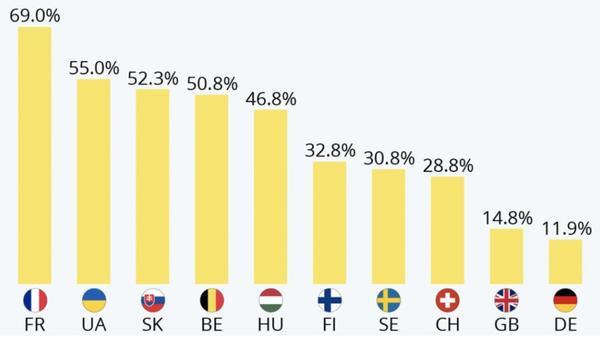
  • These are the countries most reliant on nuclear power.  Must only include Europe, for the USA is not shown, for we are at 19%, which is 1% less than from renewables.
  • Total worldwide offshore windpower capacity = 35,300 megawatts.  With UK at 29% share China 28% and Germany 22%.  The 1200 MW Hornsea Project of the UK is the largest.  Here is where offshore windpower looks good...the dark redder the better.
  • Heatwaves:

  • Britain recorded its highest temperature ever (40.2 C, or 104.4 F), and Portugal did, too (47 C or 117 F).
  • China: heat and flooding are forcing masses of people to relocate ... and a museum roof melted.  Portions of the country are facing unprecedented temperatures.
  • Northern India: In May, temperatures reached 49°C (120°F), a record that has been broken many times since.
  • The heat wave in Japan is its worst on record (in terms of heat, intentsity and duration).
  • Texas: Extreme high temperatures are straining ERCOT.  What is ERCOT?  I think Electric Reliability Council of Texas.

  • Communities that replace dark surfaces — like streets, rooftops, playgrounds and parking lots — with lighter and cooler alternatives can lower "heat island" temperatures by 5°F, and the overall total can feel up to 15°F cooler.
  • We just passed that mark,: July 28th is Earth Overshoot Day
    , the date each year when humanity has used all the biological resources that Earth regenerates during that year.  In 2021, Earth Overshoot Day was July 29th.

  • Valero Energy Corp, Marathon Petroleum Corp. and Phillips 66, the three largest independent refiners in the U.S., will set all-time cash records for the third quarter of this year.
  • Because the value of the Yen has dropped, the price of oil this year shows an increase of 70% in Japan.  The USA?  Only +40%.
  • Bad enough that there is a lot of methane leaking out of home appliances, but recent research has detected 21 toxins/carcinogens like benzene and hexane from natural gas.  However, this risk is less than from secondhand smoke from cigarettes.
  • People in Texas might not realize it until they see their electricity bill, but the price instantly jumped for short periods up to $4/kWh this summer.  The usual price is from 4 cents to 7 cents / kWh.  Hawaii is as bad as it gets with a range of 30 cents to 40 cents/kWh.
  • Think you're having a hot summer in Phoenix?  Be thankful that you can remain comfortable.  The annual per capita income in India is about 91,000 rupees ($1183).  The average cost of an air conditioner (that is, the electricity cost) is about 22,000 rupees ($286)/year.  That is about one-fourth of their annual income.
  • I can go on and on....but enough is enough.
The beauty of mathematics:


Day 15 of Blood Lily batch 1, Day 2 of BL2 and BL 3/4 on lanai:

-