Total Pageviews

Thursday, November 27, 2014

FALL CIRCLE PACIFIC ADVENTURE: Day #24B--A Kinki Blue-Fin Tuna Future


The world record for bluefin tuna is 1496 pounds, caught off Nova Scotia. Last year Kiyoshi Kimura paid $1.75 million just for one 489 pound bluefin tuna.  That's $3600/pound.  Sashimi is a must for the Japanese on New Year Day, and this was one way for a restaurant to entice and reward regular customers.  These two pieces of sushi need to command a price of $450 to cover expenses.

However, the Pacific blue fin is close to extinction, as the drop from the baseline has been 96%.  Further, the vast majority of those caught are below 2 years old, when they haven't yet reached reproductive capability.    Yet, while at one point endangered, NOAA does not consider the Atlantic bluefin tuna to warrant species protection, for regulation seems to be working.

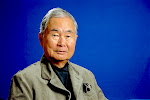
I've long been following the research to close the growth cycle for the Pacific Bluefin Tuna, and  Kinki University, with their two main campuses located in Osaka, is the world leader.  On an afterthought, I just made an attempt to visit with Tokihiko Okada and Hidemi Kumai (left), pioneers who have been conducting this work since 1969.  My butler at the St. Regis eventually succeeded in helping me contact one of the staff, Dr. Keitaro Kato, but we couldn't work out a time to meet during my short stay.  Kinki also has a research lab growing this tuna at Kushimoto in Wakayama Prefecture:


.
Called honmaguro, or true tuna, the bluefin variety is especially treasured in Japan, and is why too many were caught.  The annual catch is now down to 45,000 tons (20,000 tons is the sanctioned max, but it is feared that 60,000 tons are actually being annually caught), about a 50% drop during the past decade.

Farmed fish in general now account for 42%, up from 13% in 1990.  However, 56% of shrimp and 99% of oysters are aquacultured.
Dr. Kumai, in particular, has now been at this for half a century, and their team did close the growth cycle for bluefin tuna.  However, simple fireworks can kill off a bunch, and they lost 2000 babies once when someone just turned on the light.  That 11March 2011 Great Tohoku Earthquake 400 miles away killed 10% of their brood.  As disappointing as their success rate might be, for only one in a hundred survives to any kind of maturity, in the wild, only one in tens of millions becomes an adult.

Interestingly enough, the two companies most involved with the coming commercialization of farmed bluefin tuna are Toyota and Mitsubishi.  The latter has already cornered 40% the world bluefin tuna market.  Toyota is the corporation involved with commercializing Kinki University's farmed bluefin tuna.  A key breakthrough occurred in 2002 when Kinki achieved a complete farming cycle, and as early as 2009 was alreading shipping 40,000 artificially hatched young fish a foot long to local farmers.  One of these aqucultural companies in Nagasaki is called Tuna Dream Goto:


I am attempting work out a cooperative program for the Kinki bluefin tuna entrepreneurs and researchers to utilize the Pacific International Ocean Station in their future plans, for the open ocean is the ideal environment for their commercial operations.

My next posting will be really kinky!  But as I'm now in Osaka, the headquarters of Kinki University and the home of Yu-chan, what about the prospects of the whale shark being aquacultured to replace beef steaks, and maybe even turkey on Thanksgiving?

-


FALL CIRCLE PACIFIC ADVENTURE: Day #24A--Hiroshima Peace Park


On 16August1945 Little Boy was dropped over Hiroshima by B-29 Superfortress Enola Gay:

Of that 64 kg (of U-235), only about 1 kg actually underwent fission. The other 63 kg of uranium were vaporized and sent spewing into the atmosphere over Hiroshima. And of that 1 kg that fissioned, only about 0.6 g--roughly the mass of a penny--was actually converted into energy. The other 999.4 g were fission products, again spewed out in the massive fireball created by a penny's worth of E=mc2.

This Atomic Bomb was less than 3000 times as powerful as the Hydrogen Tsar Bomba of Russia in 1961:


Thirty one Little Boy assemblies were built by 1947.  Nagasaki's Fat Man was named after Sydney Greenstreet (left) from the movie, Maltese Falcon, while Little Boy (right below, Elisha Cook) also came from that film.

I have long wondered how Nagasaki and Hiroshima can be safe when Plutonium and Uranium have half lives of hundreds of thousands to a million years.  Hiroshima, for example, has to account for 141 pounds of highly radioactive U-235, which has a half life of 704 million years.

Here is the answer, from my Huffington Post article (which was a consensus summary of a dozen colleagues in physics and engineering) of April 13, 2011:

     Why worry about Fukushima when Hiroshima and Nagasaki are safe?

For an Atomic-Bomb, the Uranium and Plutonium half-lives are so long that there is almost no radioactivity to affect humans.  For Chernobyl and Fukushima, the dangerous radioactive elements are not Uranium nor Plutonium, but Cesium-137, which has a half-life of 30 years, Iodine-131 of only 8 days and Strontium-90 with 28 years.  Both Fukushima and Chernobyl will be barren for hundreds of years.  Nagasaki and Hiroshima are today thriving cities.

So is nuclear warfare safe and nuclear power plants dangerous?  The former is certifiably terrible, and the latter, potentially worse.  Anyway, I visited the Hiroshima Peace Park today:


The A-bomb Dome was the Hiroshima Prefectural Industrial Promotion Hall, and was not vaporized because the hypocenter was 160 meters away.

The day before Thanksgiving, the Dow Jones Industrial Average broke its all-time high for the 30th time this year, up 13 to 17,828.

-

Wednesday, November 26, 2014

FALL CIRCLE PACIFIC ADVENTURE 2014: DAY #23--Nagasaki


From HORROR can come BEAUTY.  I've long wondered, though, why both the Nagasaki and Hiroshima Peace Parks chose to emphasize the best of humanity to contrast with the worst of war.  Yes, there is that A-Bomb Dome in Hiroshima and a wall of a demolished cathedral in Nagasaki, but most visitors probably come away impressed at how beautiful these parks are.

At 11:02AM on 9 August 1945 Fat Man was dropped over Nagasaki, exploding 500 meters above this monolith, decimating the city, killing and injuring 150,000.


Ironically, the grandest church in all of east Asia, Urakami Cathedral, was below this hypocenter.


The commanding piece of art is the Peace Statue:


The statue's right hand points to the threat of nuclear weapons, while the left symbolizes eternal peace.  The park is a permanent international outdoor art festival, with contributions from all over the world.  Here, the Maiden of Peace from the People's Republic of China;


The Fall colors were also prominent:


While certainly beautiful, the Spring Sakura setting might be even more dissonant, for here is that same epicenter in April:


Well, I've become a peace monger in my old age, evidenced by some of my Huffington Post articles and my #2 ranking to Ron Paul in a U.S. News and World Report Debate Club poll.  But we all need to eat, so for dinner I asked my hotel what was the best tonkatsu (breaded deep fried pork cutlet) restaurant in close walking distance. I was not disappointed:


In fact, I was impressed.  I can very highly recommend Hamakatsu in Nagasaki.  I can't understand why L&L and Zippy's in Hawaii can't prepare anything close to what might be Nagasaki's gift to high cuisine.

A word about my hotel in Nagasaki, called the Richmond.  This is a chain you can find throughout  Japan.   On check-in a staff member takes you to a machine, where you pay the cost for the night.  Sounds like a businessmen's hotel, but my room is large enough, with a queen size bed, largish flat-screen TV, place is relatively new, free coffee-making, free toothbrush/razor (in fact, same brand as that provided in the Tokyo Ritz-Carlton).  While not heaven, I'm paying TEN TIMES less than I did at the Tokyo Ritz-Carlton.  However, I won't be back because a cab ride each way to the Nagasaki Station is around $10, and I usually stay at a JR hotel attached to major train stations.

-

Tuesday, November 25, 2014

FALL CIRCLE PACIFIC ADVENTURE: Day #22B--Hajime...Food from Planet Earth


For Yu-chan, the new Osaka whale shark, scroll down to the next posting.  Today, I have two entries, the second on Hajime, a French restaurant in Osaka.

Hajime Yoneda is a computer engineer from Kinki University, who, while tolerating his job, began taking cooking lessons, then moved to France to become an artist and chef.  He says:

I am interested in the balance, harmony, mystique and spirituality that exist in the universe.  After the Big Bang, the earth was born in the universe and life was born on earth. Human beings were born and evolved. People exist based on a miraculous balance. I feel the mystique of the universe in gastronomy.


Hajime ranks #42 on Pellagrino's Top 50.  In the past I could not dine here because a single customer was not admitted.  Plus, no photos could be taken.  However, perhaps they are opening up, for the St. Regis not only was able to obtain a reservation, but permission for me to take photos.  According to Pellagrino about Yoneda:

Stunning service and fabulous French food from a philosophical chef


The restaurant only holds 16 or so.  I ordered their 16 course special plus half-size portions of the accompanying nine wines.  Each course features some aspect of Nature.  The first, for example, was Forest, a consommé:


I could only take photos of three courses, for the chef wants diners to be surprised.  I should have told them that the odds of someone reading my blog coming here are nil.  The first wine was a white from Hokkaido using a German grape, Kerner, from Takizawa Winery.  The rest of the meal:

  • Life:  roe/flatfish/black olive
  • Rocky coast:  oyster/kelp/mussel/sea urchin/etc
  • River:  salmon/roe/miso/mango/sorrel
  • Planet Earth:  a large salad of perhaps a hundred vegetables on a giant plate:

Note that the wine is a New Zealand Reisling, and the winery is owned by a Japanese, Sato.  The next course came with a sake (Junmai Daiginjo from Kyoto)
  • Sea-flow:  gingko/peas/etc
  • Sea-relation:  scallop/uncured ham/quail's egg/day lily
  • Destruction and assimilation:  foie gras/pumpkin/et, which came with a 1998 Chateau d'Yquem

It's a shame I can't show you each dish, for the artistry was exquisite, better than DOM's Chef Atala, who also features natural products and the concept of sustainability.
  • Hope-dew:  a pine sherbert
  • Hope-sky:  a fabulous duck ensemble
  • Hope-Mother Earth:  an equally exceptional lamb with black garlic, etc
  • Harvest-ripen:  almond/persimmon
  • Harvest-aki michiru:  chestnut/pear
  • Love:  strawberry/raspberry
I should mention that also served were:
  • Clos de la Roche for the duck
  • Trevellon for the lamb
  • Nechi Watanabe Junmai Ginjo from Niigata
  • Rose d'un Jour, a sweet rose
Then, the final course:


Looks like a small cloud, but that is cotton candy to the left.  I couldn't finish this assortment.

This was no doubt my best meal on this trip, and possibly in the top three of my life.  I was able to photograph Chef Hajime at work in his kitchen:


Perhaps the highlight of the experience was Ai, who explained each rainfall, cloud formation, etc, evocative of the dishes:


As I was leaving, Chef Hajime came by to wish me goodbye:


The Chef and Ai then walked me out to my waiting taxi.  I can highly recommend Hajime in Osaka to my Chaine des Rotisseurs (a gastronomical society created in the year 1248--not a typo) epicureans.

-

FALL CIRCLE PACIFIC ADVENTURE: Day #22A--Yu-chan, Osaka's Whale Shark

Of all the coincidences, the name of Osaka's whale shark coincides with Pearl's Japanese name:  Yu-chan.  Here is a video of her.  Some photos:


Two years ago I wondered where they were.  Now there is Yu-chan.  It is a bit sad, though, that she circles the tank once/minute and lives an all too boring life.  On the other hand, there are no predators, secure source of food, ideal living conditions and a loving audience.

The thickness of the acrylic panels is just about a foot.  A few other inhabitants:


Pals:


There were hordes of young schoolchildren:


My dockside snack cost $6:


From the outside:


A large ferris wheel (369 feet high, $6 or so) at the entrance:


The fall colors in Kansai appear closer to peak.  Kansai is the region that includes Kyoto, Osaka and Kyoto, while Kanto surrounds Tokyo.  Interesting that in Japan, you walk and drive on the left.  However, in Osaka, anyway, on an escalator, you stand to the right so others can pass you on the left. In Tokyo, you stand to the left.  Kansai has around 17 million people, while Kanto is about double that. 

-