
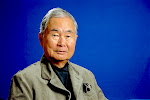
- Homo sapien
- male
- roots with ancestors from Toyama and Hokkaido
- mostly from Honolulu, with several years each in Palo Alto, Naalehu, Baton Rouge and Washington DC
- degrees in chemical engineering
- epicurean in cuisine and travels
- mediocre golfer and serious TV sports fan


But for nearly half a century I have mostly been an engineering professor and university administrator for the University of Hawaii. I've worked for the Lawrence Livermore National Laboratory in laser fusion, but I'm certainly not a fusion engineer. Same for the NASA Ames Research Center on SETI, so I'm not an astrophysicist.


 It all began in 1972 when I earned my PhD with a dissertation entitled Tunable Organic Dye Laser Irradiation of Escherichia coli. Read all 180 pages of this tome if you have any particular interest in this subject, or 5 pages in Applied Microbiology. In short, I constructed a tunable laser from scratch (when you couldn't buy one), built a microreactor to either sterilize or catalyze the growth of that bacterium, and got interesting results ranging from sterilization to catalysis depending on the exogenous photosensitizer and laser wavelength.
I subsequently joined the University of Hawaii College of Engineering and 46 years ago had my first research project: partially funded by the Electric Power Research Institute to feed power plant effluent (the carbon dioxide) to an algae raceway. Here I am at a subsequent facility at our Hawaii Natural Energy Institute (HNEI) operations at Look Lab, developed by Oscar Zaborsky.
 There are two types of algae: macro (large, like kelp) and micro (tiny, like Haematococcus pluvialis, right, from which comes astaxanthin, which returns at the end when I take on my white rat role). Note the blood red color, which comes from astaxanthin.
Then, of course, there is algae that grow in freshwater and those that survive best in the ocean. The field of freshwater algae has been well-studied. Marine algae remain mysterious, and I was intrigued by the potential. According to a colleague at the University of Hawaii, Jaw Kai Wang, the gallons/acre of oil you can produce from the following crops separates marine algae from standard feedstocks:
o Corn 18
o Soybean 48
o Sunflower 102
o Palm oil 635
o Marine algae 10,000
o Soybean 48
o Sunflower 102
o Palm oil 635
o Marine algae 10,000

 For the record, we also did some macroalgal research, and thought that artificial upwelling (using the OTEC process to provide fertilizer and cooler temperature) showed considered promise. A marine biomass plantation would be one of the bioproducts from the Blue Revolution.
 The Journal of Marine Biotechnology was founded by friends of mine in Japan, primarily Shigetoh Miyachi and Tadashi Matsunaga, who served as the original editor. Assisting him was Grant Burgess, who was a post-doc in Matsunaga's lab at the Tokyo University of A&T. The paper I spearheaded on Marine Macrobiotechnology was the only American entry in the charter issue of this journal, providing, like this posting, an umbrella view of this field. Matsunaga went on to become president of his university, and is now head of the Japan Agency for Marine-Earth Science and Technology. Burgess is running his own marine biotech lab at Newcastle University. The three of us are noted for our lack of golf skills and minor competence in karaoke.
 The most distinguished research project HNEI ever won was a national competition, where the National Science Foundation promised to provide $25 million over five years to our Marine Bioproducts Engineering Research Center, making Hawaii the national center for marine biotechnology. I soon thereafter retired, but chaired the Asia-Pacific Marine Biotechnology Conference held in Honolulu.
 Most university professors stick to academics. I actually started a marine biotech company, then later served on the board of a start-up company.
I created Rainbow Pearls International with various colleagues around the world, including Matsunaga and Burgess. We figured out a way to color the white akoya pearl to produce a rainbow of colors, including Kelly Green, Chinese Red, etc. If you're at the University of Texas, we can produce a Burnt Orange pearl. The company is dormant, but could will be re-activated when major funding is received. The core symbol for my SIMPLE SOLUTION books might well be ideal for this company.
In the mid-1990's:

... I joined the Hawaii Biotech board, we hired David Watumull, and twenty years later, they seem, with spin-off Cardax, to be just about ready to make a profit on astaxanthin to remediate inflammation. Unfortunately, all my stock options are so diluted as to be negligible...I think.
 Now, a quarter century later, I come full circle. First I abhor pill-taking. However, I went to see a knee doctor last week, and he recommended cortisone shots followed by a vigorous (and very painful) therapy program. I abhor pill-taking, but hate more injections and pain. So a friend recommended that I try Zanthosyn (which is astaxanthin) by Cardax as a natural way to remediate my problem.
 Two pills after each meal add up to 180 pills/month. Went to GNC and bought four 90 count bottles, which should have cost $240 plus tax, or around $120/month. However, it was on sale so I only paid $186, or, effectively, $93/month if I continue this for any length of time.
 I should have checked with my doctor first, for I'm sure he would have warned me about a few things. I got a huge scare when a few days later I thought I saw blood in my excrement. Worried for a whole day, then remembered that astaxanthin was fed to farm-bred salmon to provide the pink color. Thus, this pill must be red. Yes, that was the problem, I hope. So my role as a white rat or guinea pig continues. If this effort fails, then on to cortisone and vigorous therapy.
 The Dow Jones Industrial Average again broke it's all-time record today, rising 31 to 27,493. Why? Must be Kurt Suzuki of the Washington Nationals wearing Trump's Make American Great Again cap. Otherwise, perhaps there is optimism about U.S.-China trade talks. Oil hit a six-week high.
-



No comments:
Post a Comment