Total Pageviews

Showing posts sorted by relevance for query sendai, wagyu beef. Sort by date Show all posts

Friday, November 22, 2019

YOKOHAMA TO SENDAI

In planning this one week Japan Rail Pass itinerary, the primary requirement was maximization of Fall colors.  However, Sendai, I thought, would be a bit too north to be optimal.  However, the attraction was our favorite Japanese Wagyu Beef restaurant, named Iseya in the Sendai Station basement.

I had a minimal Sheraton breakfast:


Bullet train (Shinkansen)::


There wasn't much color from the train:


We arrived in Sendai and went for late lunch / early dinner at Iseya:


You can purchase these steaks for $93/pound.  Unfortunately, I mis-ordered and somehow got both the wagyu beef and wagyu tongue.  On a  trip to Sendai five years ago I mistakenly ate beef tongue and did not realize until the next day what I had.  It tasted almost like beef but was crunchy.  I still feel a blob of Sendai beef tongue above the pit of my stomach...five years later.

So, anyway the beef tongue is that plate at the top of the photo below, next to the pork tonkatsu, which was not quite as good as the Nagasaki variety:


On  the walk from the station to the Sendai Westin, I was surprised that Sendai still showed a lot of Fall color:


Gingko trees outside the Westin, and the hotel below:


One view from our room:


The Club Lounge at the Sendai Westin is more dignified than that of the Yokohama Bay Sheraton, but the food and drink offerings are not as generous.  Plus, I just had this wagyu meal a couple of hours ago.  But this was my final snack of the day.

The view from the Club is awesome.  While we somehow got the best table of the house, where I took the photo to the left, the place got filled by the time the drinks became available.  The food was pu-pu style...no real dishes of prominence, and the gin martini was totally dry.  That is, no white vermouth.  However the ambience, sights and discussion made this evening memorable.


Tomorrow, another 3-train itinerary, from Sendai to Matsumoto, where I hope to see Pearl's Gold Koi,

-

Friday, December 6, 2019

JAPANESE CUISINE

There is traditional Japanese cuisine and the modern version.  Those who are moderately familiar might recall Washoku, based on rice, miso soup, sashimi, pickled vegetables and a variety of small dishes.  Then there is Kaiseiki, featuring dainty and artistically arranged works of art, derived from the Imperial Court, Buddhist temples and samurai times.   While Japanese food originated in China, more recently there has been a mix of international influences, the dominant one being French.  The best fusion restaurants feature Japanese chefs who trained in those foreign countries for a decade or so and returned home to start their own.

The gastronomical standard is Michelin.  There are 137 3-Star restaurants around the world, with leaders being:
  1. 32  Japan
  2. 27  France
  3. 14  USA
Interestingly enough, Paris has 134 total stars, while Tokyo has 304, when you include all 1-, 2- and 3-Star restaurants.  For a French publication to so honor Japanese cuisine is indeed extraordinary.

On my previous trip to Japan I dined at Joel Robuchon, which got a Japan 3-Star ranking in 2008, the year Jiro also was so honored.  Alas, because he is so popular, this sushi bar does not take reservations anymore, and lost a star this year.  It was seven years ago that Jiro personally served me.  I paid $350 for 18 sushis and a large bottle of beer.  Today, a set costs 40,000 Yen, or just under $400, plus liquor.

The other international rating steeple is Pellegrino.  They have a Best 50.  I've dined at #2 Noma and #4 Gaggan and a dozen others, including #22, Narisawa of Tokyo.  Chef Rene and Chef Gaggan, each to my left.  It was cold in Copenhagen:


But back to Japan, the ultimate is Wagyu Beef.  The best comes from Miyazaki, and I try to go there annually, as I have for the past two decades or so, for they now also feature locally raised sturgeon for caviar, while their mangoes have just about replaced musk melon as the ultimate fruit gift in the country.

About wagyu, a typical supermarket price is $250/pound for the best cut.  So the reality is that the lowest possible cost of a one pound steak meal of this beef must be at least $500.  

However, this article purports to suggest that you can find affordable Kobe beef in Kobe.  First, it says go to lunch, for dinners are double the price for almost the same thing.  Second, seven restaurants for less than $50 are listed.  The catch is that nowhere is the amount of beef listed.  

Sure you can get wagyu for that price, but the weight of the meat is less than a quarter pound, if that, and the quality is probably low.  Here is an explanation.  The best is A5.

The restaurant we go to with regularity is Iseya in Sendai.  Surely, each piece must be around half a pound.  Yet, the whole meal costs 8000 Yen, or $73.  

I might add that not only is wagyu exceptional in taste, but is almost healthy.  To quote:

Wagyu beef has been likened to olive oil and salmon in terms of its health benefits. It has up to 300% more monounsaturated fat than normal beef due to the high marbling of the meat, as well as incredibly high omega 3 and 6 content.
Wagyu beef has the lowest cholesterol levels of all meats, even lower than fish or chicken, and it contains oleic acid which is considered good for your heart. It’s also believed to have anti-carcinogenic properties. 
-
Super Cyclone Ambali has strengthened to 155 MPH with a track towards Madagascar, but Mauritius and Le Reunion are also in danger.  In addition Tropical Cyclone Belna has developed, headed straight for Madagascar:


-

Monday, April 28, 2025

OCEANIA RIVIERA: Sendai to Hakodate

The Shinkansen takes around 3 hours to get from Sendai to Shin-Hakodate.  A car, perhaps 8.5 hours.  Our cruise ship leaves Sendai at 3PM and is expected to arrive in the Port of Hakodate at 7AM, or 16 hours later.  Our ship would need to cruise at 22 MPH.  The Riviera's top speed is 23 MPH.

The largest cruise ship today is the Icon of the Seas.  She has a top speed of 28 MPH.  The Titanic could just about reach that speed.


The Oceania Riviera was supposed to depart at 3PM, but instead left at 2:50.  So this is the only photo I took.

Sendai is a special place for me.  I have stayed at the Sendai Westin at least ten times.  Photo to the left, sunset from the Executive Club.  The room price now is around $350/night.  I remember a few months after the 11March2011 Great Tohoku cataclysm, with the Fukushima damaged nuclear reactors only 50 miles away, I only paid $45/night.

  • 2012:  In April, 13 months after the Great Tohoku disaster.
  • 2014:  Beef tongue.  I thought I had ordered steak.  This meat was crunchy.  Then I realized what happened.  I still feel the tongue in my intestinal track.  Sendai is especially noted for beef tongue.
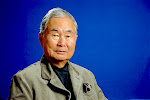
  • 2017:  Here am I in the lobby of the Westin Sendai.
  • 2017:  Later in the fall, I returned, went walking, shopped at Daiso, and bought all those items below...for a grand total of $7.56.
  • 2019:  Iseya, a restaurant that specializes in wagyu beef, is a spot I always have lunch.  Is located in the Sendai Station.  They sizzle the wagyu close by so you can smell and hear it all.
  • 2023:  Here is the Westin Sendai below.

I have made around a dozen Japan Rail Pass trips, and almost every time I go north, I stop in Sendai.


But back to the Oceania Riviera, Adam Tanner gave his second lecture on Japan, featuring the reign of General MacArthur from 1945 to 1952.  All totally new to me.

  • Tanner shared facts few know about the reign of the Supreme Commander of the Allied Powers, General Douglas MacArthur.  For example, how dedicated he was, and yet so isolated.  It would take me too long to list everything.

  • One key point was that he went against popular American opinion, and maintained the role of Emperor Hirohito for a more peaceful and successful occupation, and for the overall stability of Japan.  Many felt that Hirohito was complicit with leaders like General Hideki Tojo, and should have been executed.
  • You can read all the details about MacArthur's seven years in Japan.

Here are some facts you might not have known about General MacArthur.

  • His mother came from a Confederate family.
  • Only Robert E. Lee, leader of the Confederate, surpassed MacArthur in West Point performance.
  • He was president of the American Olympic Committee for the 1928 Summer Games in Amsterdam.
  • During 1933, he was tasked by FDR to mobilize 300,000 in the Civilian Conservation Corps.
  • He promoted a nomination as a Republican nominee to run against FDR in 1944.
  • Was fired by President Harry Truman on April 11, 1951.  On April 19 he gave a speech to a joint session Congress, where he was interrupted by 50 ovations, and closed with:  Old soldiers never die; they just fade away.  MacArthur was more popular than the president, and received a ticker tape parade the next day.
  • The MacArthur Bowl awarded to the top college football team?  Named after him, and the 25-pound trophy is shaped like a football stadium, featuring his quote:  There is no substitute for victory.

Went to Terrace Cafe, a buffet, for dinner.  They had a sushi/sashimi bar.

We just arrived in Hakodate.  It's raining.  
We are getting ready for our first tour from this ship.  Tomorrow, our visit to this city on Hokkaido.

-

Monday, April 29, 2019

TTT2019: Day 39--Batteries and Wagyu

Now what could possibly be the connection between batteries and Japanese wagyu beef?  Well, today, nothing.  Two disparate subjects that ended up being the foci of this posting.

Noticed in a recent Japan Times that Elon Musk is fighting Panasonic, supplier of all the lithium-ion batteries Tesla uses.  Why doesn't Musk just make his own batteries?  Well, Panasonic owns the major patents.

This tiff reminds me of the lawsuit Stanford Ovshinsky won over Panasonic, Matsushita and Toyota almost two decades ago regarding his nickel metal hydride battery.  Unfortunately, ECD never was able to significantly cash-in on the NMHi battery, possibly because the American auto industry, especially General Motors, dreaded the coming of battery vehicles, and essentially killed the technology

But Stanford and Iris lived quite a life in Troy, Michigan.  He passed away in 2012 at the age of 89.  More than a third of a century ago, his company wanted to ease him out and asked if he could fill a chair within the Hawaii Natural Energy Institute if they provided the supporting funds.  I tried, but having never even graduated from high school, that did not work out, for universities are so elitist.  We did, however, become close friends.  Stanford was a prolific inventor, with 350 American and International patents.  Iris had a PhD in biochemistry, and they formed a wonderful partnership.  

The one passion Iris and I shared was on our search for blue-colored flowers.  We both felt that the BLUE rose Suntory developed was not blue, but lavender.  Incidentally, it was announced that a blue tulip has been created.  I don't think so.

Incidentally, wonder what will be the next battery?  I'll tell you.  The lithium battery will be the final major version.  Why?  Its place in the chemical table.  There is no other element capable of replacing lithium.  You will read about nanotechnology, nanowires, graphene, liquid electrolytes, and super capacitors.  However, all of them still will use lithium.  Lithium itself cannot be re-cycled, but there should be enough for the next few decades.

However, watch out for the fuel cell, as Japanese motor companies are already investing a lot of time and effort for something that won't come until 2030 or later.  On the basis of size and weight, fuel cells will take a car at least twice as far  as batteries, and probably more.  That graph to the left shows that, on a specific energy basis, hydrogen beats lithium 236 to 1.  The problem is that hydrogen today is too expensive and the platinum electrodes are not ideal.  I still think that the direct methanol fuel cell is the next bridge to the hydrogen economy.  Read my HuffPo of a decade ago.

Well, that's enough education for now.  Today, we caught the bullet train from Morioka to Sendai.  A typical scene as our train whizzed by at almost 200 MPH.  A bit fuzzy, but consider the speed.


In Sendai, we decided to go back to the same wagyu beef restaurant, Iseya, we experienced three weeks ago:


Above, brothers Makoto and Hirotomo Matsuzaka, who run the place.  What a name, for Matsuzaka wagyu is right up there with Miyazaki, although you really couldn't really tell the difference with Sendai wagyu.  Our meal:


You ask, where is Mystery Lady?  Well, she had the same order, and we both agreed that this was the best lunch we had on this trip, although our two meals with those three Seoul Mystery Ladies certainly are up there with the best.

The night before we leave for Hawaii, Robuchon, located across the street from the Tokyo Westin, where we'll stay tomorrow.  Robuchon is a Michelin 3-Star restaurant.  Paris only has nine of them.  Tokyo now has 19 and 230 with at least one star.  

Seems extravagant for a retired person to eat so well, but the fact of the matter is that, if you don't count train bentos, I think I've only paid for six meals in almost forty days of travel.  How so?  The Starwood Hotels I've been staying in all had fabulous breakfast buffets and an executive club with free food and drinks.  Like the Sendai Westin:


That was my entire dinner?  Yes, with a Kir Royale.  You saw my lunch today.

-