Total Pageviews

Friday, April 26, 2024

MYKONOS TO PIRAEUS

We are still in Mykonos, and I see only a clear sky...

...and we should be in the path of the dust cloud from Libya that cast an orange hue to Athens where we will be tomorrow.

Here is an excellent link to Mykonos, which has about 1.5 times the area size as Manhattan.

Mykonos is that island for superyachts, supermodels and superstars, with an unrivaled nightlife, and island that never sleeps.

  • Named after the grandson of Apollo, Mykonos.
  • It is here that Zeus and Hercules fought the Titans, and these giants are said to be buried at Houlakia Bay.  The beach is so sacred that you can't remove a single pebble.
  • There are 4 nudist beaches. No real rules, but read this.  
  • From the 1980s has been a gay friendly spot, especially catering to the LGBT community.
  • Only 31 taxis. but 800 churches and 200 bars/restaurants.
  • While Mykonos was discovered by the famous and wealthy in the 20th century, way back in 250 BC, the rich sent their family to stay there during the summer months.
  • The most famous islander is Petros the Pelican, who is replaced as necessary.
  • In earlier days there were Mykonian pirates, but they also served to protect islanders.
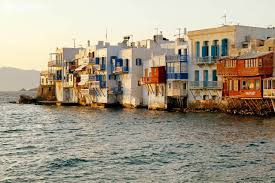
  • Houses have a strict color code, requiring door and windows to be painted blue, green or red, with the houses in white.  Reflects light in the summer.
  • A lot of donkeys.
  • Use of motor vehicles is forbidden in Chora, the main town of Mykonos.  You can use a ferry to bring your car and drive around the rest of the island, but parking can be a problem.
  • Has 15,000 permanent residents, but 4000 of them are foreigners who come only in the Winter.
  • However, during the summer you might find 50,000 tourists.There are 70 county fairs from June to September.
  • Little Venice is where jet setters play.

Piraeus has a total population of 168,151.

  • Founded in the early 5th century BC.
  • Chief port of Greece.
  • Our ship lands there, and we immediately will go to the airport and on to London, where we will await in Southampton for the Queen Mary II.

Final meals on the Voyager.  Roast pork, salad and hamburger with rosé wine and beer.

So anyway, we did arrive in Mykonos yesterday.
Tender to port.
On Regent Seven Seas they allow you to order full bottles of alcohol for your room, and the fruit bowl is always full.
Tomorrow we go from Piraeus to the airport, and catch Aegean Air to London, then a bus to Southampton, and next, after a stay in this city, the Queen Mary II to New York.

-

Thursday, April 25, 2024

TURKEY TO GREECE

But before more from the Regent Seven Seas Voyager, the continued travails of Donald Trump news.  

Light lunch of salami sandwich, salad and garlic vegetable soup, with rosé wine and beer.
An assortment of dessert items.
We departed Istanbul for Mykonos.  
Had dinner at the French restaurant Chartreuse.  Ordered a mushroom truffle soup with beet root salad, followed by three more appetizers.
Mesclun salad, Truffle Soufflé and Foie Gras something or other, with a Raymond Cabernet Sauvignon.
We heard that there was a COVID outbreak on this ship, so we are now avoiding other passengers.  Did almost nothing else today, for I walked only 1854 steps.

What can I say about Greece that you don't already know?  So a few fun facts.
  • Made up of around 6000 islands, but only 200 are inhabited.  We're just stopping at one today, Mykonos.
  • Has 18 UNESCO World Heritage sites.
  • 80% made up of mountains.
  • No part of Greece is more than 85 miles from the ocean.  Piraeus, the cruise port, is about 5 miles from Athens.
  • More tourists (33 million) visit Greece than the entire national population (10.4 million).  With a population of 336 million, the USA has 51 million tourists.
  • The capital is named after the Goddess Athena, of wisdom and warfare.  Athens has a history of 3000 years, and is the oldest inhabited city in Europe.
  • Third largest producer of olives.  Some of these trees were planted in the 13th century and are still bearing fruit today,
  • Has more theaters than any other in the world.  After all, the art of acting and theater was born here.
  • There are more than 10,000 traditional dances.
  • Is one of the world's sunniest countries, with 250 sunny days, or 3000 hours, each year.  Some islands see 300 days.
  • There are more archaeological museums , 110, than any other country.
  • On the island of Santorini, there is an active caldera which is the only one in the world inhabited.
  • It is Graecia, not Greece.  Also, the official name of Greece is the Hellenic Republic, or Hellàs, or Hellàda.
  • Greek is one of the oldest languages still in use. Began 5000 years ago.  About equivalent in age to the India Tamil language, which is used by 1863 newspapers today.
  • Never on Sunday.  Everything but a few convenience stores is closed.
  • Greeks also believe in the evil eye, which is bad luck thought to be transmitted by a malicious glare.  However people wear jewelry of the evil eye to cast off its influence.  Not also that Cycladic house roofs are blue for this purpose.
  • In ancient Greece, a unibrow was considered a sign of both intelligence and beauty.
We arrived in Mykonos.

-

Wednesday, April 24, 2024

ISTANBUL IS TRULY FASCINATING

 I begin with departure from Izmir.  We had drinks in the observation lounge.  Piano player added to the atmosphere, which was serene and secure, yet stirring.

Then off to dinner, starting with Raymond Cabernet Sauvignon and Chardonnay.

Compass Rose is a classy and sprawling restaurant.

Tomato soup, Caesar Salad and Escargot.

Then Rib Eye Steak.

Ending with a soufflé.

Went to the theater for a broadway show.

Walked 4042 steps.

As the song goes by The Four Lads in 1953, but first recorded by Paul Whiteman and His Orchestra in 1928:


Istanbul was ConstantinopleNow it's Istanbul, not ConstantinopleBeen a long time gone, ConstantinopleNow it's Turkish delight on a moonlit night


The city proper was founded in 660 BC by Greek settlers, and called Byzantium.  

  • Yesterday I said that this the only city on two continents (Asia and Europe) and today has the largest population in all of Europe with 15 million.
  • In 324 AD, Roman Emperor  Constantine the Great made it his imperial capital, renaming it New Rome, or Nova Roma.
  • Six years later the city was changed to Constaninople.
  • The city fell to the Ottoman Caliphate in 1453.
  • Then move along to 1923 when Angora (now Ankara) replaced Constantinople as the national capital.
  • Officially, it was in 1930 that Constantinople became Istanbul.
  • Interesting, though, that the song mentioned above was written in 1928, before that date. So?  Don't know.
  • The names of cities change all the time.  Each has a different story, as for example New York from New Amsterdam and Saint Petersburg to Petrograd, then Leningrad.
  • Istanbul is now the most visited city in the world with 20 million foreign visitors.
While there are numerous reasons why Istanbul is so popular, two structures are especially monumental, Hagia Sophia and the Blue Mosque.
  • Hagia Sophia:
    • Built by Byzantine Emperor Justinian I in 532 as the Christian cathedral of Constantinople.
    • Converted in 537 to an Eastern Orthodox church.
    • Said to have changed the history of architecture, for it became the world's largest interior space (remaining so for a thousand years) and the first to employ a fully pendentive dome.
    • Converted to a Catholic church in 1204.
    • Became a mosque with the Ottoman conquest of Constantinople in 1453.
    • Served as a mosque until 1931 when it became a museum in 1935.
    • But again became a mosque in 2020, a very controversial decision, appreciating the state of religious fervor of the times.
  • The Blue Mosque.
    • Also known as the Sultan Ahmed Mosque.
    • Constructed between 1609 and 1617.
    • A major restoration took place from 2013, and completed a decade later.
    • There are a lot of stories about the six minarets.

We arrived in Istanbul, and our cabin was right next to all the activity.

April 23 is National Sovereignty and Children's Day in Turkey. It is a public holiday, and there were crowds everywhere.  We took a bus tour that drove us to the Asia side, then to the Hagia Sophia and Blue Mosque on the European side.

A telecommunications tower at 1211 feet is the tallest structure in Istanbul.

Faces in the crowd.

That's the Voyager in the background.

We stopped to walk through the Grand Bazaar:

  • Has 4,000 shops.
  • History dates back to the 15th century.
  • Draws up to 400,00/day.
  • Bargaining is a must.
  • Closed on Sunday, but open from 9AM to 7PM on other days.
  • Shopkeepers speak English.
Then off to Hagia Sophia and the Blue Mosque, the two perhaps greatest city landmarks that face each other, separated by Sultanahmet Park.  In fact, just around 5PM there were dual ezans (call to pray) from both, each trying to outdo the other, for their voices are strongly amplified by speakers.
Right in the middle of the two is the Obelisk of Theodosius, first erected around 1450 BC in Egypt, but moved to Constantinople by Roman Emperor Theodosius in 390AD.  These are the kinds of artifacts that will be demanded back by Egypt.  Most of these objects were simply looted, and there is movement to repatriate them back to ancient grounds the world over.  However, this will take time and a lot of resistance.  Perhaps a kind of middle ground solution can be worked out, such as a rental fee.
Istanbul is captivating.  This is my third or fourth time here, and I had a sense that this part of the world was too dangerous.  While that's probably true, I gained a new respect for this city.

Our ship was docked very close to the final stop, and when we returned, we stopped by to view a special showing of Turkish dances in the theater.
The show was about 40 minutes long, and belly dancing must have taken up almost half of the time.
So dinner again in Compass Rose.  They've all been great, and so was this one.
Sushi.
Duck.
Risotto.
Nw York Steak with Baked Potato.
Roast Pork.
Big walk day with 6545 steps.
We next head for Mykonos.

-