From Worldometer (new COVID-19 deaths yesterday):
DAY USA WORLD Brazil India South Africa
June 9 1093 4732 1185 246 82
July 22 1205 7128 1293 1120 572
Aug 12 1504 6556 1242 835 130
Sept 9 1208 6222 1136 1168 82
Oct 21 1225 6849 571 703 85
Nov 25 2304 12025 620 518 118
Dec 30 3880 14748 1224 299 465
Jan 14 4142 15512 1151 189 712
Feb 3 4005 14265 1209 107 398
Mar 2 1989 9490 1726 110 194
April 6 906 11787 4211 631 37
May 4 853 13667 3025 3786 59
June 1 287 10637 2346 3205 95
July 7 251 8440 1595 817 411
Aug 4 656 10120 1118 532 423
Sept 1 1480 10470 703 505 235
8 1700 9836 250 339 253
14 1934 9001 709 281 300
22 2228 9326 839 279 124
29 2190 8859 643 309 108
Oct 6 2102 8255 543 315 59
12 1819 7544 201 249 37
19 2005 7528 401 160 80
27 1594 8671 433 734 62
Nov 4 1207 7009 184 480 35
9 1524 7953 214 480 35
10 1493 8366 264 362 48
Summary: The World and USA seem to have plateaued in new deaths. The countries with the most new cases yesterday were:
- USA 94,376
- Germany 45,416
- UK 39,058
- Russia 38,058


First a bit of history:
- Name comes from Greek words hydro and genes, which together mean water forming.
- Robert Boyle of Ireland first produced hydrogen in 1671.
- Almost a century later, British scientist Henry Cavendish recognized it as a distinct element in 1766, and is the Father of Hydrogen.
- Edward Teller is known as the Father of the Hydrogen Bomb, and I worked under him when he was director of the Lawrence Livermore National Laboratory.

- Is at the head of the chemical table of elements with atomic number 1.
- The lightest element.
- 75% of normal matter and 90% of all the molecules in the Universe is hydrogen.
- There were no elements immediately after the Big Bang, with hydrogen first coming into being about 370,000 years later.
- Is mostly produced today through a process called steam reforming of natural gas.
- Hydrogen can also be generated through the electrolyis of water and a variety of other ways, including using a catalyst in water onto which sunlight is beamed and biological options.
- There are at least seven isotopes: protium, deuterium, tritium and others synthesized in the lab.
- Protium is 99.98% of all hydrogen, with a half life of 10 to the 34th power years
- Deuterium has a neutron added to the proton, and is 0.015% of all hydrogen. It is stable.
- Tritium is only one billionth of a billionth percentage of hydrogen, with a half-life of 12.32 years.

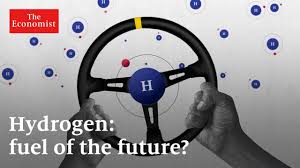
- Being 75% of all known matter, this must be a clue that hydrogen must be the fuel of the future.
- When combusted in air, the only product, if designed properly, is water vapor.
- The infrastructure is largely in place. Pipelines might need to be internally coated, but that expense is trivial compare to having to buy land, gain rights, satisfy permitting requirements and the like.
- Is the best gas to be used in a fuel cell, which is two to four times more efficient than battery or fossil-powered vehicles.
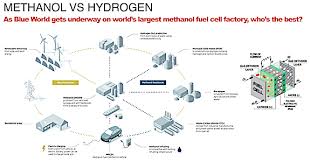
- Mind you, I still think a biomethanol fuel cell is the transition to ultimately using hydrogen.
- Hydrogen today is too expensive, and biomethanol can be produced from biomass though gasification and utilization of an efficient catalyst for methanol. This catalyst is not good enough today.
- Note that drag racers do best with methanol and space ships are launched using liquid hydrogen.
- About the danger of hydrogen and memory of the Hindenburg, NASA and the rest of the world have found a way to safely use liquid hydrogen, which should improve with experience. Remember that there have been 210 serious aircraft incidents and we still use jet fuel.
- Our Sun and all stars consume hydrogen to produce energy through a process called fusion.
- Uranium and plutonium for nuclear fission reactors are unsafe: radioactive wastes with long half lives, potential to make dirty bombs and major catastrophes. Fusion power using hydrogen, or Star Power, shows huge promise.
- However, ITER using magnetic confinement and the Lawrence Livermore National Laboratory laser fusion process seem today stymied, it will be a matter of time when the urgency will bring results and utility.
- Regarding the Search for Extraterrestrial Intelligence:
- There is a quiet band of the electromagnetic spectrum between 1420 and 1652 megahertz called the waterhole, which radio telescopes use to see out into space. The reason is that the hydroxyl radical spectral line and atomic hydrogen molecules absorb radio noises, making this band the logical extraterrestrial communication station site.
- NASA Ames Research Center discovered this waterhole.



- The First Energy Crisis occurred in Fall of '73, so that I ended up gaining leadership over the academic wind power program. Funds were found to send me to DC to seek funds the following year.
- My interest in hydrogen spurred me to stop off first in Miami to attend the initial gather of Hydrogen Romantics, which led to the field journal and semi-annual World Hydrogen Energy Conference. Nejat Veziroglu, who is now 97 years old, was the organizer.
- In 1980, I found myself working in the U.S. Senate and recalled what I learned in Miami. I was so inspired that I wrote the initial hydrogen legislation for the Senate, which led to the Matsunaga Hydrogen Act in 1989.
- In 1990 I chaired the World Hydrogen Energy Conference in Hawaii.
- Soon thereafter I became chairman of the Secretary of Energy's Hydrogen Technical Advisory Panel, which prepared The Green Hydrogen Energy Report, which served as the guide for a decade of Congressional hydrogen funding. This led to selection of the Hawaii Natural Energy at the University of Hawaii to become a National Hydrogen Center for Education and Research.

- During the summer of 1974 I co-directed a NASA-sponsored program on Earth 2020, directed by the Ames Research Center. I got to know the people there, so in 1976 was among 20 faculty members to work at Ames on the Search for Extraterrestrial Intelligence, a subject that most interested me because I thought that beaming in from space could well be the Encyclopedia Galactica, provided by an advanced civilization to engender peace, generate fusion power and so on. I like to think big.


- What About Free Hydrogen (Part 1)
- What About Free Hydrogen (Part 2)
- The Free and Clean Hydrogen Age (Part 3)
- The Free Green Energy Age (Part 5)
I can't seem to find Part 4, but I'll later enter it above if it exists.
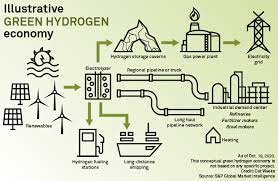
The Society of Electrical and Electronic Engineers is dismissive. But there is a reason. Electricity and hydrogen represent two competing energy interfacing alternatives. I've long felt that both will be necessary and best. Hydrogen can be complementary and should be more practical than batteries. For example:

The ETC’s Mission Possible report, Shell’s Sky Scenario, and the International Energy Association’s below 2 degrees Celsius scenario all show well-developed pathways to decarbonizing the hard-to-abate sectors, and those pathways all require substantial global hydrogen growth.
Power magazine reports on the bullishness of Siemens. Read this for a fair statement about Green Hydrogen. What are my views?

- In all the public hearings I chaired in the 1990's, most of the participants were too hopeful.
- A quarter century till today, it has not surprised me that there has not been much progress.
- A core of enthusiasts will always be around to provide a hopeful point of view.
- Global warming could well provide that catalyst to minimize the transition period for arrival of the Hydrogen Economy.
- If hydrogen airships and jetliners become prominent by 2050, the lowered cost of hydrogen should also favor fuel cell- over battery-powered vehicles.
- 2050 should also be around when fusion-power should begin to become available.
- Cold fusion? Maybe never, but the concept is worthy of continued investigation.

-