Total Pageviews

Monday, December 14, 2009

EROEI AND EROI

Energy Returned on Energy Invested (EROEI) and Energy Return on Invested (EROI) are equivalent terms. I sent the following to one of those virtual discussion forums:


Dear XXXy:


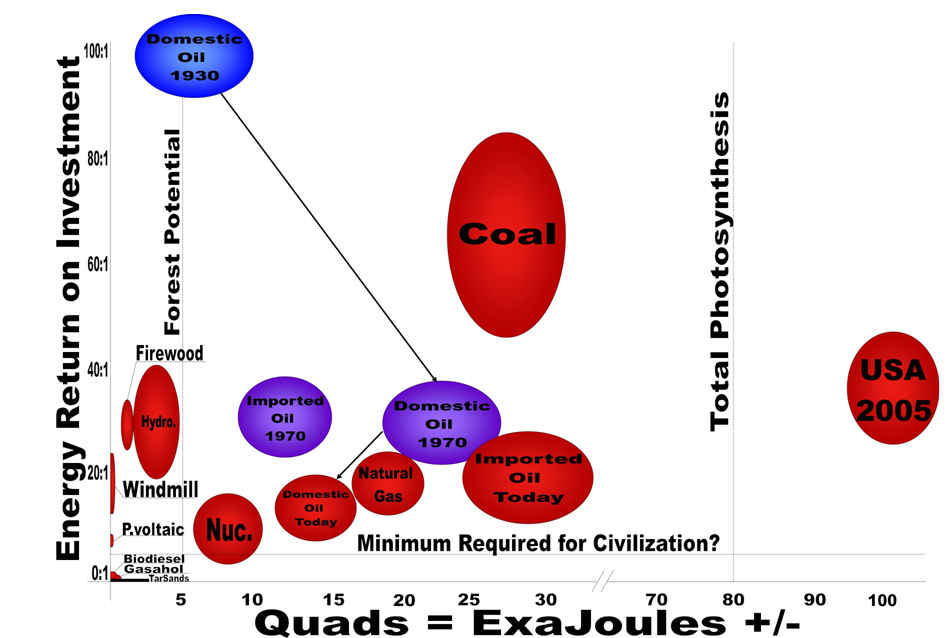
Yes, we do need to consider more than pure EROEI (which is, incidentally, used interchangeably with EROI--go to The Oil Drum), but here is a table which shows that renewable energy is, indeed, greater 1.0 (you need to look far to the left for them):


Note that windpower is slightly better than domestic oil today, on the order of imported oil, and quite a bit above "minimum required for civilization?" But is that 0:1 really 1:1? Plus, if there is no global warming, coal certainly looks attractive. Geothermal energy is about the same as wind energy (scroll down that Oil Drum article).


Here is another one:


The key numbers are on the x-axis. Note where nuclear is located. But all the above is from The Oil Drum. Here is another comparative analysis from the Encyclopedia of Earth:
Figure 3: EROI of various electric power generators.
What happened to coal? Anyway, EROEI numbers vary quite a bit and the field remains in transition. But the bottom line is that wind power and geothermal look okay, solar technologies seem almost marginal and biofuels look terrible, with, maybe, marine algae plus genetic engineering worthy of more research.

Aloha.

Pat

-
The Dow Jones Industrials jumped to a 14 month high today, up 30 to 10,501, while world markets were all positive, except for Japan. Gold increased $11/toz to $1127 as the dollar weakened, and oil remained just below $70/barrel.

-
Tropical Cyclone Mick struck Fiji over the weekend as a Category 2 storm, has weakened to 65 MPH, and is moving northwest. There are three storms in the Indian Ocean. Tropical Cyclone Laurence at 65 MPH, is skirting the northwest coastline of Australia, closing oil production facilities in the Timor Sea. Tropical Cyclone Ward at 35 MPH is over Sri Lanka (Ceylon, if you missed the change in 1972) and weakening. The third storm is going nowhere.

-


-

Sunday, December 13, 2009

ACROSS THE UNIVERSE WITH ABSINTHE VIA BLUE RAY

Over the past couple of weeks I have featured the Search for Extraterrestrial Intelligence chapter from SIMPLE SOLUTIONS for Humanity. Thus, the conjunction of three totally unrelated elements nevertheless linked to the universe seemed particularly relevant on this weekend.


Here is what happened. I’ve long avoided adding SONY’s Blue Ray DVD player to my system because I didn’t think the quality improvement would be worth it. Well, the price dropped so significantly that I purchased one, had to find a BR DVD, so I got Across the Universe(ATU), a movie I had not previously seen, which featured no one you know, but Beatles music (32 songs). I could identify with finding myself generally out of my element on the Stanford (they used Princeton) campus, the Alice in Wonderland series of events, morphing into psychedelic transcendentalism. Hippy days in San Francisco mingling with what might have been Janis Joplin, Tina Turner and Jimmy Hendrix. All this brought me back to the first Battle of the Bands, an event I staged in Naalehu in 1967.


For no particular reason, I selected a Grande Absenthe (138 proof, and subtitled, Absinthe Originale) to sip with the flick. Now, absinthe has long been drunk, certainly by the early Egyptians, Greeks, Romans and during the Middle Ages, mostly for medicinal purposes. There is no worm in absinthe. The holy trinity of herbs are fennel, anise and wormwood. Here is what grande wormwood looks like:

It is just a unique plant, with a good amount of thujone, a compound that apparently is able to keep the mind clearer while inebriated. This bottle I poured was illegal in the U.S. until 2007. Absinthe is not hallucinogenic, but at 138 proof, very alcoholic.


Anyway, back to the movie, maybe it was the absinthe or the quality of the viewing, but I found it to be the most revealing movie ever. I never really considered the '60's to be a particularly relevant decade, but as I think about it now, it might have been my most important, for I graduated from Stanford, married Pearl, just escaped being sent to the Vietnam War and transitioned into graduate school. The movie went through all these motions, and while the songs themselves were sung by the characters who went by the name of those Beatles songs, the presentation was outstanding. Then, out of nowhere pops out Joe Cocker (and you might not necessarily recognize him), Bono (absolutely superb) and Eddie Izzard (the most memorable).


Vietnam was a key part of the film, and next month I visit Danang (China Beach), Hue, Saigon, Hanoi...then on to Cambodia. The movie Tigerland also comes to mind, as I had to spend some time at Fort Polk in Louisiana. As in ATU, my life was a complicated series of ups and downs in the sixties, including a very happy ending.


-

Total views 18,977

Countries 126

This week 633

-

Saturday, December 12, 2009

HOW THE PRICE OF OIL AFFECTS THE WORLD ECONOMY

My view of just another sunset as I complete this posting:


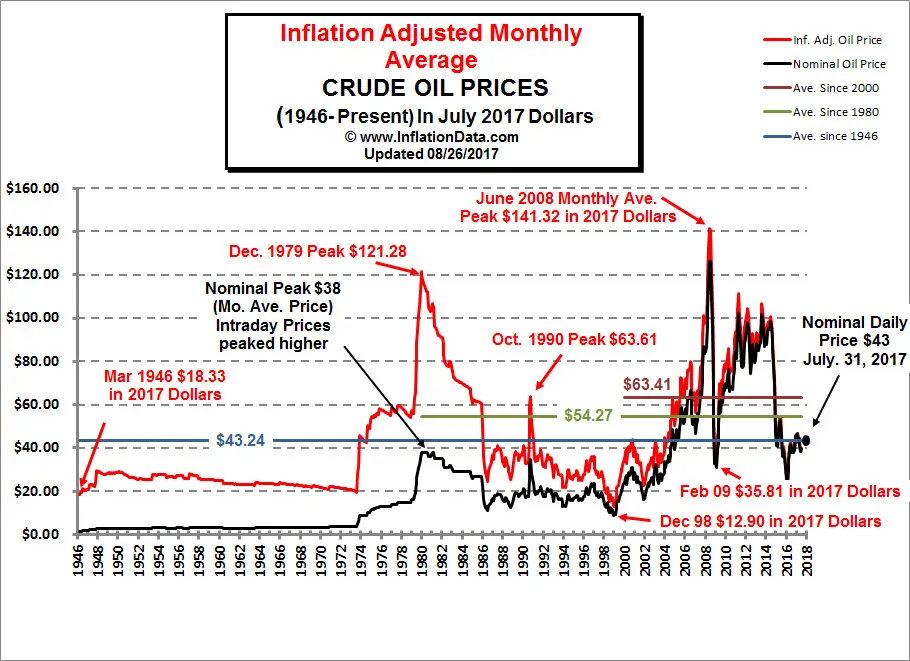
The following chart shows how oil prices have fluctuated, with the black line representing the actual cost of oil and the red the inflation adjusted, and, therefore, true cost, relative to 2009:


Note that the lowest value for oil actually occurred in 1998, not 1973, before the First Energy Crisis. There was a second shock after the Second Energy Crisis, when the price escalated to $107/barrel. There was a small spike during Gulf War in 1990, but a descent down to around $10/bbl in 2009 dollars. Then in June of 2008 came that highest ever price of $124.52/bbl. Oil actually peaked on a July day at $147/bbl, but ended up lower for the entire month.


Those peaks represent when we have had our two greatest recessions, so oil prices certainly do affect the economy. What might be lost above is that society gave up on renewable energy mostly because in 1998 oil reached its lowest price ever. Now that crude has retreated below $70/barrel, can we expect another significant dip to again scuttle sustainable resource activities? There are people like Michael Lynch and Raymond Learsey who at the end of August expected $30/barrel oil soon. The Oil Drum had a good rebut and Joe Romm extended a challenge. Suddenly, on October 21, Lynch somehow re-challenged at $65/barrel. Deutsche Bank also predicted an average 2010 price of $65, so maybe that is about as low oil will go into the future.


Finally, clicking FUTURE PRICE OF OIL on the right, you can view what speculators believe to be where oil will go. Nowhere is there $65/barrel, and $100/barrel is finally reached nine years from now.


If all the above holds, we are being given a decade window to do monumental things with conservation, the renewables and global climate change. Alas, our decision-makers seem not to care much.

-
My block stock challenge as of today is at 202%. That is, from a little more than a year ago (complemented by my Ford buy and GM buy and sell earlier this year), I've more than doubled my money. Here I purchase many of the worst stocks possible, mostly because these companies were into wind energy conversion systems, OTEC, the hydrogen jetliner, smart grids and next generation vehicles, and still end up ahead. Call it luck, but what it is is buying when the market is down.

-

Friday, December 11, 2009

PRECIOUS METALS VERSUS THE STOCK MARKET

You will note that my two books initiated certain chapters with gold, silver and diamond. My daily blog always provides a price for gold. Note that I use toz (troy ounce) instead of oz (ounce) because that is the convention. Simply, if you buy a toz of gold, you will receive 31.1034 grams, while an oz will only give you 28.3495 grams, Thus, the toz will result in almost 10% more gold. So, today, I will review the field of precious metals, and compare it with the Dow Jones Industrial Average.


The three primary precious metals are gold, silver and platinum. You've probably noticed that gold prices have jumped this year. Well, silver and platinum have increased more spectacularly than either gold or the Dow Jones Industrial Average (DJIA):

METAL.......2JAN09......3DEC09.....12DEC09....% INCREASE


Gold..............875..............1218.............1129...............29

Silver............11.08............19.18............17.39..............57

Platinum........926...............1500.............1416...............53

DJIA............9034.................................10471...............16


So the percentage increase of silver is double that of gold. Actually all these metals have dipped since December 3, when gold was at +39%, silver at +73% and platinum at +62%


Price of GoldPrice of SilverPrice of Platinum

The above charts are from Global InfoMine. From KITCO, here is what gold has sold for over the past decade.


Here is an interesting (though somewhat dated) table from Wikipedia:


YearGold,USD/ozt[1]Silver,USD/ozt[2]DJIA,USD[3]World GDP,USD tn[4]US Debt,USD bn[5]Trade Weighted US dollar Index[6]
197037.41.6838.93.3370.1
1975140.34.2852.46.4533.233.0442
1980589.515.5964.011.8907.735.6922
1985327.05.81,546.713.01,823.168.2042
1990353.44.22,633.722.23,233.373.2249
1995369.65.15,117.129.84,974.090.3097
2000272.74.610,786.931.95,662.2118.6013
2005513.08.810,717.545.18,170.4111.5580
2008865.010.88,776.454.610,699.896.0884


You can make whatever you want of it, for this is information overkill, but by just dividing gold into the Dow Jones Industrials, you get the following chart (logarithmic).


You can hardly read it, but the point is that the DJIA has been increasing at a higher rate than gold. 1980 is taken as the 1:1 ratio, and the peak was on 14Jan08, when a 1 (gold):43(DJIA) ratio was attained. So, should you invest in gold, anyway? Click on the Contrarian Investors' Journal.


World markets almost all went up, with the Japan Nikkei now at 10108 (which has risen about 12% this year). Crude oil finally dipped below $70/barrel, ending today at $69.65.
-

Thursday, December 10, 2009

CHAPTER 4: SEEKING THE LIGHT—SETI (Part 6)

The following continues the serialization of Chapter 4 on the Search for Extraterrestrial Intelligence from SIMPLE SOLUTIONS for Humanity:


Hawaii and SETI


There were several astrophysicists at the University of Hawaii Institute of Astronomy and Physics Department who I’ve met with to talk about SETI. All of them, to my knowledge, came and went over time.


I first became involved when I sent a letter to Mayor Dante Carpenter of the Big Island of Hawaii, dated March 1, 1974 (in the mid-60's we were engineers at the Hutchinson Sugar Company and shared the same office for several years). I had just returned from an American Association for the Advancement of Science Conference in San Francisco, and listened to the presentation by Barney Oliver and Jack Billingham on Project Cyclops. They had proposed spending $5 billion (later expanded to $10 billion) over the next 15 years just to listen to the Universe. Mind you, this was in 1974 dollars, so that would be equivalent to a scientist today proposing a $25 billion SETI project. I wrote to Mayor Carpenter to meet with Jack Billingham, who was into snorkeling in Hawaii, for the Big Island surely had some worthwhile sites, both snorkeling and a possible location for Project Cyclops.


Like most things I have proposed over time, nothing happened. But, as reported earlier, I did join the Billingham group at the Ames Research Center two summers later to test out some of my ideas. Thus, it was in 1976 when I first advised NASA on my plan to cost-effectively detect an extrasolar planet using Townes’ laser light theory. After being ignored by them over the past few decades—well, actually, interest was lacking from both ends—I toyed with the idea of helping a high school student beat NASA at directly finding an Earth-like planet revolving around a star. I never found time to do this, but was partly daunted by a fear that the concept made no real sense.


But on the Big Island, detection potential was rapidly expanding. William Myron Keck was a self-educated oil worker who founded Superior Oil Company and became very, very rich through drilling and offshore exploits in the field. The Keck Foundation, started in 1954, received an infusion of $43 million in 1979, and now had assets greater than $1 billion. A sum of $144 million went to the California Institute of Technology and partners to build the Keck Telescope and Observatory on Mauna Kea. More than ten years ago I remember driving one of his sons, who I believe was also called Bill, with his new second or third, wife, through a whiteout, a true blizzard, to inspect Keck I. At 13,796 feet (4205 meters), and all that snow, I was convinced that this was not a place I again wanted to visit.


In 2001, the W.M. Keck Observatory and NASA jointly announced their “outrigger” project to link Keck I and Keck II with six 1.8 meter (6 foot) new telescopes to provide sufficient resolution to detect these planets. Unfortunately, this came at a time when Hawaiians and environmentalists were in a strengthened mode, and thought that enough was enough. There were already too many telescopes on the mountain. If my street smart geothermal staff got derailed when environmentalists were weak, there was not much hope for the astrophysicists.


Yet, in 2005, NASA officially selected Mauna Kea for the Outrigger Telescope Project because no alternate site matched the scientific capability of Mauna Kea. There was some passing mention of the Wekiu bug, found nowhere else in the world. This insect, actually, is interesting, as its blood has an anti-freeze like substance. Well, Mauna Kea Anaina Hou (People who Pray for the Mountain), a local organization, was watching, and pointed out that:


o Mauna Kea is sacred to Native Hawaiians.

o The summit is home to divine deities, the meeting place of Earth Mother and Sky Father, and the temple of the Supreme Being.

o The cinder cone where the outrigger telescopes were scheduled to be built is where Lilinoe, the wife of the deity for fishermen, Kukahau’ula, was buried.

o The Hawaii State Historic Preservation Division is planning to propose that the entire summit be listed in the National Register as a historic district/cultural landscape.

o There are eleven indigenous anthropods living there, with, of course, the Wekiu Bug, a candidate for listing as an endangered species.

o The highest lake in the country, Lake Waiau, is located in this area.

o Mauna Kea is part of Hawaii’s ceded lands trust that belongs to the Hawaiians.

o In 1998, the Hawaii State Auditor issued a report criticizing the management of their mountain.


NASA did offer $1.86 million towards Native Hawaiian causes. A sum of $15 million to $20 million was spent to prepare the documentation.


In June of 2006, NASA announced that they were pulling out of the Outrigger Project, saving $50 million. That same month, acceding to a Natural Resource Defense Council’s suit, U.S. District Judge Florence-Marie Cooper issued a temporary restraining order barring the use of any sonar in the annual rim of the Pacific naval exercise (Rimpac) around Hawaii, involving 19,000 servicemen, 35 surface ships, six submarines, and 160 aircraft and amphibious forces of the navy and coast guard from the U.S., Australia, Canada, Chile, Peru, Japan, UK, and Korea, severely compromising their activities.


So, the thought from the intelligentsia then was that Hawaii might well have eliminated itself from playing significant roles in the romance of space, defending freedom and developing renewable energy, all because environmental and cultural factions prevailed over technological progress. The irony is that much of this effort involved the research of clean energy technologies and high tech jobs for tomorrow. Well, there, too, is the evidence of a pod of 200 melonhead whales frightened into Hanalei Bay, Kauai in the 2004 Rimpac. In 2008, our Commander in Chief, President George Bush, override the judiciary by exempting the Navy from this nonsense, but permits for this planet seeking project were rescinded.

tmt

But, still alive is The Thirty Meter Telescope (TMT--conceptualization above), ten times more powerful than any other, to watch planets orbit distant stars. They never learn. After an intensive review of all the usual suspects, surprise, surprise...Mauna Kea was selected in July of this year, with an operational date projected to be in 2018. While Hubble is still operating, who knows, it might not get a reboost, and TMT is almost a decade in the future, so perhaps a high school science fair project might still be a worthwhile endeavor.


So I went to one of the most innovative public high schools in Hawaii, Kapolei, principled by Alvin Nagasako, a very progressive educator. My primary purpose was to gain a sense of where the field was for my chapter on education. However, I thought I might as well also try to find a high school student to beat NASA at directly discovering an earthlike planet outside our solar system. The teacher coordinating science courses, it turned out, had a son, who already had directly found an extrasolar planet. He used a masking technique and actually succeeded. So much for trying to interest him in something as prosaic as an optical coherent technique for what he had already accomplished. I nevertheless introduced this student to my contact at the Institute of Astronomy, and waited to help. Nothing happened. The student has since graduated from high school and the astrophysicist has left Hawaii. I think I’ve heard this song before.


Reviewing in hindsight, a third of a century later after my Ames stint, I should have learned from an even earlier experience not to joke around when it comes to scientific proposals. In the early ‘70’s I submitted one to tap magma for geothermal power by leading off with a B.C. cartoon on power from volcanoes…and got thrown out for irreverence. The combination of PAT from La Mancha was not smart.


Thus, the field still is mostly confined to measuring star wobbles and finding giant sized (meaning no chance for life) planets. Notwithstanding TPF, NASA’s main-line detection architectures seem not to be close to directly measuring an Earth size planet and determining its atmosphere.


Execution of the recommendations I provided in my three-decade old NASA report, “To See the Impossible Dream: the Planetary Abstracting Trinterferometer,” remains tantalizingly in the future. If this book ever gets published, perhaps I will be contacted by some high school student [PTakahas@Hotmail.Com]…or NASA.


-
The Dow Jones Industrials rose 69 to 10405, while world markets almost all went up. The Japan Nikkei is just under 10000. Gold dropped $2/toz to $1134. Crude oil is now just below $71/barrel.

-
Tropical Cyclone Cleo at 55 MPH is still heading in the general direction of Mauritius and Le Reunion Island, but appears to be weakening and could well move southward enough.
-

Wednesday, December 9, 2009

CHAPTER 4: SEEING THE LIGHT--SETI (Part 5)

The following continues the serialization of Chapter 4 on the Search for Extraterrrestrial Intelligence from SIMPLE SOLUTIONS for Humanity:


To See the Inevitable Dream: Earthlike Exoplanets


The SETI field, while always seeking to detect and encrypt actual communications from aliens, has been plagued by not yet being able to pinpoint even one suitable extrasolar planet where life could exist. In many ways, this was then an impossible dream because it never had been done, yet. My interest during those early days (a third of a century ago) of finding an Earthlike planet circling another star has, shockingly enough, still eluded the experts. But this dream is no longer impossible, it is now inevitable. Drawing together some of the historical threads previously mentioned, let us now focus on task #1: find Earthlike exoplanets.


Remember, NASA does fund these searches. However, astroscientists mostly use INDIRECT methods to hunt for exoplanets, like astrometry (measure a star’s position in the sky—if there is a planet, then the orbit would be affected), radial velocity (determine variations in the speed at which the star moves from or to our planet, the change surmised to be caused by a planet—this has been the most productive method), pulsar timing (detect anomalies from the precise radio pulses, which must be caused by a planet) and a host of other esoteric techniques. In short, wobbles are measured and programmed for computer matching with a possible planet or more.


The direct means used involve the transit method (when a planet crosses in front of the star, the brightness drops—you need to be really lucky for this one), circumsteller disks (where space dust can more easily be detected, with any features suggesting a planet) and others. Some of these direct techniques could probably also have been utilized by Galileo.


Take one direct technique, planet dimming. Searchers are focusing on M-dwarfs, faint red stars, which make up 70% of all stars. In these solar systems, it is possible to obtain light reduction of up to 1% when a planet passes across the star, as compared to 0.001% dimming if you were viewing from many light years away and Earth blocks the light of our Sun, a G2 star. But life prospects are not exciting for M-dwarf systems. So why? We already know there are planets outside our solar system.


When was the first extrasolar planet truly detected? This remains somewhat controversial, but it was in 1988 that Canadian astronomers Bruce Campbell, G. A. H. Walker and S. Yang, using radial velocity observations, first cautiously claimed success. The first published and confirmed paper appeared in 1992 when Polish astronomer Aleksander Wolszczan and Canadian radio astronomer Dale Frail announced the discovery of planets around a pulsar. In 1995, Swiss astronomers Didier Queloz and Michel Mayor saw a planet orbiting a typical star, using high resolution spectroscopy.


At the end of 2005 there were 150 exoplanets identified (406 as of December 8, 2009). On November 7, 2007, the W.M. Keck Observatory reported on a fifth planet orbiting 55 Cancri, a star about the same size as our Sun, and just 41 light years away. But none of them would qualify to harbor life as we know it, for most of these exoplanets are Jupiter-sized with very short orbit periods. But, of course, that is because the current techniques can only find these, except for those lucky dimming observations.

Absent really useful data because all the planets unwobble-ized, as of 2007, are too large, a planet orbiting the red dwarf star Gliese 581 (artist conceptualization above from National Geographraphic News), could be at a probable surface temperature where liquid water might be possible. Discovered on April 24, 2007 by a Swiss team using a radial velocity technique in La Sill, Chile, the speculation is that this exoplanet is not good enough because Ymir, still officially called Gliese 581 c, has about five times the mass of Earth, an orbital radius only about 7% that of Earth (but the red dwarf is cooler than our Sun) and a period of only 13 days (that is, it takes 13 days to revolve around the star). Gliese 581 is 20.5 light years away and, apparently, has four possible planets. When you look up into the night sky, you can’t help, though, but be impressed with how in the heck astroscientists can glean so much information from a rotating body so far away.


The first earth-like exoplanet approximating the size of our globe (1.7 times larger) is COROT-7B was found early this year. Close to 500 light years away, it was discovered photometrically. The problem is that the temperature is 3600 degrees F facing its star and minus 328 F on the backside. It also has a year shorter than 24 hours. Here is an artist's concept of what the system might look from GEARlog:

ESO_COROT_7B_planet.jpg

-
The Dow Jones Industrials increased 51 to 10,337, while world markets all went down, except for Canada. Gold went up $3/toz to 1134 and crude oil slid to $71/barrel.

-
Tropical Cyclone Cleo is now up to 105 MPH and is headed for Mauritius and Le Reunion Island, except that she should weaken by this weekend and not seriously impact those two communities.

-