Total Pageviews

Tuesday, December 8, 2009

THE SWINE FLU MIGHT NOT BE A PANDEMIC AFTER ALL

No big surprise, for my first blog on the swine flu was on April 24, hinted just so when the story broke. Here is a quote:


So, before you get too uptight about travelling anywhere or contemplate wearing some kind of mask in public because a few hundred have passed away from the Mexican flu, remember that the world-wide annual death rate from the flu can be up to ONE MILLION.That's the high norm, but hardly a pandemic. Thus, be mildly concerned, but, heavens, don't worry. All governments will hyper-react to this episode because, first, you can't take a chance, but, two, if less than one million die worldwide over the next year from the flu, they can take credit for responsibly preventing an epidemic.


Possibly because of 9/11, society now has a tendency to overreact to anything that directly threatens them. We don't care too much about global warming because sea level rise, as a worst case scenario, will be about a third of an inch a year, and could with equal probability be a third of an inch a decade. The temperature rise is predicted to be between 0.025 and 0.10 degrees F per year. People can't feel or discern this kind of change. This attitude is further reinforced by the disinformation campaign paid for by fossil fuel companies, sort of like Republicans orchestrating public forums on how terrible that health legislation is, and PEOPLE BELIEVE WHAT IS FED TO THEM. Unbelievable.


But swine flu? With the potential to kill children? Mothers get very protective. Too much government is not enough.


A little more than a month later, on June 3, the Huffington Post published my thoughts on this subject, and here is a portion:


1. The regular flu kills one in a thousand, while the swine flu seems closer to one in a hundred. That previous avian flu of a decade ago has a 60% mortality rate, but it is not all that contagious. The fear is that the swine flu will morph into a more dangerous form. The potential of this happening is very low, and, in any case, it is appearing that all 50 or so variations might turn out to be treatable with one vaccine. So, certainly, continue the vigilance and spend my tax dollars to develop a common vaccine, but don't close down countries and schools, and, by the way, tourists can safely return to Mexico and Hawaii.


2. The numbers are embarrassingly obvious. Since the so-called epidemic was announced only a little more than a month ago, we have had about 500 cases and 3 deaths a day. I wouldn't want to be one of those statistics, but consider that a million people daily contract some form of flu and at least a thousand die, every day, usually from complications (heart, pneumonia, etc.). This terrifying swine flu is thus hardly detectable noise. I might further add that traffic fatalities number 3000/day, but we drive on.

Why, then, has the world, epitomized by the World Health Organization (which can best be appreciated if you know the internal workings of the United Nations), gone bonkers over the swine flu? I would like to speculate on the reason. I think it has to do with our political way of life influenced by the world wide web (WWW), as sensitized by the terroristic act of September 11, 2001. Add the palpable need to cover your rear.


AND, OH, BY THE WAY, IN ALMOST THE SAME BREATH, THE CDC ALSO SAID THAT, ACTUALLY, THE H1N1 SWINE FLU HAD PEAKED IN MID-OCTOBER AND WAS ON ITS WAY OUT.


This was just after:


October 24, (when) President Barack Obama made the H1N1 Swine Flu pandemic a national emergency. According to the White House, it's designed to "allow hospitals to better handle the surge in patients" by allowing them to bypass certain federal laws. What?


What is happening here?


Anyway, no big surprise, but today, the local newspaper had a big front page headline:


Experts see low swine flu toll


To quote Rob Stein of the Washington Post:


With the second wave of H1N1 infections having crested in the United States, leading epidemiologists are predicting that the pandemic could end up ranking as the mildest since modern medicine began documenting influenza outbreaks.


Did the UN and national governments overreact. Probably. Is this bad. Not necessarily, for people got educated and more took precautions, including vaccinations. There was always the chance that the worse could have happened.


Want to read about a real pandemic? From Wikipedia:


  • The 1918 flu pandemic (commonly referred to as the Spanish Flu) was an influenza pandemic that spread to nearly every part of the world. It was caused by an unusually virulent and deadly influenza A virus strain of subtype H1N1. Historical and epidemiological data are inadequate to identify the geographic origin of the virus.[3] Most of its victims were healthy young adults, in contrast to most influenza outbreaks which predominantly affect juvenile, elderly, or otherwise weakened patients. The flu pandemic has also been implicated in the sudden outbreak of encephalitis lethargica in the 1920s.[4]
  • The pandemic lasted from March 1918 to June 1920,[5] spreading even to the Arctic and remote Pacific islands. It is estimated that anywhere from 50 to 100 million people were killed worldwide which is from three to seven times the casualties of the First World War (15 million), making it the most deadly natural disaster in human history.[6][7][8][9][10] An estimated 50 million people, about 3% of the world's population (approximately 1.6 billion at the time), died of the disease. An estimated 500 million, or 1/3 were infected.[7]

-


The Dow Jones Industrials sunk 104 to 10286, with world markets all also falling. Gold dropped $38/toz to $1130 and oil further settled to $73/barrel.


-

Monday, December 7, 2009

DECEMBER 7

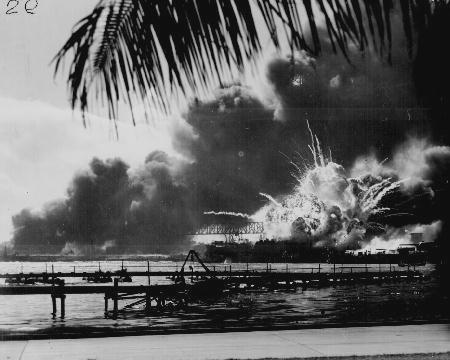
There are 24 days left in 2009. Two historic events commemorate December 7, both bordering on tragedy: the attack on Pearl Harbor and the opening ceremony of the Copenhagen Climate Conference.


USS Arizona - Pearl Harbor

The "Day that Will Live in Infamy", the speech delivered by President Franklin D. Roosevelt on December 8, 1941, devastated the American Navy in the Pacific, but left untouched our aircraft carriers and submarines. Battleships don't win wars. The Japanese armada was comprised of 6 aircraft carriers, 24 support ships and 353 aircraft. I was, apparently, a spectator, as my mother talked about carrying me (I was 15 months old) and said she pointed to the smoke coming from Pearl Harbor. Nearly 2500 were killed and more than 100,000 Japanese-Americans were sent to internment camps. (In comparison, just about 3000 were killed on 9/11/2001, triggering what might well be WW III.) There was an expectation during that period of an invasion by Japanese forces. Just above, the Arizona Memorial, which will receive a $58 million makeover, tripling the size, for, ironically, this has become the most visited attraction in Hawaii, drawing more than million and a half each year. It is free.


We now mostly remember Pearl Harbor through films: In Harm's Way with John Wayne, From Here to Eternity where Frank Sinatra and Donna Reed won best supporting Oscars, Tora! Tora! Tora! (which means Tiger! Tiger! Tiger! in Japanese) and Pearl Harbor (2001). The most memorable scene no doubt was Deborah Kerr and Burt Lancaster on the beach (the book by James Jones was a lot more graphic) enjoying eternity:

This is the beach today next to the Halona Blow Hole Lookout.

From Here to Eternity Beach View by Hawaiian Sea.


Now, about that opening ceremony, welcoming the delegates is Lars Loekke Rasmussen, Prime Minister of Denmark. It is said that 192 nations are represented and that there will be 15,000 participants.
: Lars Loekke Rasmussen, Prime Minister of Denmark, speaks during the opening ceremony of theHistoric climate conference opens to dire warnings

The 12-day event will draw 110 heads of state, including President Barack Obama, who is scheduled to arrive during the final two days when agreement will be reached. But on what?


Many times saying nothing is better than saying something useless. Take Afghanistan, for example, now that Obama has announced a 30,000 troop surge with a "promise" to begin returning the military in 2011, it was left to Secretary Robert Gates to say, well, maybe not, for Al Queda or the Taliban or Islamic terrorists, are extensions of a two millennia war, and even these fundamentalists will be smart enough to let things rest for a couple of years until Obama can declare victory. World War II lasted four years, the current Afghanistan skirmish double that, and is destined to linger for as long as the Vietnam War, which was something on the order of 15 years, depending when you say it began, for Americans, at least.


With planned good timing, though, President Obama was able to get his Environmental Protection Agency to follow-through on his Administration making the necessary climate change decisions in case Congress does not, so he will have some liberty to sound convincing in an empty sort of way. He will get a health plan for Christmas, but there are just too many Democrats in the Senate with fossil fuel connections. And they will not allow Lisa Jackson, director of the EPA, to make those decisions. Nothing is better than cap and trade, and even this won't pass next year, unless tens of millions perish from a suddenly hot summer of 2010...which almost certainly won't happen, because the warming will only be 4 degrees in 100 years, or just 1/25 of a degree Fahrenheit per year.


My prediction is that there will be many pledges to reduce carbon dioxide emissions, but that of a few key nations, namely, the U.S., China and India, will be wanting in relativity. There will be unenforceable promises and mention of aid to needy countries. But with stabilized global temperatures over the past decade and conferees freezing in the Scandinavian cold, there will be no definitive, legally binding, agreement. It will be Kyoto light, very light. I say, on to Delhi in August of 2012.

-
The Dow Jones Industrials inched up 1 to 10390, while world markets were mixed and Japan jumped another 145 to 10,167. I keep mentioning Japan because of some readership from that country, but also because the DJI and Nikkei have been exchanging leads for a year now. But this like comparing rice and mashed potatoes, for the Nikkei 225, which is in yen (1/90 the dollar today) reached a high of 38957 in 1989 (twenty years ago). The high in this century was 18,300 in 2007, when the all-time high of 14,198 was attained by the DJI. Anyway, you get a sense of how depressed the Japan stock market is when you note that it is today only about a quarter what it was in 1989, and, in terms of 2009 dollars, just one-seventh (1/7) of that high. Or look at it this way. If you had invested $100,000 into the Japan stock market in 1989, it would today be worth just a bit over $14,000. If an American had invested $100,000 at the peak (2007), it would still be worth close to $94,000.

Gold fell $3/toz to $1159 and crude oil dropped to $74/barrel.

-
Tropical Cyclone Cleo is at 50 MPH and strengthening in the Indian Ocean, moving west, and seems to be headed nowhere important.

-
Just another sunset in Hawaii yesterday...with a Nikka Yoichi scotch, now noted to be the best single malt in the world.


-

Saturday, December 5, 2009

CHAPTER 4: SEEKING THE LIGHT—SETI (Part 4)

The following continues the serialization of Chapter 4 on the Search for Extraterrestrial Intelligence from SIMPLE SOLUTIONS for Humanity:


What about the Optical Spectrum?


To be frank, the early focus, plus Project Cyclops (artist's concept above), carried so much eminence that the microwave searchers dominated from the beginning and continue to today. Thus, indirect techniques prevailed for the detection of extrasolar planets, while the capability of distinguishing signals from longer distances solidified the case.


There are two types of optical SETI researchers: those employing incoherent photon counting and others utilizing coherent (like a laser light) heterodyne detection. I was advocating the latter as an exoplanet detection concept more than twenty years before the optical approach for exosignals began to be accepted by atrophysicists in 1998. However, the second energy crisis arrived in 1979 and I turned my efforts toward crusades like Green Enertopia and the Blue Revolution. A third of a century went by and I have finally returned. I missed the 2001 SETI gathering in San Jose where Charles Townes presented a paper entitled, “Reflections on Forty Years of Optical SETI—Looking Forward and Looking Backward,” but look forward to participating in the next one.


At that California conference, Stuart Kingsley talked on “Optical SETI Observatories in the New Millennium: A Review.” Kingsley valiantly pursued the subject with his Visible Optical SETI Observatory associated with Ohio State University at Columbus. He was mostly self-funded and in 2007, after 26 years of general futility, moved to Bournemouth, England. His attitude is that the scientific community went in the wrong direction because of mistaken assumptions.


In any case, over the next few decades, I would think that the optical spectrum will gain in respect, especially in the search for exoplanets. The next section will provide some details to this historical sketch. If it can be shown that coherent signals can be sent efficiently over reasonable distances, then even the detection of actual optical extraterrestrial intelligence signals might gain in prominence, too. Hmm…a career reborn?


-
Total views: 18344

Countries: 126

Visitors this week: 746
-

Friday, December 4, 2009

OUR VAST UNIVERSE, DARK MATTER/ENERGY AND BLACK HOLES


The December issue of Scientific American has an overview article about Black Holes (BH). As I’m now covering Chapter 4 on the Search for Extraterrestrial Intelligence from my book on SIMPLE SOLUTIONS for Humanity, I thought we would divert today just so we can get to better appreciate time and space, synchronized with matter and energy:


1. It takes light 100,000 years just to travel across our Milky Way Galaxy. Homo sapiens just about developed that far back in history.

2. If we were to flash a hypothetical ultra powerful laser in the direction of the Andromeda Galaxy (our closest neighbor), it would take two and a half million years to get there.

3. The fastest man-made object, Helios 2, at 154,00 mlles per hour, traveled at about 0.00023 the speed of light.

4. There are more than 100 billion galaxies out there, and maybe as many as 500 billion.


Our universe is, indeed, vast.


But astrophysicists keep remarking that what you see is not all that there is. There are atoms and stuff that make up stars, you, whatever...viewable, but those account for less than 5% of what must exist to satisfy current theory. 23% is something called dark matter, which the recently reactivated Large Hadron Collider might succeed in detecting. Then there is the remaining 72% (some say 74%) called dark energy, whatever that is. Words like quintessence and cosmological constant are tossed around. Anyway, the real we (us, cars, stars) are apparently shrinking, in the media, for in 1998, only 90% of the universe was invisible.


The current astroscience is that there is a black hole in the middle of our and all galaxies. The question is, did the hole come first, or did the swirling stars create it. The answer is probably the former.


Now that you are totally confused, we can slip into the world of Black Holes (BH). First, what is it? BHs are, simply, the last stage of a massive star, which has to be at least ten times larger than our Sun. Thus, our Sun will never become a BH. Now this huge star needs to actually undergo a supernova explosion, which leads to an entity with no volume and infinite density, whose surface is called the event horizon, surrounded by an accretion disk. A reasonable analogy would be our solar system, with the planetary/asteroid system being this disk, the Sun the event horizon and the black hole hidden inside. Energy and matter get drawn in and cannot leave, except for certain emissions. What you will someday see is not the black hole but the sucking-in activity. There are essentially two kinds of BH, the type above and the super massive BH (SMBH), which could have trapped the equivalent of billions of stars.


The average black hole has a diameter of tens of kilometers, but there are supermassive black holes about three times the size of our solar system. The Hubble Telescope thought it saw a BH in 2002, but the confirmed first might have been in 2004 3 light years away from Saggitarius A.


The mystery of BHs is that some feel there can be no such object and probably no one has yet seen a black hole. A BH should almost surely be a sphere, although some have mused about a spinning top.


Scientists are still developing detection systems to view our SMBH (guessed to be 3 million suns) at the center of our Milky Way, known by astronomers as Sagittarius A* (SGR A*), plus a second site, the elliptical galaxy M87 (3 billion suns). Our BH is only about 25,000 light years away, while that of M87 is 55 million LY away. However, M87 is expected to have a silhouette twice as large as SGR A*. The telescope of choice is the very long baseline interferometer (VLBI), where an array of such devices scattered around the world will be synchronized. They should succeed before 2020, if not by 2012.


Care to speculate on how a BH will look? This is a black hole from Mr. Barlow’s Blog:

Peter Barlow lived two centuries ago and created a special lens.


Here is another one from EIU Astro:

black_hole_big_2_3


Then, there are fuzz balls and wormholes, but I’ll leave them to a later posting.

-

After jumping nearly 150 points in the first hour, the Dow Jones Industrials crashed, but settled up 23 to 10,389, with world markets also mostly up. Japan's Nikkei is now at 10,023.


-

Gold sunk $41/toz to $1162. Whoa, what's happening? Simple, for the jobs numbers look better, signaling a strengthening of the American dollar. Silver and platinum both also fell. Oil is at $75/barrel.

-

There are no major storms over our oceans.


-

Thursday, December 3, 2009

HAWAII AND ENERGY TODAY


I rarely post a blog with too many numbers and arcane technicalities. Today is one such entry. Sorry. If you can't stand these figures, go to my blog of yesterday and scroll to the end.


  1. Hawaii's personal income average ranks as #19 and energy use/capita is #42.
  2. We are charged from 300% to 400% more for natural gas (which, in Hawaii, is high, because our gas is not natural, but synthetic).
  3. We ($3.37/gallon, click on right box) pay "only" 27% more for gasoline than the national average ($2.65/gallon).
  4. Hawaii homes (25.13 cent/kWh) are charged 209% more for electricity, commercial rates (22.88 cents/kWh) are 216% higher and industries (19.13 cents/kWh) 267% more. The average in Connecticut and New York is around 20 cents/kWh and California is at 16 cents/kWh. More than a quarter of our states pay less than 7 cents/kWh.
  5. We produced 0.3% of all the electricity generated (in the Nation) in August of 2009, but used 30.2% of the oil consumed by powerplants. Let me repeat, this tiny state is responsible for almost one third of all the oil for electrical generating facilities in the country. Other states, of course, largely burn coal and natural gas.
  6. With 0.4% of the national population, we account for 0.5% the amount of renewable energy, use 0.2% of the gasoline and release 0.4% of the carbon dioxide.

The item that caught my attention had to do with natural gas, electricity and gasoline. Hawaii residents moan about paying more than the national average for gasoline, and yesterday it was 27 % higher, but say almost nothing about the 300% for natural gas and 200+% more for electricity. Of course, there are reasons, for that gas is synthetic, and we are not connected to the national grid and primarily use oil. Amazingly, with less than one half of one percent of the national population, we use 30% of the oil consumed in electricity production.

Then there is the matter of aviation, which is poorly covered by the Department of Energy. Thirty percent of the petroleum used in Hawaii goes to power our air system. This is three times the national average. Our economy is dominantly dependent on tourism, which is significantly affected by the price of jetfuel. The most important challenge Hawaii faces today is to find, as soon as possible, a replacement for the current jetliner or a substitute for jetfuel.


Here we have an abundance of renewables, but don't do much better than the national average for using them. An excellent summary of Hawaii's current usage was written by Terry Surles and Milton Staackmann. (Terry/Milt: your pie charts only go up to 2003: do you have a more recent publication on this subject?)


Given the highest energy prices in the nation is reason enough, but the security of our state is in particular jeopardy. When oil prices jump, our electricity rates will soar and the Hawaiian economy will head into depression because tourists will stop coming. We are only beginning to convert to renewable electricity, are barely treading water for ground transport, and are doing almost nothing for sustainable aviation, our biggest problem. The Nation and World are also ignoring this topic. Yes, there is jet fuel from microalgae research, but my posting of November 30 indicated that, at best, in ten years, this renewable aviation fuel will probably still cost $150/barrel, or more, a level much too high to sustain our tourist industry.

-

In the final half an hour of trade, the Dow Jones Industrials suddenly took a nosedive, dropping 87 for the day to 10,366.

(Hmmm, interesting...this DJI chart is REAL TIME, and does not represent 3Dec09. Learn something every day.)


World markets mostly went up, with the Japan Nikkei jumping 369 to 9978. Bet they sink tomorrow (which is today there, but because of the International Dateline...ah, you get the drift). Gold decreased $12/toz to $1212 and crude oil settled at $76/barrel. CNNMoney.com reports that cheap oil is here to stay. Note that they use the word cheap. Deutsche Bank predicts oil at $65/barrel next year and surmises that U.S. oil consumption has peaked (that is, into the future, use will only drop).

-

Wednesday, December 2, 2009

SOME THOUGHTS ON NUCLEAR ENERGY


We all have likes and dislikes. I hate fission nuclear energy, the kind that uses uranium and plutonium. The combination of Hiroshima/Nagasaki, terrorist potential for bombs, crisis looming on where to store these wastes (for the radioactivity can be dangerous for millions of years), the high cost of construction, the fact that peak uranium might not be that far away and the nightmare that our civilization was on the edge of Mutually Assured Destruction (MAD) until the end of the Cold War have so alienated me to this power potential that I have done everything within my power to discredit this option.


Mind you, I think fusion (the kind of nuclear reaction that occurs in our Sun and all stars) could well be the solution to our sustainable energy future. I worked at the Lawrence Livermore National Laboratory in the seventies on this concept (see Chapter 1 of SIMPLE SOLUTIONS for Planet Earth), but abandoned this field because I saw no potential for commercialization in my lifetime. The international ITER effort recently initiated in South France could cost from $15 billion to $30 billion just to show net positive, hopefully in 2018. Half the United Kingdom budget, apparently, just goes to support this initiative. The U.S. has been vacillating, for our Congress keeps talking about pulling out, then, maybe not.


Ironically, many environmentalists have embraced nuclear energy because the process produces very little carbon dioxide. Turns out that a facility which uses uranium from poor ores releases about as much carbon dioxide as a natural gas generation facility, but, in general, nuclear electricity and wind power are much cleaner:

So where are we today on nuclear energy? The 16November09 issue of Forbes has an article on nuclear energy that caught my attention. While no new nuclear powerplant is under construction in the United States, there are 53 new projects being readied around the world. More so, the 370 gigawatts (1000 times a megawatt, where one gigawatt can produce electricity for half a million people) today will more than double to 800 GW by 2030.


A particularly uncertain factor is the cost of fuel: uranium. The price of uranium to produce 1 gW for one year:


$ 6 million 2000

$80 million 2007

$28 million 2009


Of course, oil would cost more than a billion dollars for this amount of electricity production, as we spend in Hawaii. But the cold water for ocean thermal energy conversion would be free. The catch is that the total generation system costs a lot more for nuclear power, and much much more for OTEC.


Anyway, after the uranium (mostly U238, which has to be separated from the fissionable U235) is mined, it is milled into something called yellowcake. Yes, the color is yellow:

Enrichment needs to bring the U235 to around 5% concentration, and there are three ways to do this:


  1. An inefficient and soon to be obsolete process called gaseous diffusion. (U.S.)
  2. A slightly more efficient method called centrifugation. (France, United Kingdom, and, more recently, Iran)
  3. The most efficient technique called laser enrichment…but this is only in R&D (General Electric)


If GE fails, then, the U.S., which already imports 80% of our reactor fuel, will then most probably import all. However, Peak Uranium http://www.bloggingstocks.com/2009/11/23/so-long-peak-oil-here-comes-peak-uranium/ has been said by some to occur in 2013.


All in all, if it is true that wind power is cheaper than new coal (with carbon storage) and new nuclear, and solar thermal is getting close to competing, then why even consider nuclear fission?


Now, nuclear fusion is another matter. The problem is that this option is probably two generations away from commercialization, unless the heavy-ion fusion concept miraculously can be successful.


Chances are that industrial forces will find a way to orchestrate a resurgence of nuclear fission power (because fusion will not be available, with R&D proceeding, but very slowly, and if successful, will reach maturity around 2100--of course activists will intensely protest, but fail to stop industry). What about renewable energy? A lot of wind farms will come on line, a few solar thermal parks will make inroads and solar photovoltaics will remain too expensive for decades.


The next 25 years of electricity will be coal (especially if nothing much happens in Copenhagen and follow-on global climate change summits) and nuclear, with a smattering (by next year wind/solar will generate less than 2%, going up to perhaps 10% in a decade) of renewables. Only if tens of millions perish one hot summer and Peak Oil results in oil shooting past $150/barrel (which, somehow pulls up all fossil fuel prices) will significant changes occur. Otherwise, coal and nuclear for electricity. Sorry.

-

The Dow Jones Industrials dropped 19 to 10, 452, with world markets almost all up. Gold set yet another all-time high, going up $15/toz to $1215, and crude oil slipped below $77/barrel. The latest rumor is that, in addition to India, China will begin buying gold, and this could double the price of gold. Remember that gold was once, in the early 1980's, at that level in 2009 dollars.


-

Nida is now down to 45 MPH, weakening, and heading towards Taiwan.


-

My only real meeting today was lunch at Happy Day with Paul Yuen and Pepper Shiramizu, completed by a typical end of the day in Hawaii:

I enjoy just watching the sunset. Today, I had a Columbus Special Series salami sandwich with arugula (which I grow on my roof), with a Peter Vella Chardonnay. This is a box wine (5 liters) that has been in my refrigerator for a few months, and just refuses to stop pouring. Still okay. On the side I fried some shiitake mushrooms, sliced hasu (lotus root), and broccalini in butter, shoyu, mirin and sake. Sunset came, and ended, with a Gurkha premium congnac infused cigar and Bas Reserve armagnac as the stars appeared.

-

Tuesday, December 1, 2009

CHAPTER 4: SEEING THE LIGHT--SETI (Part 3)


The following continues the serialization of Chapter 4 on the Search for Extraterrestrial Intelligence from SIMPLE SOLUTIONS for Humanity:


Exoplanetary Search and SETI from the 80’s into the 21st Century


You will note that I have added exoplanetary search to SETI. There is a reason for this.


In 1981, Senator Proxmire sponsored an amendment to eliminate SETI from NASA. One of my side efforts was, with others, and also the considerable personal suasion of Matsunaga with Proxmire, help Carl Sagan, a colleague of Frank Drake at Cornell, reinstate funding. The involved team set up that fateful meeting with Senator Proxmire, who was of the Dyson school of thought that it was a silly waste of government funds to search for extraterrestrial intelligence. I had met Sagan when he served on a panel during my NASA Ames stopover, where he was in a group commenting on the first Viking photos to arrive fromMars. We were the first to see these photos, line by line, being posted unto the auditorium screen in Mountain View before they were released into TV land. Who knows, maybe fuzzy Green Ladies could have shown up. I still remember Sagan pontificating as to why the color of Mars had a salmon-tinge, and commented so in fine scientific detail…except, well into his elocution, a technician sheepishly commented, “Dr. Sagan, we haven’t yet applied the correction filters.” That’s the only time I saw Sagan visibly embarrassed. It turned out that the addition of the filters did not change the salmon hue.


The story has become almost legendary, as Carl Sagan was so successful in his conversation with Senator Proxmire that the following year Congress funded SETI at the level of $1.5 million. This support very slowly grew to a point in the early 1990’s when a ten year, $100 million program, was announced by NASA. A sum of $11-12 million was annually expended through three fiscal years in the early 90’s. The Search for Extraterrestrial Visitation (SETV) web page on “A Scientific Search for Visitation from Extraterrestrial Probes,” is 58 full pages long, with references, abstracts and a fair mix of both SETI and UFO related documents and articles. I should underscore, of course, that the two acronyms should not be confused to be themselves related. SETI is good science, while UFO’s belong in the realm of the twilight zone.


Then, Congress summarily terminated the program in 1992. Explained Stephen Garber of NASA:


On Columbus Day, 1992, the National Aeronautics and Space Administration formally initiated a radio astronomy program called SETI (Search for Extraterrestrial Intelligence). Less than a year later, Congress abruptly canceled the program. Why? While there was and still is a debate over the likelihood of finding intelligent extraterrestrial life, virtually all informed parties agreed that the SETI program constituted worthwhile, valid science. Yet, fervor over the federal budget deficit, lack of support from other scientists and aerospace contractors and a significant history of unfounded associations with nonscientific elements combined with bad timing in the fall of 1993 to make the program an easy target to eliminate. Thus SETI was a relative anomaly in terms of a small, scientifically valid program that was canceled for political expediency.


Why did Congress kill SETI? Proxmire was no longer in the Senate. Neither was Matsunaga. The identified assassin was Senator Richard Bryan (D-Nevada), who largely avoided discussion with SETI researchers, and even NASA representatives, but it also was the combination of SETI being only a $12 million program, with no major aerospace contractors (this was an efficient effort where equipment was bootstrapped), in a field that bridged subject areas with no effective scientific constituency, with a high giggle (green men) factor, when there was a serious national budget deficit, and at a time when NASA was fighting bruising battles over much larger programs (SETI was one thousandth of the NASA budget). SETI also could only report on the fact that, after decades, it still had not even detected one small promising signal.


The private sector then stepped in to help. In a sense, if the foundation and industrial funding process works, the program will maintain some continuity without the vagaries of Congress. In one parting shot, SETI supporters remarked, “what can you expect from a deliberative body represented by one scientist and four undertakers?” This was true of the 103rd Congress.


Thus, while NASA could continue with search for exoplanets and do astrobiology, it had to completely abandon SETI. NASA hosted two workshops during this period and published TOPS: Toward Other Planetary Systems, which is a good source for information on detecting exoplanets. Thus, I should again explain that, as it is today accepted that there are planets revolving around some stars, the next logical step is to find potential Earth-like planets, so that those microwave dishes can more efficiently detect intelligent signals. NASA is involved with the former, while being careful not to hint that the purpose is SETI-inspired.


The non-NASA SETI people in 1992 then went to the rich, corporations and foundations. The SETI Institute (SETII) itself had been formed in 1984, a year after original congressional funding, to explore, understand and explain the origin, nature and prevalence of life in the universe. Today, in Mountain View, it employs 100 scientists, educators and support staff. There are two scientific leaders:


o Center for SETI Research, where the Bernard Oliver Chair is held by Jill Tarter, who is also the director, and

o Center for the Study of Life in the Universe, where the Carl Sagan Chair, originally held by Christopher Chyba, is now occupied by Scott Hubbard, past director of the Ames Research Center.


Thomas Pierson has served as Chief Executive Officer since the founding, and Frank Drake still serves on the Board of Trustees with emeritus status.


The primary effort of SETII has been Project Phoenix, which was begun in 1995 with private financing, but, equipment “borrowed” from NASA. Congress was cruel, but, either permissive or not too watchful.


Along the way came the 1997 movie Contact, from the book by Carl Sagan, starring Jodie Foster. All the elements were there: God, the afterlife, SETI, attack by religious terrorists. Sounds like Simple Solutions, Book 2. The film starts with the Arecibo dish in Puerto Rico listening to space for signals. As is the tradition of SETI, funding was terminated. Jodie Foster sort of played Jill Tarter of SETII, plus there was a blind researcher, Kent Clark, who in real life was Kent Cullers, director of R&D for Project Phoenix. Measurement then shifted to the Very Large Array (photo below) in New Mexico, a more photogenic site representative of dish systems, where signals do arrive and get de-coded. The movie then jumps into the hyperspace of the improbable, but, in many ways, that’s part of why politicians are wary of SETI.


The Targeted Search System of NASA was upgraded in 2002 by SETII to the New Search System, based on a modular architecture and programmable integrated circuits—a bit quicker, with the same search power, but only 20% the room space. In addition to the Arecibo and Jodrell Bank (U.K.) observatories, the initial 42 dishes of the new Allen (financed by Paul Allen of Microsoft fame) Telescope Array, (photo abpve) located 290 miles northeast of San Francisco in Hat Creek, California, a radio-quiet zone, was added to the mix in 2007. Do you need an expensive 350 dish array, as has been brought to the hypothetical table by the Allen Array? If you can afford it, sure, as Paul Allen has committed $25 million to the effort.

-
The Dow Jones Industrials reached a 14 month high, going up 127 to 10472, with world markets mostly also up. The DJI is now 60% higher than on March 9, when it hit a 12 year low. Gold also hit, yes, another all-time high, increasing $21/toz to $1200, while crude oil edged up to $78/barrel.

-
Nida is still a typhoon at 75 MPH, but is expected to continue weakening, as it moves north, then northeast, away from Japan.
Hooray, the hurricane season is over in the East Pacific and Atlantic. You could, however, continue to see typhoons anytime in the West Pacific, plus, of course, the Indian Ocean. The season just started in the South Atlantic, but Cyclone (or, you can call it hurricane if you want) Catarina, at 100 MPH, struck Brazil in March of 2004. This is a rare occurrence, mostly due to wind shear.
-