Total Pageviews

Showing posts sorted by relevance for query israel, iron dome. Sort by date Show all posts

Tuesday, October 10, 2023

THE ISRAEL-HAMAS WAR IS CATALYZING SURPRISING DEVELOPMENTS

You know this Israel-Hamas War is newsworthy because I've been gazing at MSNBC all morning, and there has yet to be even one commercial.  On nostalgic Tuesday today, I focus on the Hamas and the Gaza Strip.  My posting 15 years ago said:

 End to the Gaza Strip War: “Why don’t those #&%#@* Hamas idiots just stop lobbing rockets into Israel,” courtesy of a golf buddy pundit expressed at the Ala Wai Golf Course Clubhouse. He wanted me to repeat this in my daily blog, but I thought we should protect both of us from any possible fatwa by not specifically identifying the source. 


Two years later in 2010, I reported that the 128th country to visit this blog site, was the Gaza Strip, with, then, a population of 1.5 million.  

  • I might add that I am now up to 221 entities and 2,731,530 pageviews.  That 875,512 pageviews in the graphic is because, I stopped paying Google many years ago to carry my blog.
  • While there are only 195 countries in the world, their are 221 entries because some are not countries, like Antarctica.
  • 21 entities have not seen my site, like the Vatican City, Falkland Islands, North Korea, Nauru, Kiribati and Christmas Island.  Click on that link and if you have any connections to those locations, ask them to join this blog.  Confusing is that Christmas Island is now called Kirimati, which is part of Kiribati, once called the Gilbert Islands.
  • There have been 231,788 visitors from the USA, and surprisingly enough, #2 is Singapore, with 74,952.

As you can see, this Israeli-Palestine conflict had been one-sided with respect to deaths.  Not this time, for while 1500 dead Hamas bodies have been counted on Israeli land so far, at least a thousand Israelis have so far been killed or abducted.  Here is the current situation regarding the Israel-Hamas War.

  • First, Israel was close to forming an authoritarian government, and the Hamas attack possibly ended that pathway.  
    • Benjamin Netanyahu needs to quickly form a united government, and he will only get that if he dismisses a few of his supporters and leans back towards democracy.  
    • With all the rhetoric flying around, as of this moment, this has not yet occurred.
    • If Netanhayu fails to gain total cooperation, this will become a very difficult war.
    • If he succeeds, there should be swift retribution, meaning Israel will attempt to root out the Hamas from the Gaza Strip and change the leadership.  But how do your eliminate a population that was elected to run the country?  All the other terrorist organizations in the Middle East represent only a tiny percentage of the population.  And still both Russia and the USA lost to them in Afghanistan.
    • There is worry that the powerful Lebanese militant group, Hezbollah, could take a more active role.
  • The Gaza Strip:
    • Was part of Egypt from 1948 to 1967.
    • Borders Egypt on the southwest for 6.8 miles, and Israel on east and north along a 32 mile border.  Total area of 141 square miles, just about the size of the island of Lanai.
    • Population of 2.3 million, making it the 3rd most densely populated political unit in the world.
    • Sunni Muslims make up 99.8% of the population.
    • Is blockaded by Egypt and Israel.  However, there are more than 1200 tunnels along the Egypt border that is controlled, but still used to ship in rockets and other stuff.
    • More than 20,000 rockets have been lobbed into Israel by the Hamas since 2001.
Note the year 1967 above, when the 6-day war with Arabs occurred.
  • This was the third war with Palestinian guerrilla groups in Syria, Lebanon and Jordan.
  • The difference was that Egypt played a supportive role to the terrorists.
  • Israel started this war with a pre-emptive air strike destroying 90% of Egypt's air force.
  • Israel lost 700, while the 17,000 Arabs were killed.
  • Israel's victory led to capture of the Gaza Strip, plus Sinai Peninsula, West Bank, Old City of Jerusalem and Golan Heights.  
  • Led to the Camp David Accords between Israel and Egypt, plus what became a two-state solution with the Palestinians.
In 1973 came the Yom Kippur War, the fourth conflict.
  • This was the big one with a lot of long term consequences.  
  • The U.S. intelligence community failed to foresee anything much.
  • Conflict started and ended after 19 days in October.
  • The Arab coalition, mainly Egypt and Syria, launched a surprise attack against Israel on the Jewish holy day of Yom Kippur.  
  • Iran never got involved.  However, Libya, Saudi Arabia, Kuwait, Morocco, Tunisia, Lebanon, Sudan, East Germany, Algeria, Pakistan and North Korea did aid the Arabs.
  • Early in the war, Israel was losing and seriously considered using nuclear weapons.  
  • Israel would have lost if not for military supplies from the U.S., more than $5 billion worth today.
  • It was during this war that Saudi Arabia reduced oil production, initiating the First Energy Crisis!  The spark was King Faisal of Saudi Arabia declaring an oil embargo against the U.S. when President Richard Nixon began to supply arms to Israel.
  • A huge danger was that Russia supported the Arabs and the USA helped Israel, which could have led to worldwide nuclear war.  The Soviet Union had 97 ships in the Mediterranean, many with nuclear warheads.  The U.S. had 60 vessels.
  • Warfare was intense, with Israel fighting two fronts, Egypt and Syria, plus naval and air encounters.
  • But Israel prevailed.
  • Negotiations led to the 1978 Camp David Accords, leading to a peace treaty between Egypt and Israel in 1979, the first Arab country to recognize Israel as a country.  Egypt in return began a three year process of regaining the Sinai Peninsula from Israel. 
The Hamas has been running the Gaza Strip since 2007.
  • However, the last real election was 15 years ago.
  • While largely financed by Iran, keep in mind that Iran is Shia, while the Hezbollah and most of the Arab nations are Sunni.  In general, they are their own worst enemies.
  • There is a small contingent of Hamas in the West Bank.
Good time to introduce the Iron Dome Defense system, which was designed by the Israelis, but more recently has had major U.S. fund assistance. 
  • Concept began in 2004 after the Hezbollah fired rockets from Lebanon.
  • First used in 2011, and by 2012 intercepted 90% of Gaza rockets.  By 2014 destroyed 1200 rockets.  In 2014 it was estimated that it cost from $70,000 - $100,000 to intercept a rocket.  Mind you a Patriot missile can cost up to $3 million/shot.
  • But the type of rockets used by terrorists only cost several hundred to thousand dollars each.
  • In 2021 there was an estimated 30,000 rockets and mortar bombs in Gaza.
  • In 2021 the Iron Dome system intercepted 90% of all rockets.  Also good for drones.  
  • Yet, there are reports that Iron Dome only intercepted 59-75% of threatening rockets during Protective Edge, and 32% during Pillar of Defense.
  • The Iron Dome can be jammed by the enemy.
  • The U.S. has purchased a few of these systems.
  • But a newer laser system began deployment last year to complement the existing defense.  While the laser defender is cheaper per target, the range is shorter and clouds are a problem.
  • The bottom line is that, while Iron Dome generally works, air raids and bunker shelters are reliable.
    • Israel was declared a state in 1948, formed on Palestine lands from Roman times and mentioned by The Bible as Jewish kingdoms.  After King Solomon's death around 930 BC, his kingdom split into Israel and Judah.  However, opposition governments don't recognize Israel, and still call the entire area Palestine.
    • Senate Majority Leader Chuck Schumer and a delegation of U.S. senators met with Xi Jinping yesterday in Beijing.  Said Schumer:
    "I urge you and the Chinese people to stand with the Israeli people and condemn the cowardly and vicious attacks upon them,” Schumer told Xi in the meeting, which he attended with a bipartisan group of U.S. lawmakers. “I say this with respect, but I was disappointed by the foreign minister’s statement showing no sympathy or his support for the Israeli people during these tragedies."

    • Seven hours later, Xi called for an "immediate ceasefire" and reiterated support for an independent Palestinian state.
      • In June of this year Xi  met with Palestinian Authority President Mahmoud Abbas in Beijing and said that this territory should become a full member of the United Nations.  He also proposed an international peace conference on the Israeli-Palestinian conflict, and indicated he was willing play an active role in facilitating peace talks.
      • In March Xi brokered a tentative detente between Iran and Saudi Arabia.
      • In September, Xi hosted Syrian President Bashar Al-Assad in China, the first time any Arab leader had visited the country.
      • In short, Xi wants to build closer ties with the Arab world.
    Leaving aside the machinations of Iran, Russia and Arab countries for now, what options exist for the Israeli government?
    • This was their fifth Arab war.
    • In the past, Israel, with U.S. help, never lost.
    • The problem this time is that the Hamas doesn't want peace.  And they have hostages.
    • How can Israel keep bombing the Gaza Strip?  Too many innocents will be killed.  The world will turn.
    • They can't attack the Gaza Strip and root out only the Hamas.  The Hamas dominate and is leading the country because they were voted into office.  What about their families?  What about the hostages?
    • Then up north is the Hezbollah, with 150,000 rockets awaiting launching.
    • And what about Netanyahu?  He is facing three separate cases of graft.  While his legal problems pale compared to Donald Trump, who attempted a failed coup, where people died, first you wonder about what would happen to the USA if Trump somehow become president again in 2024.  Second, you got to be concerned about how well Netanyahu can unite the country with all his problems, and his attempt to destroy democracy by neutralizing justice?

    So what surprising developments has the Israel-Hamas War catalyzed?

    • The next week or two will end up with a new Speaker of the House.  Another surprise about the Israel-Hamas War is that the crisis could well lead to bi-partisan cooperation in the House.
    • If Netanyahu compromises, Israel's current path to autocracy could well be derailed for the sake of unity, leading back towards democracy.
    • One more item is that it was the Yom Kippur War that initiated those energy crises, raising the price of oil from $2/barrel to what it is today.  Note, taking into consideration inflation, while it looked like the price of oil rested at $2 from after World War II to the Yom Kippur War, that graph below shows an inflation-accounted-for $20/barrel during those days.
    • In particular, note how Middle East Wars have jerked up the price of petroleum, leading to worldwide recessions.  Where would the world economy be today if oil remained at this $20/barrel level?
    Oh my, Hurricane Lidia has shot up to 140 MPH.  While earlier models showed the eye making landfall north of Puerto Vallarta, now the projection is south of this city, meaning models are only iffy.
    Yesterday I said that Monday was Moldy Cheese Day.  Thus, I changed by lunch to include Roquefort Cheese.

    -

    Tuesday, June 17, 2025

    WAS HAWAII THE LAST STATE IN THE U.S. TO ABOLISH SLAVERY?

    Before the nostalgic topic of the day, the latest on what is happening in the Israel-Iran War.

    • The fact that Israel actually had the audacity to bomb Iran was a shock.
    • The Iranian response came, but was weaker than expected.
    • So far, after four days.
      • Iran:  220 deaths, with 1,000 injured.  Don't believe what they report.
      • Israel:  24 deaths, 600 injured.
    • This is not a war for territory.  Israel just wanted to eliminate their most serious existential threat, that of extinction, and felt this time had come.  Not that Iran was a few days from having a nuclear capability, but that it was getting too close for comfort.
    • Israel has dominated this war, and now has air supremacy over Iran.  This is almost like saying they have won the war.  But not quite.
    • There is now a new risk.  Iran might be forced to take desperate measures.  About the only thing left to do is assassinate enemy leaders, something Israel has already accomplished.  The Ayatollah has be purposefully kept alive, but even President Donald Trump is now hinting....so far.
    • There are two steps Israel now needs to accomplish.
      • Get the bunker-busting superbombs the U.S. and European nations have to more completely take out nuclear facilities.  This is what one looks like below, weighing 30,000 pounds and only U.S. B-2 stealth bombers are configured to carry it.  In other words, the U.S. Air Force will need to participate for bunker-busters to be used.
      • Send their militia to these sites to more completely do the job.
    • While Trump bragged that he could end both the Ukraine-Russia War and Israel-Hamas War in one day, it has been almost five months, and counting, with this Israel-Iran War now a third, and most concerning, conflict as an added burden.  Why is it that everything he does only makes things worse?

    So now into my posting of the day.  It took my whole life to finally understand and appreciate racial relationships in Hawaii.

    • Growing up, and this would be from 1940 to 1958 in my youth, I accepted racial discrimination as a way of life.  From the annexation of Hawaii in 1898 through most of the 1950s, the local society was paternalistic and white-controlled, with sugar plantations, to be later mentioned, as iconic examples.  Asians born in Hawaii who went away to universities, for example, had difficulty securing a good job when they returned home into the 1960s and even beyond.
    • Previously, while the Kingdom of Hawaii had outlawed slavery, there was a system of indentured servitude that prevailed in the sugar plantation system until 1900.  Formalized by the Master and Servants Act of 1850, conditions were created where laborers brought in from foreign countries were bound to plantations with limited rights and harsh working conditions.  This was a system of bondage, or, in other words, slavery.
    • To provide background, some earlier history.  American Protestant missionaries arrived in Hawaii in 1820.  They were led by Reverend Hiram Bingham (left) and Reverend Asa Thurston (right).
      • The Thurston lava tube in Hawaii Volcanoes National Park is named for his family.  Son of Asa, Lorrin Thurston, was a leader of the 1893 overthrow of the Kingdom of Hawaii, and great-great Grandson Thurston Twigg-Smith, owned the Honolulu Advertiser, a local newspaper.
      • Hiram Bingham I designed Kawaiahao Church.  Hiram Bingham II became a professor at Yale, then a U.S. Senator and Governor of Connecticut.  He "discovered" Machu Picchu.
    • Sons and grandsons of these early missionaries largely began and controlled the Hawaiian sugar industry, which was run by Castle & Cooke, Alexander & Baldwin, C. Brewer, American Factors and Theo H. Davis.  Into the 1930's, the board of directors were heavily influenced by missionary descendants.
    • This Big Five group of companies also gained control of other aspects of the Hawaiian economy, including shipping, warehousing, banking and importing.
    • They pretty much played the most significant roles in the overthrow of the Kingdom of Hawaii and subsequent annexation of Hawaii by the U.S.
    • After graduating from Stanford University in 1962, I spent seven years in the sugar industry working for C. Brewer, which sent me to LSU, where I subsequently earned a PhD in biochemical engineering, which led to my working for the University of Hawaii from 1972.  53 years later, I still have an office on the Manoa Campus.  
      • When I started at Hutchinson Sugar Company on the Big Island of Hawaii, I knew very little of the history of sugar plantation life, for I grew up in Honolulu and was unaware of that society.
      • When I first arrived back home from college in 1962, this was three years after Hawaii had became a state, and the local politics were were shifting away from a Republican-run paternalistic society, which still was prevalent in all the sugar plantations, where the manager was king, there was a competing labor union of an Asian/Philippine workforce and a management of almost all Caucasians.  Read the details here.
      • It was the sugar industry, which from the 1800s brought in workers from the Orient and Pacific, leading to the diverse ethnicity we still largely have today of 37% Asians, 22% White, 10% Pacific Islanders., 8% Latino, 2% Black and 25% multiracial.
      • Republicans ran the state for a long while, until 1954, when a transition began, led by Japanese American veterans from World War II.  In 1959 Democrats took over the State Legislature.  This racial shift was also experienced in education and other fields.  From total Republican control to Democratic dominated still today, for the 2024 presidential election had Kamala Harris getting 61% of the votes to Donald Trump's 37%.  All four congressional representatives today are Democrats.
    Here is an animation showing the free/slave status of U.S. states and territories:
    Slavery within the continental U.S. officially came to an end on 14June1866.  
    Hawaii has a particularly interesting history regarding "slavery."
    • In 1852, the Hawaii constitution included a clause abolishing slavery, which went into effect in 1856, ten years before the Civil War.
    • That Masters and Servants Act of 1850 that allowed sugar companies to collude with the government to treat recruited laborers from China, Japan, Korea, Portugal and the Philippines as slaves, however, was tolerated.  Those who ran away were hunted down, and when found, jailed.
    • A Japanese only known as Mioshi challenged the law in 1891.
      • The sugar industry fought this.
      • The Hawaii Supreme Court rejected Mioshi's argument, which thus continued this form of slavery in Hawaii.
      • However, the court opinion written by Sanford Dole (right) indicated that, even though Mioshi was paid, the contract was unconstitutional.  Confusing, but this later led to Dole, who was part of the group that overthrew the Hawaiian monarch in 1893, becoming president of the provisional government, and first governor in 1900.  Sanford's second cousin, James, founded Dole Food Company, which dominated the local pineapple industry.
      • When Hawaii became a territory in 1900, it had to follow the national abolishment of slavery.
    • The prior year in 1899, however, the Hawaiian sugar planters had just imported 26,163 Japanese as contract laborers, the largest number brought to the islands in any single year.
      • These laborers demanded that the contracts be cancelled because of territory status.
      • There was a strike on Maui in 1900, and 200 Japanese workers rioted.  It worked, contracts were thus cancelled.
      • So I guess this was the end of slavery in Hawaii.
    • However, on 10October 2010, a report called Neil Abercrombie's slavery problem, surfaced.
      • Governor Linda Lingle (the last Republican governor of Hawaii) vetoed a gay civil union bill.
      • Congressman Neil Abercrombie claimed that civil rights cannot be compromised.  Not sure how this topic gained any link to slavery, but civil rights are civil rights.
      • In this brouhaha, it comes to light that the owners of Aloun farm, Mike and Alec Sou, were involved in the "largest human trafficking case in U.S history."  This is an exaggeration of what happened when the Sou's pleaded guilty in 2001 to paying a Thai agent to bring 44 farm laborers at low wages and shabby housing, just as the sugar industry did in 1899, which was disallowed in 1900.
      • Was then this legal result the  real end of slavery in Hawaii?  I'll let you read this Hawaii Free Press article if you wish.  Not exactly all that clear what really happened, nor the legal ramifications regarding slavery.
      • In any case, the Sou brothers are still running Aloun Farms, doing well and now expanding into Kauai.
    So which state was the last one to abolish slavery?  It's not as totally clear as you might think.
    • Clearly, Mississippi was the final state to ratify the 13th amendment, and this occurred in 2013.  
    • Hawaii, it turns out, did ratify this law in 1959 when it became the 50th state.  So Hawaii was not the last state to abolish slavery, and even that recent so-called civil rights issue was before Mississippi's ratification.
    • However, there are rumblings about slavery even today, as you shall see.
      • Racist lawmakers exploited this loophole and created Black Codes, allowing states to imprison Black people for sins like walking on the grass or being unemployed.
      • These individuals, thus were forced to work as a slave for minor infractions.
      • Perhaps more than $18 billion in wages/year are thus essentially stolen from these incarcerated individuals in the U.S.
      • How many?  2 million people. To quote:
    Although the U.S. Constitution only allows slavery as punishment for crimes, forced labor in correctional settings isn’t limited to people who have been convicted. Far too many people 
    await trial behind bars because they can’t afford to buy their freedom through money bail. Indeed, of the more than 600,000 people who were held in jails in 2021, 71 percent were presumed innocent. A lawsuit against the sheriff of the Broome County Jail, located near Binghamton, New York, alleges that the jail enslaved people who were awaiting trial, forcing them to work and violating state labor laws. People who are held in civil immigration detention facilities awaiting the resolution of their immigration proceedings have also reported being forced to work for little to no pay. Vera’s Louisiana Locked Up data tool shows the clear connection between antebellum-era chattel slavery in the fields and forced labor in prisons today. Louisiana State Penitentiary, for example, is located on the land formerly occupied by Angola Plantation. The prison has even been dubbed “Angola,” and the people incarcerated there, who are disproportionately Black, are forced to produce cotton, sugar, and other crops that were produced on the land during the nightmare of slavery.


    In the 2022 midterm elections, voters in four states—Alabama, Oregon, Tennessee, and Vermont—wisely voted to amend their state constitutions to end slavery for incarcerated people; prior to that, only three other states had done so. The Kentucky General Assembly is considering a bill that would remove slavery as a punishment for crime. In Michigan, lawmakers are trying to get a “crucial and long-overdue” constitutional amendment to end slavery on the ballot. In Nevada, voters will have the chance this November to vote for the Remove Slavery as Punishment for Crime from Constitution Amendment. And in New York, Vera supports 13th Forward, a coalition working to end exploitation and brutality in the state’s prison labor system by passing the No Slavery in NY Act and the Fairness and Opportunity for Incarcerated Workers Act. It is imperative that lawmakers and voters in these states and others vote to truly abolish slavery.


    So the title of this posting should probably have been:  Has Slavery Truly Been Abolished in the USA?  For the reality is that, five years after Juneteenth became a holiday, we still have a form of indentured servitude, as Hawaii had long after the end of the Civil War.  Two million in the U.S. and 50 million globally are still today....slaves.


    I'll end with a somewhat provocative analysis of early American songs of the slavery genre.  Considered to be the first American songwriter, I summarized the life of Stephen Foster in 2016:

    Then came the pioneer that changed everything.  Controversial, and with a sad ending (at the age of 37 with 3 cents in his pocket),  Stephen Foster, born near Pittsburgh in 1826, was the ninth of ten children and lived an upscale life.  At 24 he launched a professional career as a songwriter, and on a delayed honeymoon in 1852 took his only trip to the deep south on a river steamship.  During this period of black-face minstrelsy, he attempted to reform the genre and stressed compassion, ethnic identity and longing for family and home.


    He wrote more than 200 songs, including:

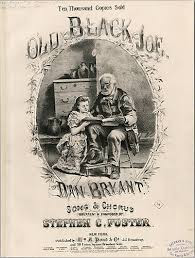
    Many of his songs were condemned as racist, as for example, Old Black Joe.  Some say not, you need to understand the attitude of those times.


    You can also read from Wikipedia, Slave Songs of the United States.

    • List of 136 songs, provided in 1867.
    • You can refer to that link for details, but one song surprised me.  I did not know that the 1960 Michael (Rowed the Boat Shore), by the Highwaymen, came from this group of slave songs.

    -