 I've had numerous postings on my roots searches for Kenjiro's grandmother, rumored to have been a female samurai somewhere around the mid-1800's. I have unofficially passed on future searches to Mateo Takahashi, for he is the last male Takahashi to be born.
 However, this could well be my final visit to Hokkaido, so I decided to again take that arduous trip to Utashinai, where Kenjiro Takahashi left at least 120 years ago to educate himself in America. I have a well-documented official copy signed by the Secretary of the Territory of Hawaii describing him coming to Hawaii, and how he was a supervisor for the construction of the Wainiha Hydropowerplant in 1906.
You, of course see that colorful emblem on the cover of two of my three recent books. Below, SIMPLE SOLUTIONS FOR PLANET EARTH.

With that backdrop, this morning we caught the Lilac from Sapporo to Takikawa. My snack was a breakfast burger from Lotteria, with a Coke:


What did we see? SNOW....SNOW SNOW. Here, with May soon to come, there are snowbanks all around:

See that arrow? It snows more than 30 feet/year in Utashinai, and that sign points out the end of the road when covered with snow.

From Takikawa Station, it was a one hour bus ride to Utashinai. We dropped off at Yumetsumugi Museum, which opened in 1997:

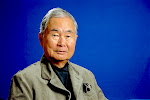
We were met by a staffer who gave me his card, but it was in Japanese, so I thought his name was Yumetsu Mugi. Apparently, not, but here he is pointing out where Kenjiro might have begun:

He said they have a complete set of archives and, if he finds anything, he will send it to me. Otherwise, the museum exhibited artifacts from the past, including a Subaru:


I was born one mornin' when the sun didn't shine
Picked up my shovel and I walked to the mine
I hauled Sixteen Tons of number 9 coal
And the store boss said, "Well, bless my soul"
Anyone know what #9 coal is? Well, just click on this.
Sorachi Coal Mine opened in 1890, around when Kenjiro's parents moved to Utashinai. Japan Railway stopped coming here in the later 1980's, and the coal company which was the whole economy, closed down inn 1995. There is still a lot of coal, but it is cheaper to import from Australia:

In 1948 Utashinai had a population of 46,000. Today, 3500 and declining. It is already Japan's smallest city. The town has tried to re-build itself with a Swiss theme, featuring skiing and onsens.
Our personal guide spent two hours with us and even walked us to the bus stop, which was just outside the door:

Yes, that's snow.
Back in Takikawa we had a hot soba lunch with water:

Walking back to the train station, it actually began to snow.

So, back in Sapporo, we had an excellent pork tonkatsu dinner. All those sauces, where you suribachi your own sesame seeds. What an experience:


-



ไม่มีความคิดเห็น:
แสดงความคิดเห็น