

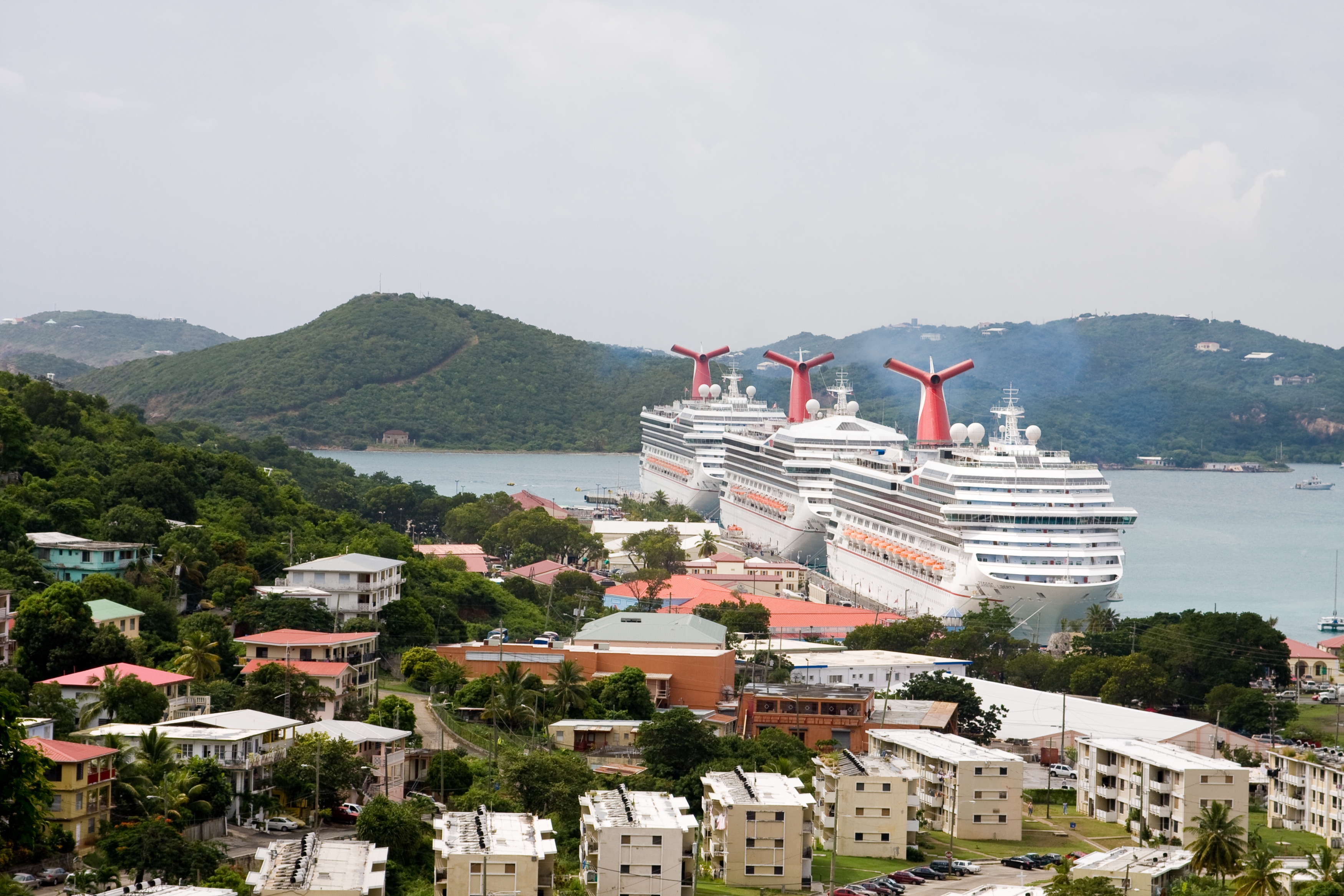
(Above: Majesty of the Seas)
Jet engines roaring across the sky. Their lights flashing, making the houses below rattle if they get too low. On a blue skied, cloudless day the airplanes burn cloud-like streaks into the sea of blue. With that image in mind, it might come as a surprise that cruise ships actually emit twice the amount of carbon dioxide as airplanes. That is not the only damage they cause when serenely floating around tropical islands, ancient Greece and Norwegian fjords.
Cruise ships vary in size, but can carry thousands of passengers and even over a thousand crew members too including entertainers, cooks, cleaners and so on. In addition to size, each destination reacts differently to the ships, their size, their number and their frequency. Marine environments below the water also react differently to these variables.
According to Climate Care a large ship carrying thousands of people releases approximately 0.43kg of carbon dioxide into the air per passenger mile. A long haul, international or trans-America flight releases only 0.257kg. Their impact does not stop there as according to Our Planet, passengers account for about 3.5kg of trash each day compared to 0.8kg generated by the local populace of the places cruises go to. Then there’s hazardous waste, the millions of tons of tiny airborne particles released each year by ships and even the human impact, which the University of Delaware believes may kill around 60,000 people by causing heart and lung conditions.
First, governance and legislation should be either enacted or strengthened to prevent grievous environmental disasters such as spills and emissions. A large number of ships and cruise lines have been fined for environmental discharges such as waste material and fuel spillages. These fines need ramping up. International governments need to agree on minimum specifications for new cruise ships to minimize their impact. Also, they should limit, ban or rotate areas cruise ships can access. This is especially needed for the 109 countries with coral reefs.

Policies do not have to take just the stick, they can also offer the carrot. Low emission cars can receive tax discounts in a number of countries, the same should apply to low emission engines such as those being developed, which utilize sea water for this purpose. They should be allowed to take part in carbon trading.
Like with all aspects of good practice and especially with regards to the environment, standards should not be set just by governments and just because a company can do something does not mean it should. Companies should do impact surveys before launching cruises and should work with the local community. Surely it is possible to navigate routes which minimize impacts while still offering passengers the sights.
Companies should promote genuine sustainable and environmentally friendly cruises and cruise ships. One way to do this is to begin a trend away from the mega ship. Ships are getting bigger and bigger, but the bigger the ship, the more damage it causes. Keep them lean and mean. Another way is to reduce speeds or to make more energy efficient engines. Are they able to make use of small wind turbines or solar panels to save energy?

Much of the food they process onboard can be bought from sustainable food growers and developers or from local sources on the tour. Liners should look into offsetting their carbon imprint, which can be done by investing in green spaces such as planting new woodlands.
Finally, there is a role for customers too. In this modern world, whenever we make a decision we have the option of choosing something environmentally friendly as well as comparing costs against services. Sure, destinations come first and affordability, but if customers opt for greener companies, the penny is going to drop with those who are not doing their best for the environment. If the people make a lifestyle change, the companies will have to follow.
Things are improving slowly. Companies have invested millions of dollars on upgrading their vessels or replacing them with better ones. Most of the upgrades are concerned with waste management systems. Some liners have begun a range of waste saving and recycling initiatives. For example, Norwegian Cruise Line donates its waste grease from cooking to farmers in Miami and Hawaii. Another liner, Carnival Cruise Lines now uses eco-friendly detergents.
The cruise industry has retained its popularity despite the economic downturn as they offer sights, entertainment, safety, and a variety of exotic locations. Cruises need to be able to offer great deals, so they can remain economically competitive, but the industry can take bold steps to make itself more environmentally friendly and to, if not reduce its impact, then offset it with pro-environment policies.
-






ไม่มีความคิดเห็น:
แสดงความคิดเห็น