
After I returned to the University of Hawaii in 1982, the new Dean of Engineering Paul Yuen and I agreed that one problem with the research to commercialization model used in our country was that the bridge from the former to the latter was missing. What was needed was a different type of organization to serve as a technology transfer agent.
So we asked Senator Spark Matsunaga to speak about this problem at an American Society of Civil Engineering meeting in Honolulu, with a solution. Of course, we wrote the speech, where Sparky suggested Hawaii create such a program. This is how it all unfolded:
- Governor George Ariyoshi liked the concept, and submitted a bill, calling the organization the Pacific International Center for High Technology Research (which should have been called the Pacific International Center for Technology Transfer, for the inclusion of research irritated university personnel).
- Various Hawaii Senate chairmen, Ben Cayetano, Richard Matsuura and Ann Kobayashi, and the Hawaii House, supported the bill, and at the end of the session we had a sum of money to start PICHTR.
- The original board included Ariyoshi, Fujio Matsuda (president of the UH), Akio Morita (headed SONY), others, and was chaired by John Bellinger, CEO of First Hawaiian Bank.


You need to read that entire posting to appreciate how PICHTR formed. Anyway, with those funds, I took several trips to Japan to give lectures at various universities, like Tokyo University and Tokyo Institute of Technology, meet with the American Ambassador to Japan, Mike Mansfield, and also Japanese government officials, which we saw as our best hope for external funding. To quickly summarize, we got a million dollars spread over eight years, mostly to develop OTEC. The key individuals were President Ronald Reagan and Senator Spark Matsunaga.

I traveled the world to recruit Luis Vega and Gerard Nihous from Berkeley, Steve Masutani, who was with Hitachi in Ibaraki, Japan, and Andrew Trenka from Colorado. They hired the staff to do the work. I also made frequent trips to DC, and a fateful meeting occurred in 1986:
 Just around this time, Louis Rotundo (left) of the Florida Solar Energy Center (FSEC) and I met with Len Rogers, director of ocean/wind programs of the Department of Energy at Trader Vic's in D.C. Without much ado, Len told us that he would be shutting down the OTEC program because the government had done all it could and it was now up to the private sector to commercialize it. Out of nowhere, Louis, who is a history major and noted authority on obscure battles of World War II, blurted out, what about open-cycle OTEC (Louis drove a red Ferrari and later became chairman of the board of FSEC, so there was that something special about him). This was not planned, but I knew enough to convince Len that this was worth a shot, and more so, I could get Japan to cost-share. No one knew anything about open-cycle, so PICHTR scooped up all the OTEC funds for the next decade and succeeded with their 40 kW (net) OC OTEC project in 1992. It remains the last and largest OTEC project to attain net positive.

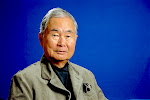
Paul is now Executive Chairman of Central Pacific Bank. His father was that famous athlete, Wally, who played for the San Francisco 49ers (football) and managed the Tokyo Giants (baseball). His mother had a thriving pearl store in Roppongi that attracted people like Liz Taylor. He asked me to go there and his mother would give me a good deal. So I went, and she mostly showed me those thousand dollar pearl necklaces which I couldn't afford. Thus, I picked a simple pearl earring for my wife, Pearl, which cost $40. She just gave them to me.

I left PICHTR in the early 1990's after getting for them approximately $25 million for the open-cycle OTEC program and another $25 million on a project to produce biomethanol from sugar cane on Maui. Twenty-seven years later, nothing much is happening in both areas.
 I spent almost a decade building up and serving as the chief fund-raiser for PICHTR. I chose not to receive any recompense, save for all those travels. I remained director of the Hawaii Natural Energy Institute during this entire period.
 However, I still had a continuing interest for their success, and in the late 1990's, while serving on a large committee to plan for the future of the University of Hawaii, I noticed that Hamilton Library Phase II was soon to be occupied. Some of us had connections with a new company called Google, and they were already on their way to pioneering digital publications. Books would soon become obsolete, and I proposed to the committee that we turn this new building into the first virtual library, with Google assistance, thus opening up several floors to another first, university-industry partnerships to spur the local economy. My thought was to have PICHTR find a new home on campus, but without being managed by the administration.
 This could well have been one of my greatest failures, for everyone on the committee thought that was a terrible idea. Students wanted the space for sleeping (they said studying), university people had too much love for libraries, etc. Oh well, we could have become the first digital library, and a world leader in something, being on top of this list.
 The lesson here is don't just spring an idea on a group of people. You need to cultivate their interest, arrange someone from Google to make a presentation, and so on. PICHTR did not just happen by accident. Matsunaga wrote personal letters to state leaders. I went on trips with legislative movers and shakers. We went karaoke singing, golfing, had dinners, and more. This I did not do with that University committee. Frankly, while this matter made sense to me, it just wasn't a priority. I was too busy trying to save the world.
 Some, like Bill Gates and Mark Zuckerberg are lucky. They have visions, and quickly become billionaires. Me? My dreams are amorphously complex and monumental for the benefit of Humanity and Planet Earth, considerably lowering the assurance for any success. Someday I still think these concepts will gain prominence, and maybe too PICHTR, but I might not be around anymore.
 I spent almost a decade building up and serving as the chief fund-raiser for PICHTR. I chose not to receive any recompense, save for all those travels. I remained director of the Hawaii Natural Energy Institute during this entire period.
 However, I still had a continuing interest for their success, and in the late 1990's, while serving on a large committee to plan for the future of the University of Hawaii, I noticed that Hamilton Library Phase II was soon to be occupied. Some of us had connections with a new company called Google, and they were already on their way to pioneering digital publications. Books would soon become obsolete, and I proposed to the committee that we turn this new building into the first virtual library, with Google assistance, thus opening up several floors to another first, university-industry partnerships to spur the local economy. My thought was to have PICHTR find a new home on campus, but without being managed by the administration.

 Some, like Bill Gates and Mark Zuckerberg are lucky. They have visions, and quickly become billionaires. Me? My dreams are amorphously complex and monumental for the benefit of Humanity and Planet Earth, considerably lowering the assurance for any success. Someday I still think these concepts will gain prominence, and maybe too PICHTR, but I might not be around anymore.
-



No comments:
Post a Comment