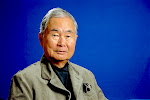
 Having roots in Japan, while I closely identify myself with the place and people, growing up in the USA, specifically Hawaii, I feel different. Pico Iyer (left) in an April issue of TIME, marvels at how his Japanese wife continues to honor old customs. There is something about the culture that makes the populace look inwardly, making them distinct.
  Compared to North Korea, Cambodia, Indonesia and other countries of the Orient, Japanese come in last in English proficiency. In Iyer's Princeton classes, there are a lot of students from China, India and Singapore, but not even one from Japan. While today North Korea has inherited the title of Hermit Kingdom, Japan, actually, in reality, has pretty much remained so.
 Urbanist Richard Florida measured 45 countries for their closeness to tradition, and modern-seeming Japan came in at #1. In this age of global migration, this continuity of spirit is not necessarily an affliction, but might well be good:
- bonfires propitiate the gods in the hope of a good harvest
- lantern festivals are throughout the country
- yes, women are still not treated equally
- everyone gets drunk under cherry blossoms

Looking at this positively, I think what Iyer was getting at is that we should all visit Japan to participate in this feast of culture.
 So on my way out of Japan, let me reflect on a few changes to come to come. Tokyo passed strict anti-smoking laws. So how did 7/11 respond? It added a smoking room adjacent to this store.
 The next shinkansen will be the Chuo Line between Shinagawa and Nagoya Stations. It will be a maglev system to travel at 314 MPH, connecting the two cities in 40 minutes. Eventually the time between Tokyo and Osaka will be 67 minutes. While operation will not be until 2027, there might be a demonstration service for the 2020 Summer Olympics from a new station in Kofu.
 Maglev stands for magnetic levitation, and there is very little wear on rail and wheels. However, the cost can be up to five times more than the current shinkansen system. Another serious problem is noise.
 The UK experimented with the first one in 1984, which had a top speed of 26 MPH. Germany had a demonstration in 1990, and that worked well enough that a consortium from that country built the Shanghai maglev operating between the airport and town since 2002 having a top speed of 268 MPH. However, there are major losses each year. There was some early thinking to link Beijing and Shanghai with one of these, but the nearly $20 billion cost was just too much. A New York City-DC system would connect the two cities in one hour.
A good example of Japanese attitude has to do with their banknotes. While the USA tends to feature politicians, Japan's currency currently has a Hideyo Noguchi (1000 yen), a bacteriologist who found the clue to syphilis, Ichiyo Higuchi (5000 yen), Japan's first prominent female writer, and Yukichi Fukuzawa (10,000 yen), also into infectious diseases, and founded Keio University.


What else you did not know about the Japanese banknote is that there is a 2000 yen note:

No human, but the Shurei-mon Gate. Anyone ever see this bill?
In 2024, this currency will be replaced by Shibasaburo Kitasato (1000 yen), another bacteriologist, who co-discovered bubonic plague, Umeko Tsuda (5000 yen), who pioneered women's education in the Meiji Period, and Eichi Shibusawa (10,000 yen), the father of Japanese capitalism.


Why not emperors and prime ministers? That's the culture of Japan, I think.
I'm not quite yet home, but had to add that a Category 5 Cyclone Fani is close to making landfall over India at 155 MPH:


I'm not quite yet home, but had to add that a Category 5 Cyclone Fani is close to making landfall over India at 155 MPH:


The latest information, though, has Fani slightly weakening:

This is India's worst cyclone in two decades. A million people were evacuated.
-



ไม่มีความคิดเห็น:
แสดงความคิดเห็น