Total Pageviews

Showing posts sorted by relevance for query cost of great tohoku disaster. Sort by date Show all posts

Tuesday, February 7, 2023

A RETURN TO THE GREAT TOHOKU EARTHQUAKE, TSUNAMI AND NUCLEAR CATACLYSM


The Monday Turkey earthquake killing at least 7900 had a magnitude of 7.8.  Of course, no tsunami and no nuclear disaster.  The largest earthquakes ever:

1. Valdivia, Chile 22 May 1960 (magnitude 9.5)

This earthquake killed 1655 people, injured 3000 and displaced two million. It caused US$550 million damage in Chile, while the tsunami that it spawned caused deaths and damage as far away as Hawaii, Japan and the Philippines. The 'rupture zone' of the quake was more than 1000 km long. Two days after the initial quake, the nearby volcano Puyehue erupted, sending ash and steam up to 6 km into the atmosphere over a period of several weeks. 


2. Prince William Sound, Alaska 28 March 1964 (magnitude 9.2)

Compared to the Chilean earthquake, this earthquake was less damaging: the resulting tsunami took 128 lives and caused overall US$311 million in damage. The earthquake was felt mainly over Alaska, as well as some places in Canada, while the tsunami created by it caused damage as far away as Hawaii. The most damage was sustained by the city of Anchorage, 120 km north-west of the epicentre. Shaking from the quake itself is reported to have lasted for three minutes. 

3. Sumatra, Indonesia 26 December 2004 (magnitude 9.1)

In terms of damage and loss of life, the scale of the disaster caused by the resulting Boxing Day Tsunami was enormous. In total, 227,900 people were killed or presumed dead, with around 1.7 million displaced over 14 countries in South Asia and East Africa. The epicentre was 250 km south-east of Band Aceh, Indonesia, at a depth of 30 km. Several days later on 28 December, a mud volcano began erupting near Baratang, Andamar Islands, which is thought to have been associated with the earthquake. 

4. Sendai, Japan 11 March 2011 (magnitude 9.0)

So far the official death toll stands at several thousand from the combined effect of the powerful earthquake, aftershocks and the tsunami. However, the total is expected to rise, with some estimates of a final toll of over 10,000. Economic impacts are expected to be huge, with the shutting down of nuclear reactors which many industries rely on for power. 

5. Kamchatka, Russia 4 November 1952 (magnitude 9.0)

This earthquake generated a tsunami that caused widespread damage in the Hawaiian Islands. Property damage was estimated at around US$1,000,000. Some reports describe waves of over 9 m high at Kaena Point, Oahu. A farmer on Oahu reported the loss of six cows to the tsunami, but no people were reported killed.

How well is Japan recovering from that Great Tohoku Disaster of 11March2011?  On 9June2011 I provided an update.   

  • There were 15,365 deaths, with 8,206 missing
    . (Total deaths and missing today seem to range between 18,500 and 20,000...or lower than 12 years ago.  In comparison, the 2004 Sumatra earthquake, also 9.1, killed 230,000 people.  The difference is that Japan was prepared, and Indonesia was not)
  • Estimated damages were at $300 billion.
    • In 2013 Brookings estimated damages of $360 billion.
    • In a 2022 LiveScience article, the World Bank estimated an economic cost of $235 billion, which they said would make it the costliest natural disaster in world history.  
      • However, in 2018 the Japan Center for Economic Research, a private think tank, said just the nuclear cleanup costs could range from $470 billion to $660 billion, and would take 30 to 40 years.
      • The maximum tsunami wave height was 130 feet in Iwate Prefecture.
      • The tsunami height in Chile, 11,000 miles away, reached 6.6 feet.
      • Hawaii suffered $31 million damage, California $100 million.
      • In the year following, there were 5000 aftershocks, the largest being a magnitude 7.9.
      • 250 miles of Japan's northern Honshu coastline dropped by 2 feet.
      • The jolt moved the main island of Honshu eastward by 8 feet.
      • All three Fukushima Daiichi reactor cores largely melted.
      • I showed how much the Tokyo Electric Power stock value dropped.

What has happened to this value?  Never recovered.


So what's next?  A mega earthquake is projected to hit Japan in the next 30 years, with a worst case scenario of 230,000 deaths.  Government seismologists predicted in 2018 that there was a 79% chance an 8.9 magnitude quake would occur.

Another estimate said 323,000 people could die along the Nankai Trough or 23,000 if the quake occurs on land near Tokyo.  Among the prospects include:
  • Kagoshima prefecture.
  • Location close to that Tohoku earthquake.
  • Wakayama Prefecture.
  • The Nankai Trough, an ocean-floor trench that extends from central Japan to the southern island of Kyushu.
    • This trench is where the Philippine sea plate and the Eurasian plate meet.
    • Quakes generally occur in 100- or 150-year intervals.  The last one was in 1946, killing 1,362 people.  That was 77 years ago, bringing into play that 30 year time frame.
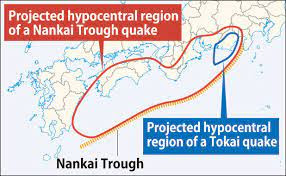
    • Could bring waves as high as 56 feet.
  • Tokyo is most-mentioned, already previously hit with the 7.9 Great Kanto earthquake in 1923 killing 105,000.
  • Then, of course, what about damage to nuclear powerplants?

Want to experience what happened in Tohoku and Tokyo on 11March2011?  Click on this.  Go to full screen and turn up the volume.  Frightening...graphic.  Actually, viewer discretion is advised.  But if you survived that and want to see more, here is Part 2.  Remember that this 9.1 earthquake lasted for around 6 minutes.  And, yes, there is a Part 3.  I was in Japan soon after and experienced a 7.1 aftershock, which can be read in the Huffington Post.  I stupidly went straight to the window to see what was happening.  I should have immediately run to the bathroom, which was towards the middle of the building.

Tuesday, March 11, 2014

THE DAY JAPAN DIED AGAIN


It was 2:46PM on 11March2011 when the Great Tohoku Earthquake, Tsunami and Nuclear Disaster incapacitated Japan again, not unlike World War II.  Here are a couple of videos of the 9.0 magnitude earthquake in Tokyo, 250 miles from the epicenter.  This is a 49 minute summary.  Here is some unbelievable footage sent to me by Charlene Oshiro.  Be sure to read how this was taken.

The 1611 Sanriku Earthquake of 8.9 magnitude, very close to the Tohoku Monster, was the largest in recorded history.  It is now #6:
  • 9.5     1960 Chile
  • 9.2     1964 Alaska
  • 9.2     2004 Great Sumatra, Indonesia (230,000 killed)
  • 9.0     1952 Kamchatka, USSR
  • 9.0     Great Tohoku
The earthquake itself:
  • shortened the day a microsecond
  • dropped 250 miles of the Honshu coastline by two feet
  • moved Honshu eight feet eastward
But Japan would have escaped calamity if it were only this earthquake.  However...


...26 minutes later came the waves of tsunami:
  • first hitting Kamaishi (a few years ago I gave a lecture to one of Japan's Marine Biotechnology Laboratories here) with a 22-foot wave 
  • reaching a  height of 133 feet in Miyako
  • mostly drowning nearly 19,000
  • destroying a million buildings
  • leaving 270,000 still in shelters
  • killing 110,000 nesting seabirds at the Midway Atoll
  • traveling inland as far as 6 miles in Sendai (which is 60 miles from the radioactive nuclear power plants, and in a few weeks I will be staying at the Westin Sendai for only $45/night, so you know something is still not right) and inundating 217 square miles

The worst part of these waves was the crippling of the four nuclear reactors at Fukushima.  This will now be a problem for a few hundred years, for 4500 square miles (about the size of Connecticut) suffer from massive radioactive contamination,  You might read official government statistics showing a smaller radioactive zone, but that is because Japan arbitrarily increased a "safe" reading as 20 micro sieverts, 20 times higher than what is deemed safe in the USA.

The result was the costliest natural disaster in history at $235 billion (Hurricane Katrina was $81 billion).  However, the economic loss just from Fukushima could be as high as half a trillion dollars, more than twice that amount.  Then you add the human cost.

I landed at Narita on 12March2011, and spent a few weeks moving around to avoid the danger, initially escaping to Beijing, then moving closer to Seoul, returning to Tokyo, then Shinkansening to Kyushu, guided by warnings from the French Embassy, then the American Embassy.  On Day 28 I shook through a 7.1 earthquake in Tokyo.  A couple of days later I published in the Huffington Post:

Why Worry About Fukushima When Hiroshima and Nagasaki Are Safe?

Incredibly enough, adding Chernobyl as another example, catastrophic nuclear power plant explosions are much, much more perilous in the long term than any Atomic Bomb detonation.  Here is a quote from that article:

In any case, this damning liability of nuclear fission facilities could well be the conclusive reason why there will be no new plants into the long-term future. This is why we should be afraid of Fukushima and any nuclear facility.
That should be convincing enough, but one final screw into the fission coffin is that society will simply determine that nuclear power is not worth the potential damage. Chernobyl supposedly cost Ukraine, Belarus and Russia hundreds of billions of dollars. This was greater than the revenues gained from all the nuclear power plants in those countries from the beginning of operation in 1954 to when the accident occurred. The cost of Hurricane Katrina was about $125 billion, but what can we do about hurricanes? (Actually, the Blue Revolution has a possible answer.) Something similar to Chernobyl will be true for Fukushima, as the estimated cost of damage will exceed $300 billion. When you realize that Tokyo Electric Power Company reported a net income of about $1.3 billion last year, you must get the message.
Can Japan engineer a second resurrection?  I would think, eventually, but a wide swath of Fukushima will become the third nuclear park, this one devoted to the end of fission power, as Hiroshima and Nagasaki exhibited the horror of the Atomic Bomb. Has Japan learned a lesson?  I fear not, as Prime Minister Shinzo Abe is getting ready to start-up most of their nuclear reactors, and guess where they're located:

-

Thursday, December 26, 2024

HOW DANGEROUS ARE TSUNAMIS?

Twenty years ago today, the deadliest tsunami in recorded history inundated Asian countries and killed about 230,000 people.  The Sumatra-Andaman Earthquake, also called the Boxing Day Earthquake (Boxing Day is a holiday celebrated after Christmas Day, mostly in Europe and Commonwealth nations):

  • Was caused by a subsea earthquake possibly as high as 9.3 magnitude (this was #2 to the largest, which was the 1960 Chile earthquake at 9.5) off the coast of Sumatra, Indonesia.
  • Waves were as high as 167 feet in Aceh province, and two hours later, Sri Lanka saw 20 feet (with run-ups as high as 41 feet--there is a difference in these two terms), and  Thailand had run-ups of up to 64 feet.  
  • At Phuket, Thailand, the second wave was the largest at 20 feet.  Also two hours after the earthquake, India saw heights as much as 33 feet.   3100 miles away in Somalia, there was a run-up of 30 feet.
  • The maximum height above sea level a tsunami reaches on shore is called the run-up.
  • In this tsunami, the second wave was the most damaging, and there were smaller first and third waves.
  • The time between the waves is usually unpredictable and varied, typically ranging from 5 minutes to 2 hours.  Dangerous tsunami currents  can last for days.
  • Costas Synolakis writes that the U.S. is not ready for a giant tsunami.  He founded the University of Southern California Tsunami Center in 1996 and this year was named manager of the year.

Historically, there have been truly monumental tsunamis, caused by asteroids, landslides, volcanoes and earthquakes.

  • The more serious tsunamis come from asteroids, volcanoes and landslides.
    • That Chicxulub asteroid event over the Yucatan Peninsula 66 million years ago created tsunamis of 330 feet high waves.  
      • Also killed off the dinosaurs.
      • But a major asteroid the size of a football field hits Earth only every 2000 years, while one large enough to threaten civilization comes only once every few million years.
    • Between 1 and 1.5 million years ago, the Nuuanu Slide occurred, when the eastern half of the Koolau Volcano on Oahu collapsed, causing a mega-tsunami that ravaged the West Coast of North America. 
    • 1.4 million years ago, one-third of the East Molokai Volcano collapsed, generating a tsunami in the near field of 2000 feet.
As natural disasters go, tsunamis are considered to be relatively rare.
  • In the past 100 years, there have been 58, claiming 260,000 lives.
  • That Boxing Day Tsunami itself accounted for 230,000 lives.  #2 was the 2011 Japan Tohoku disaster with 20,000 lives.
  • 78% of tsunamis from 1900 to 2015 occurred in the Pacific Ocean.  Only 5% originated in the Indian Ocean, where that #1 killer originated.
  • Thus, much of the alert warning technology is in the Pacific Ocean, although, after that disaster of 20 years ago, other areas are beginning to take precautions.
Some countries have never seen a tsunami, especially if landlocked.  
  • The five countries with the lowest risk of all natural disasters from TEMPO.com are:  Qatar, Saudi Arabia, Malta, Singapore and Uruguay.
  • Wikipedia has  quite a different list:
    • Safest, #1 Andorra and Monaco
    • #3  San Marino
    • #4  Luxembourg
    • #6  Singapore
    • #8  Malta
    • #13  Switzerland
    • #16  Qatar
    • #105  Uruguay
    • #129  Saudi Arabia
    • #158  Japan
    • #168  USA
    • #175  Russia
    • #178  China
    • #184  India
    • #185  Philippines
    • Why such a difference?  Don't know.  Singapore could someday suffer from a tsunami, but have never had that problem.  
      • The Indian Ocean monster occurred on the other side of Indonesia, so Singapore was not seriously affected, for the maximum tsunami height was less than a meter or yard.
      • With all those typhoons flying around the Philippines, down to Vietnam, and up to Japan, why has Singapore never faced one?  It is too close to the equator, and cyclonic storms don't go there.
      • Singapore is outside the earthquake zone, and has only felt minor tremors, never one which caused structural damage.
      • Want a safe place with high tech and good living?  Visit Singapore, one of my favorite places.  Singapore was this year named as the safest destination in the world for travelers by Forbes Advisor.
Since 1788, the U.S. has been struck 21 times by tsunamis.
  • Lituya Bay, Alaska has seen a handful.
    • On 27October1936, a landslide caused a 490 foot wave that travelled about 2000 feet inland.
    • On 10July1958, a magnitude 7.7 earthquake occurred, causing a rockfall which generated a gargantuan 1720 feet wave (nearly as tall as the new World Trade Center and largest ever recorded).  Five deaths.
    • Another landslide on 1January1853 created a wave of 394 feet.
  • An 8.1 earthquake hit near Alaska's Aleutian Islands on 1April1946, killing 165, 159 in Hawaii.
  • The Great Alaska Earthquake on 27March1964 at 9.2 magnitude, created a 220 feet high tsunami, killing 120.
  • Afraid of tsunamis?  Avoid Hawaii.  Want to read the right column?  Click on that link.

These Are the 10 U.S. Counties Facing the Greatest Risk From a Tsunami:

COUNTY
RISK SCORE
RELATIVE RISK
1. Honolulu County, Hawaii100
Very High
2. Maui County, Hawaii98.6
Relatively High
3. Hawaii County, Hawaii97.3
Relatively High
4. Aleutians West Census Area, Alaska95.9
Relatively High
5. Del Norte County, California94.6
Relatively High
6. Kauai County, Hawaii93.2
Relatively High
7. Kenai Peninsula Borough, Alaska91.9
Relatively High
8. Clatsop County, Oregon90.5
Relatively Moderate
9. Humboldt County, California89.2
Relatively Moderate
10. Santa Cruz County, California87.8
Relatively Moderate


-