- Being fought by 110 fire engines and over a thousand firemen.
- More than 16,000 acres burned just in the Pacific Palisades area, approaching 20,000 acres when you add the other three sites.
 There were periods of my life when I lived in Oxnard, which is about 44 miles to this wildfire, and is also under warning. I don't ever in those days remember anything like this. Global warming?
- The city of Los Angeles is only about 20 miles from Pacific Palisades.
- This area is memorialized by the Beach Boys 1960s hit, Surfin' USA.
- Wind gusts of 100 MPH. A hurricane is 75 MPH.

- Fire hydrants are using more than four times the normal.
- Of course, Donald Trump blamed Governor Gavin Newsom.


- Air quality in the Los Angeles area is at a hazardous level, well over an air quality index of 300.

- President Joe Biden was in Santa Monica to observe yesterday.

- When things go bad, it can get worse, for Veep Kamala Harris' Brentwood neighborhood has been evacuated.

- This wildfire will only get worse.


- Take the vagus nerve.
- Digestion: The vagus nerve regulates the release of digestive enzymes, gastric acid, and bile, and controls stomach and intestinal contractions.

- Heart rate and blood pressure: The vagus nerve helps regulate heart rate and blood pressure.

- Immune system: The vagus nerve modulates inflammation, which is a factor in many diseases.

- Mood: The vagus nerve can help with mood.
- Breathing: The vagus nerve controls breathing.
- Reflexes: The vagus nerve controls certain reflex actions, such as coughing, sneezing, swallowing, and vomiting.
- Sensation: The vagus nerve provides somatic sensation information for the skin behind the ear, the external part of the ear canal, and certain parts of the throat. It also provides visceral sensation information for the larynx, esophagus, lungs, trachea, heart, and most of the digestive tract.
- Taste: The vagus nerve plays a small role in the sensation of taste near the root of the tongue.

This is a meandering nerve that could cure you of ailments. More later.

- Why are bats almost always a transition species for our pandemics.
- NASA's Europa (one of Jupiter's moons) Clipper mission launched on 14October2024 toward Jupiter will look at Europa's seas as a source of life. Involved is science writer Nadia Drake, daughter of the legendary Frank Drake.
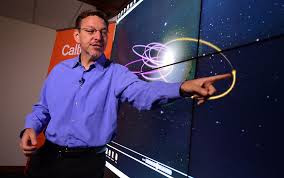
- The villain and star of the show is Mike Brown of CalTech.
 His area of study is the Kuiper Belt (KB), for stuff beyond Neptune.
- The KB was only discovered in 1992.
- There are countless objects in the KB, and many have moons themselves.

- Says Brown, we didn't lose a planet, we gained a belt.

- I might mention that there is a nearer asteroid belt between Mars and Jupiter. Ceres is the only dwarf planet in this belt.

 Pluto is now a dwarf planet, there might be 200 of them in the KP, with over 10,000 in the region beyond.
- I could define what a dwarf planet is, but I'll let Scientific American do this: must have "sufficient mass for its self-gravity to overcome rigid-body forces so that it assumes a hydrostatic equilibrium (nearly round) shape.

- But back to Brown.


His 10-year old daughter told him to find a new planet after he killed off Pluto. She said, Daddy, you know what we should do? You should find a new planet, and then people will stop being mad about Pluto.
- So that's what he did. With Konstantin Batygin, also from CalTech, they used mathematical modeling and computer simulations to discover evidence of Planet Nine.
- So, in 2016, Brown and Batygin published their "Planet Nine hypothesis," which has captured the public's imagination ever since.

- Earlier Brown had discovered Eris, a dwarf planet larger than Pluto.

- Neptune was discovered in 1846.
- A big, and partly defamed, name in all this was Percival Lowell, who founded the Lowell Observatory in Flagstaff, Arizona in 1894
- In 1906 he began an extensive project to search for a trans-Neptunian planet, which he named Planet X.
- He wanted to re-establish scientific credibility, for in 1894 he confirmed the existence of Mars canals made by intelligent life, which proved to be embarrassing, for soon thereafter, this was shown to be wrong.


- Lowell later concluded that Planet X had a mass seven times that of Earth, at 43 AU.

- He passed away in 1916.
- But his brother Abbott Lawrence in 1925 provided funds for a further search.
- Hired was 22-year old Kansas farm boy Clyde Tombaugh, who in 1930 found what turned out to be Pluto, at 39 AU.

- The naming of Pluto came from 11-year old Venetia Burney of Oxford. Tombaugh liked the name because it started with the initials of Percival Lowell. She lived to the age of 90 and saw the New Horizons mission set off for Pluto. In 2017, the International Astronomical Union approved Burney Crater on Pluto in her honor.


- Turns out that Lowell was right on another matter. He suggested that any new planet would be 7 times larger than Earth. While Pluto was subsequently found, it is 450 times smaller than Earth What Lowell was suggesting was another planet, the current Planet Nine, because all the latest data indicates it to be around 10 times the size of Earth.

- When Pluto was demoted in 2006, our solar system dropped to eight planets.

- The search for planets way out there has been ongoing since Pluto was found, but in 2014 astronomers hypothesized that there might be another planet 2 to 15 times the mass of Earth, and beyond 200 AU, with an inclined orbit. Neptune is 30 AU and Pluto 39 AU. An AU stands for astronomical units, and is the distance of Earth from the Sun.
- "It's been a roller-coaster! I've gone from thinking it was 90% there to 10% and all around," Sean Raymond, a researcher at the Bordeaux Astrophysics Laboratory in France, told Live Science in an email. "I'm rooting for it to be there, but I'm still agnostic on whether I believe it's there."

 Optimism is growing, that the new Vera C. Rubin Observatory in Chile, with first sight planned for late this year, has the capability to find this Planet Nine.
- Formerly called the Large Synoptic Survey Telescope, it is located on the El Peñón peak of Cerro Pachón, an 8,799 mountain, located 62 miles from the city of La Serena.
- Why Vera Rubin? She and her colleagues probed the nature of dark matter by cataloging billions of galaxies through space and time. Much of the funding came from the U.S. government.
 The eye is the Simonyi Survey Telescope with a very wide field of view, named after private donors Charles and Lisa Simonyi. Gave $20 million. Bill Gates provide $10 million.
- For the record, here is a comparison of primary mirrors of optical telescopes.




- Note that you can hardly find the telescope in the Vera Rubin Observatory. However:

- Vera Rubin passed away in 2016 at the of 88. The New York Times said she "ushered in a Copernican-scale change in cosmological theory.


- Began selling in 1917, just five years after Juliette Gordon Low (in the middle below) established the organization, so now for 108 years. Her inspiration was Robert Baden-Powell, who a year founded what became the Boy Scouts. Only sugar cookies were made by one troop in Moskogee, Oklahoma, and revenues went toward sending gifts to soldiers fighting World War I. Then sold for 25-35 cents/dozen.
- In 1936, the organization began working with commercial bakeries for nationwide sales. Went up to 29 of them. Today, only two: Little Brownie Bakers in Louisville, Kentucky and ABC Bakers in North Sioux City, South Dakota.


- Annually sell 200 million boxes/year, generating about $800 million.

- These are the top-selling cookie in the USA.
- Early on, they baked their own cookies at the troop level.
- This will be the final season when S'mores and Toast-Yay! flavors will sold. Nothing new. 51 flavors have been discontinued. Which ones? Click here.
- This year there will be 13 varieties. Thin Mints, Do-si-dos and Trefoils are the only cookies that won't be eliminated from the lineup, with Thin Mints the best-selling. However, the #1-tasting is said to be Samoas.
- Forget about those rumors. There will be no merger of the Boy and Girl Scout organizations.
- Began integrating in 1956, and was described by Martin Luther King as a force for desegregation.
- More than one in three women in the U.S. were once Girl Scouts.
- 56% of women in the 117th Congress are Girl Scout Alums, with 71% of current female senators former Girl Scouts.
- Five of the nine current female governors are alums.
- Every female secretary of state in the U.S. belonged to the Girl Scouts.
- Queen Elizabeth II, Taylor Swift and Venus Williams were Girl Scouts. 47 other famous females.

- Welcomes transgender girls to joins.
- There are girl scout organizations in 146 countries, but they are not linked.
- Now officially called the Girl Scouts of the United States of America.
- A female starts as a Daisy in Kindergarten, become a Brownie in the second grade, Junior in the fourth, Cadette in the sixth, Senior in the ninth and Ambassador in the 11th year.

- There are today 3.7 million Girl Scouts, with 78% from kindergarten to 12th year, and the remainder adults who provide guidance, etc.
- More than 50 million American women have participated in history.



Vegan? Try Thin Mints, Peanut Butter Patties, Lemonades, and Toast-Yay! cookies.
Kosher? Halal? Try them all! Every flavor variety is kosher and Halal certified.

The season runs now through April. However, local timing for cookie sales can vary. You can either buy boxes from a Girl Scout in your life or by supporting a local troop near you via girlscoutcookies.org and if you order on or after February 21, you can have the cookies shipped directly to your home asap.
Want even more info? GSUSA says you can also text COOKIES to 59618 for all the latest information on how to purchase Girl Scout Cookies.