Total Pageviews

Showing posts sorted by date for query hydrogen romantics, veziroglu,miami. Sort by relevance Show all posts

Tuesday, July 18, 2023

MY LATEST STORY OF HYDROGEN

I yesterday shared some depressing news showing a pathway for Donald Trump to regain the presidency.  Today, Trump revealed that he had on Sunday received an official letter from Jack Smith informing him he is a target of a grand jury probe into his efforts to overturn the 2020 election.  The whole salami, from the January 6 Senate attack to influencing seven states to coerce extra votes after the election.  The Department of Justice has declined to comment.  

But all that omens poorly for The Donald, as this latest beginning could lead to his ultimate end.  Be prepared, though, for a roller coaster political ride through next year.  Mind you, even if Trump is convicted and incarcerated, he can still run for the presidency, and if some way can be found (meaning Trump money of a billion dollars) for someone like Democratic Senator Joe Manchin to run as a third-party candidate, Trump could well win and theoretically pardon himself out of jail to run the country from 2025.

Now onto nostalgic Tuesday.  I recently received an email from a colleague in Israel, Benny Ron, about a hydrogen solution that's actually completely green.

  • Ashton Kutcher is working with an Israeli startup in a game-changing effort to produce hydrogen.
  • Kutcher, a follower of the Jewish mystic tradition of Kabbalah, is married to Jewish actress Mila Kunis.  And, incidentally, Ukrainan President Volodymyr Zelensky thanked the couple for raising almost $35 million to aid Ukrainian refugees.  
  • That article goes on to say that most of industrial hydrogen comes from fossil fuels.  
    • They admit that their product, and from other green hydrogen systems, currently costs five times more than from fossil fuels.  
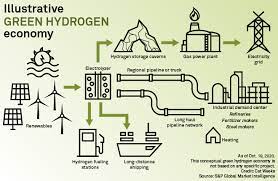
    • Most clean hydrogen processes use simple electrolysis.
    • But the Israeli system utilizes nanoparticles radiated by sunlight to catalyze the separation of hydrogen from oxygen in water.
    • Concept was developed by Chief Scientist and Professor Lilac Amirav.
Over the past many decades, numerous researchers have sought my aid on developing a new and cheaper process to produce green hydrogen.  They ranged from thermochemical, electrolytic, biological and other ways.  All of them worked, but cost a lot more than steam methane reforming.  Turned out that for Hawaii, if there was sufficient geothermal energy, the cost of electricity could drop from 20 cents/kWh to 3 cents/kWh during the early hours of the morning.  At this price, hydrogen is close to being competitive with fossil fuels for fuel cell operation to power a vehicle.


Hydrogen has long been a passion of mine now for half a century.  Read my Story of Hydrogen.  To quote:

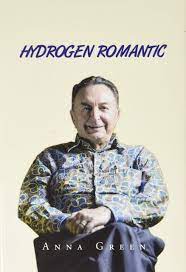
  • My interest in hydrogen spurred me (in 1974) to stop off first in Miami to attend the initial gather of Hydrogen Romantics, which led to the field journal and semi-annual World Hydrogen Energy Conference.  Nejat Veziroglu, who is now 97 years old, was the organizer.
  • In 1980, I found myself working in the U.S. Senate and recalled what I learned in Miami.  I was so inspired that I wrote the initial hydrogen legislation for the Senate, which led to the Matsunaga Hydrogen Act in 1989.
  • In 1990 I chaired the World Hydrogen Energy Conference in Hawaii. 
    (The most recent occurred in Istanbul, Turkey in 2022, and the next one will be held in Cancun, Mexico next year.)
  • Soon thereafter I became chairman of the Secretary of Energy's Hydrogen Technical Advisory Panel, which prepared The Green Hydrogen Energy Report, which served as the guide for a decade of Congressional hydrogen funding.  This led to selection of the Hawaii Natural Energy at the University of Hawaii to become a National Hydrogen Center for Education and Research.

The largest and oldest world gathering, the International Hydrogen Energy Conference, has been held every two years since 1976.   The first in Miami Beach because the organizer from the beginning was Nejat Veziroglu from the University of Miami.  

At one time WHEC was the only conference.  I can count 39 hydrogen-related conferences this year into 2024.  More specifically upcoming in 2023:

Next year, 2024:

One thing about my days with hydrogen.  I traveled a lot.


Did you know that every Tuesday is Taco Tuesday?  Started by Taco John 34 years ago to pick up a slow Mexican fast food day, Tuesday, they trademarked it.  Taco Bell filed a petition this past May with the U.S. Patent and Trademark office to cancel the trademark because everyone should be freely able to make, sell, eat and celebrate such a common term.  Taco John said it didn't have the resources to fight the challenge, so now, anyone can enjoy a taco on Tuesdays.

This could have cost TJ CEO Jim Creel a million dollars to defend, so he instead donated $40,000 to the Children of Restaurant Employees, and challenged other tacos sellers to also do the right thing.


Now, Lucy and Linus can live every day like it's Taco Tuesday.

-

Tuesday, April 26, 2022

MY LIFE

Friday, April 29, will be the beginning of my 15th year of this daily blog.  You know how long that is?

  • Imagine going back to your first year of pre-school, and suffering through kindergarten...all the way to graduating from high school.  That is a period of 14 years, or how long this site has existed.
  • However, when going to school, we had weekends, holidays, semester/Spring/Christmas breaks and the whole summer off.  My blog, with rare exceptions--especially when I'm in China, for Google, which manages this site, and that country have had a long feud-- has been a daily production.
  • Thus, the equivalent of 29April2022 is sort of like the day after graduation from high school, and I next will be off to college.
I've had 5238 postings, beginning with 29April2008.  Click on that and you will see how unsophisticated it was, with no graphics.  Wrote about a book signing for SIMPLE SOLUTIONS for Planet Earth still on sale for $19.75.  Well, if you divide by 365, you will get 14.35 years because I sometimes had two articles on certain days.

I must spend two hours or so on every posting.  Thus, I have dedicated 10,476 hours on this effort, or, if I dedicated my entire life without resting, it would take me 436.5 days to write all those blogs.


So for nostalgia and other reasons, to gain a sense of how things have changed over time, I'll chronologically scan through my past postings, and select the best 1-2%, which will amount to 50-100 articles.  I will do this almost every Tuesday, and editorialize on them.

I'll begin today with a posting of 10 May 2008, but adding some appropriate graphics.  Note that the price of oil that day 14 years ago was $126/barrel.  During the past year this price has wandered about plus or minus $20/barrel around $50/barrel, only recently jumping above $100/barrel because of the Ukraine War.


SATURDAY, MAY 10, 2008

My Life [10May08]

FIRST THE GOOD NEWS: The price of petroleum dropped below $26/barrel...oops...make that below $126/barrel...all the way down to $125.96.

Oil was ten times cheaper AFTER the First Energy Crisis in 1973/74. The price of petroleum was LESS than $3/barrel BEFORE this event. The average car then cost about $3,000. Gasoline in 1973 was purchased for $0.39/gallon and milk, $1.31/gallon. Thus, if each of these went up by the same proportion, these items should today cost:

Gasoline $16.38/gallon
Milk $55.02/gallon
Car $126,000

Does this make any sense to you? Read SIMPLE SOLUTIONS to understand what is happening.

Goldman Sachs just this week predicted oil going up to $200 in the not too distant future. How long, then, before $300/barrel, 100 times the price of the 70's? Remember, Goldman Sachs in 2005 predicted petroleum going as high as $105 in the "not too distant future," as an extreme super-spike. The industry scoffed.

The following excerpt is borrowed from the Introduction of SIMPLE SOLUTIONS for Planet Earth (http://simplesolutionsbook1.com/)


MY LIFE

A good place to start is a little more than a century ago, for this is where I can trace my beginning to sustainable resources, the underlying theme of Book 1. Somewhere around the turn of the century—that is, 1900—my grandfather from my father’s side, returning to Japan from some education or training somewhere in the USA, stopped off on the island of Kauai in Hawaii to help build a 2.4 megawatt hydroelectric facility. You wouldn’t think there was electricity in those days, especially on Kauai, made popular by recent movies such as King Kong and Jurassic Park. After all, around this period, immigrant Chinese could not marry nor own property, and were banned from most shops and public institutions in Los Angeles. Even I can’t distinguish between Chinese and Japanese. What a hellacious time he must have had. Bigotry was a way of life then…and still carries on today in many parts of the world, including Los Angeles.  (That is the family mon.)

I was born on September 6, 1940, and grew up in Kakaako, a fishing village of Honolulu, only a couple of blocks from where in 1995, I presided over a ceremony to dedicate the International Marine Biotechnology Culture Collection, close by where the new University of Hawaii Medical School was to be built, and which is now in full operation. I graduated from Pohukaina Elementary, Central Intermediate and McKinley High Schools, public schools. Then I left Hawaii for the very first time in 1958 to attend Stanford University.  (With my dog Blackie.)

My very first job after graduating in 1962 with a degree in chemical engineering was, appropriately enough, in sustainable resources, more specifically, biomass processing, or to be perfectly accurate, working in a sugar factory. This was with the oldest company in Hawaii, C. Brewer, in Naalehu, the southernmost community in the USA, where I met my wife, Pearl, who was a nurse in the next town, Pahala.

When I joined the sugar industry I thought I was the first of my direct family line of relatives to do so. Most Japanese in Hawaii trace their beginnings to their ancestors being brought to Hawaii to toil in the fields. Turned out I was the second, for that grandfather mentioned above, I later learned, worked for Eleele Plantation, now McBryde Sugar Company, but on a very specific mission, to be outlined in the section on hydroelectric power.

So here I was in 1962, when this region of the United States, Kau on the Big Island, had no access to radio (in the daytime), nor TV. Even many of my classmates, who joined the Peace Corps to places like the Philippines and the Ivory Coast, could listen to the radio. But then, Hawaii had become a state only three years earlier. Today, C. Brewer is no more and the industry is virtually gone. So much for sustainability, but biomass, it is now turning out, could well provide a promising future for transportation fuel, as described in the biomass portion of CHAPTER 2.

In 1963, after a short stint in the Army Reserves, while on a C. Brewer trainee assignment to the Kilauea Sugar Company on Kauai, a newsletter noted my arrival. A very old man came up to me one day and said he had known my grandfather. My initial reaction was mild astonishment, as while I knew that my father had been born on Kauai, I don’t recall him talking much about his parents. That individual said my grandfather was involved with the Wainiha Powerhouse and was extraordinary, in that he was very well educated and served as a supervisor. Unfortunately, he died only a few years after arriving and was buried up on the hill above the town. My family knew I was on this island. Why had no one said that I should visit my grandfather’s burial spot, for the culture of even Hawaii Japanese, was to honor the dead. Then again, maybe someone did and I did not pay any attention.  (Note Wainiha and Kilauea on the north side of Kauai.)

Life on Kauai was idyllic. Pearl, my wife, and I lived in the middle of where the movie South Pacific was filmed. She even looked like France Nuyen, the actress who dallied with John Kerr, at the slippery slide pool, which served as our backyard. I remember Tommy Sands and Nancy Sinatra one day just appearing and swimming there, which was really a river with a waterfall. Hanalei Bay, the foreground for that fictitious Bali Hai, was down the road a bit. We had a 145 pound mostly German Shepherd, Pepper, who I bathed by tossing a stick into the river, which he returned to me for a soap down, then another toss to wash himself out. I can recall when he was 6-months old and had never swum. we drove up to the Kaloko Reservoir, just outside Kilauea. On his own he bolted into the water, swam to the middle—quite an achievement for a puppy, as that was around a 100 yards, and probably more—and came back. In 2006, this reservoir/dam system fell apart and killed seven people.

Well, returning to 1963, weeks later, this gentleman came back and said he had found the gravestone, which was outside the cemetery fence, and that he and his friends went on to restore the area. He led me there and took a photo of me with his daughter, two neighbor children and Pearl. I am today, 44 years later, now kicking myself, for I never really expressed my thanks to him. Only as I write this sentence do I appreciate the enormity of what he did, for I recently used this finding as the starting point for my roots search. Also too, I never bothered to ask him for details about my grandfather. I did, though, mail a copy of that photo to my older brother, Stan.

I pretty much forgot about all this until 2005, when I got a sudden urge to search for my roots. At this point, all I had were a few rumors. Yes, there was that encounter on Kauai 42 years previously and my first visit to the grave of my father’s father. Deep in my brain cells were wild thoughts of this grandfather being educated at Columbia University, his grandmother being a female samurai Robin Hood on Hokkaido…but no proof. And I still did not even know what his first name was. So the process of searching for my roots started at a one day workshop held at the Japanese Cultural Center of Hawaii. This is where I created the family mon as a composite of two classic versions. I colorized this official form into the rainbow version shown on the cover. The mon represents a high bridge (Takahashi means high bridge in Japanese, or long chopsticks, and both, as I think about it, would apply to the symbolism) to connect countries and people taking the high road to cooperation. This book hopes to serve this function. The cover for Book 2 will use a gold version of this black and white mon to symbolize the Golden Evolution.

In September of 2005, Pearl and I visited Misa Tamura, the son-in-law of that older gentleman, to find the gravestone on Kauai. Misa, himself, was well into his 80’s by then, and he asked if we also wanted to see my grandfather’s powerhouse, for somehow, the community even then, a century later, referred to the site as Takahashi’s powerhouse. The Wainiha Powerhouse was commissioned in 1906, and today produces 4 MW with essentially the same incoming pipes and generation equipment. Around this time, my brother, Stan, found the earlier photo and sent me a note that the name on the gravestone was Kenjiro Takahashi. Thus, I learned for the first time that I was named after this grandfather, for my middle name is Kenji.  (A photo of me at this powerhouse site more than a 100 years after it was first built.)

There were still huge doubts on what was real until I had the good fortune to sit next to Elsie and David Ikegami at a 50th year Wedding Anniversary party of a mutual friend. David was born in Utah, was a Mormon, but lived most of his life in Hawaii. At the age of 80, he ran one of those Mormon family centers famous for conducting these root searches. I visited his office and passed on all the information I had, which was not much. 

Within two weeks his staff found a nine page document signed by the Secretary of the Territory of Hawaii showing that Kenjiro came to Kauai from America, was originally from Hokkaido, Japan, and served as a luna, or supervisor, at the Kilauea Plantation. He fell at the hydro site in 1906 and died in the same year that the powerhouse commenced operations. Well, with most of what I thought was largely made up now turning out to be true, the search was intensified with a trip to Utashinai, his home village, which I learned from two energy leaders in Japan, Fumio Ito and Takayoshi Ota, who were invaluable in unearthing kosekis (Japanese document providing family details), and will continue for Kenjiro’s grandmothers in Akita on Honshu and Otaru, just outside of Sapporo. Even if I find nothing else, there is enough already to write a book, tracing this possible female samurai Robin Hood great great grandmother to me. This one, though, looms as a novel.  (On the above map, you can see Otaru, and Sapporo, while Utashinai is fifty miles or so to the south and west of Asahikawa.  A few years ago I returned to Utashinai and took a photo of this station sign.)

My grandfather from my mother’s side also had an unorthodox introduction to Hawaii, for the mother of my mother passed away soon after her birth, and her father left her in Toyama, Japan, joined a crew on a steamer that came to Honolulu, and to avoid the authorities, literally jumped ship by swimming to shore, becoming a houseboy of the Waterhouse family, one of the pioneering local families with a lot of wealth. He must have been an illegal immigrant all his life, but, he, too, led an interesting life. I vaguely remember his hosting regular family luaus (Hawaiian feast), although he passed away when I was 9 years old. Still living there is his eldest son, Larry Yamamoto, my uncle, who, at all of 92 years old, is still driving.

Back again to 1963, after a year in Kilauea, I returned to Naalehu, where I really learned practical engineering, for the first time, at the Hutchinson Sugar Company—how to weld, pack a pump and manage people. Also, in these small towns, you were expected to become a useful member of the community, for I grew up in Honolulu, where none of this was necessary. I became involved with the Explorer Scouts, served on the credit union board, and even, for their annual July 4th Fair, organized what I called The First Annual Battle of the Bands, which might have been the first rock concert held in Hawaii. It was a huge success. Oh, what an impresario future I might have had if I continued that thrust. I think I invented the concept. There were no such things as Woodstock in the early 60’s, where rock groups came together to entertain the public in an outdoor setting.

The social life on the plantation was particularly well lubricated with alcohol of all types, especially Ten High, the cheapest bourbon, which was usually purchased by the case. There were memorable parties where Mai Tai’s were fashioned using the basic ingredients, including, three kinds of rum (which is a sugar by-product) and sticks of real sugar cane instead of mini-umbrellas and pineapple. Across the street from the sugar factory was a bar which only served Budweiser beer and Thunderbird wine. I later (much later) in wine tasting sessions filled this wine (a screw cap fortified wine made by Gallo) into one of those small skinny bottles used for ice wines, and true sommeliers usually picked this $2/bottle as the most expensive of the lot being sampled, for they could detect the noble rot from what was no doubt a late harvest reisling.  (Thunderbird now cost $3.50/bottle, and still with an alcoholic content of 17.5%.)

It was already clear in the early 60’s that the industry was having survival problems, so, as a matter of strategy, C. Brewer had the foresight, five years into my nearly third world existence, to send me to graduate school, Louisiana State University, for it was the only sugar school in the world, even though what they wanted was to find future options for the crop and lands. LSU had basketball star Pete Maravich, a rabid football crowd and a different way of life than Kakaako, Palo Alto or Naalehu. I proceeded to complete a dissertation where I built a tunable laser before one could be purchased to zap the DNA/RNA bonds of E. coli in a micro reactor to sterilize or catalyze growth, entitled, “Tunable Organic Dye Laser Irradiation of E. coli.” This first involvement with genetic engineering eventually will lead to the chapter in Book 2 dealing with Eternal Life.

I received a PhD in biochemical engineering in 1971, joined the faculty of the College of Engineering at the University of Hawaii, and was told to teach computer programming, a course I never took before, with a story that is continued in the education chapter of Book 2. I obtained funds from the National Science Foundation to do some reservoir engineering for the Hawaii Geothermal Project. This episode placed into my memory banks the seed for CHAPTER 6: Six Hours to Seattle. Then the first energy crisis hit in 1973, I was well prepared for the future of renewable energy, Chapters 2-4.

Dean of Engineering John Shupe was asked by Governor George Ariyoshi to do something about the long gasoline lines. Shupe convened ten of his faculty. Each proceeded to pick an energy topic of his liking, and, as I had the least seniority, was left with wind power. I don’t think I had even seen a large windmill in my life, but just within an hour of reading, figured out that if the power obtained from a wind energy conversion system (WECS) increased with the cube of the wind velocity, Hawaii, indeed, had some potential, for we had mountains that channeled and amplified the trades. What this means is that if you had two sites, one at a speed of 10 miles per hour and a second at 20 MPH, the latter would produce EIGHT (2 cubed, or 2x2x2) times more power with the same WECS.

Armed with this awesome knowledge, I went to Washington, D.C. to talk to the Energy Research and Development Agency, the predecessor of the U.S. Department of Energy (USDOE). Lou Divone was in charge of the winds (that was in 1974, and several decades later, he was still basically involved with this technology within the department in the same Forrestal Building), and I told him that Hawaii had started a wind power program. He literally laughed out aloud, reached behind his desk and pulled out an almanac, showing that the Hawaiian wind velocities were among the poorest in the Nation. But, I noticed that the measurements were only taken at airports, where you don’t want high winds. Such was the level of knowledge in 1974. He conceded that this was perhaps worth a second look, so suggested that, as there was a solar energy conference in Denver the following week, I should drop by and talk to the experts there. This story continues in the CHAPTER 2 section on Wind Energy Conversion Systems.

That trip in the previous paragraph was particularly monumental, for, while I don’t remember why, I first went to Miami to participate in the charter international hydrogen gathering chaired by Nejat Veziroglu (right). A couple of years ago I wrote a recommendation for him to the Swedish Nobel Prize Committee. Professor Veziroglu started and has been the continuing inspiration for the modern era of hydrogen. One of Nejat’s Romantics, John Bockris, also was there, and is credited with coining The Hydrogen Economy. It is this group that has initiated a campaign to “save the world” from Peak Oil and Global Heating, as reported on in CHAPTER 3.

I thus additionally got interested in the subject of hydrogen, but in offbeat ways. In the 70’s I spent some time at the Lawrence Livermore National Laboratory on two assignments, sustainable resources and laser fusion, the latter mainly to extend my PhD research, and a summer at the National Aeronautics and Space Administration’s Ames Research Center to participate in a faculty study on extrasolar (orbiting other stars) planets. Fusion, of course, depends on isotopes of hydrogen, and the individual leading the program at LLNL was Edward Teller. As the H-Bomb was such a terrible weapon of mass destruction, Teller’s dedication to fusion for peaceful uses no doubt was his attempt to balance the morality problem. Regarding my NASA experience, it turned out that the quietest portion of outer space is at a frequency where the hydrogen molecule vibrates. This combination of seemingly disparate experiences with the first element in our chemical table, hydrogen, directly links me to CHAPTER 3, The Silver Bullet: Hydrogen, and a chapter in the upcoming Book 2, Seeking the Light: Search for Extraterrestrial Intelligence.

Over the next few years I taught, did sustainable resource research and served in various administrative capacities with the College of Engineering and Chancellor’s Office at the University of Hawaii. In 1979, I co-authored the Solar/Wind Handbook of Hawaii for the U.S. Department of Energy, but when the second energy crisis came, my conclusion was that the solutions to our energy problems could more effectively be solved through politics, so off I went to Washington, D.C. to serve as the Special Assistant on Energy to U.S. Senator Spark Matsunaga. I helped pass legislation on a variety of sustainable resource measures, including wind power, solar energy, hydrogen, ocean thermal energy conversion and seabed resources. These areas all became the foundation for Book 1.

At the end of my third year in D.C., Paul Yuen, the new Dean of Engineering at the University of Hawaii, and I concocted a plan for future financial support of our projects. We decided to create our own funding agency. Thus, I returned to the University of Hawaii in 1982 and we co-founded the Pacific International Center for High Technology Research (PICHTR) to serve as a dual bridge: between academic research and the marketplace and between Hawaii and the Pacific Rim and Islands. Details on how PICHTR came into being are provided in CHAPTER 4 on the Blue Revolution. I also found time to tinker with electric vehicles, OTEC, energy storage and materials science, only to give them up on a hands-on basis when I was selected as director of the Hawaii Natural Energy Institute in 1984.

Over almost half a century I have taught courses in environmental engineering, computer applications, technology and society and renewable energy. I have written more than a hundred publications in the fields represented in this book and edited the Journal of Energy Engineering. I have chaired/directed a variety of sustainable resource workshops, conferences, national panels and projects, and might even suggest that I was the principal investigator of more National Science Foundation research prioritization workshops than anyone else. I initiated Project Green Enertopia (CHAPTER 2) and the Blue Revolution (CHAPTER 4), and drafted the first hydrogen (CHAPTER 3) bill introduced in the U.S. Senate. I’ve also determined that one of my greatest flaws is starting something, but not making time to finish them. If you’re reading this, then this could be one of my first accomplishments at completing anything.

After fifteen years as director of the Hawaii Natural Energy Institute, I took early retirement from the University of Hawaii in 1999, and began to write a dozen docu-novels related to my academic experiences, which got me nowhere, because a writer has to focus. Taking a cue from my personal flaw theory, I think I solved this problem by integrating all of them into SIMPLE SOLUTIONS.

-

Thursday, November 11, 2021

MY STORY OF HYDROGEN

      From Worldometer (new  COVID-19 deaths yesterday):

        DAY   USA  WORLD       Brazil    India    South Africa

June     9    1093     4732         1185        246       82
July    22     1205     7128         1293      1120     572
Aug    12     1504     6556        1242        835     130
Sept     9     1208      6222       1136       1168       82
Oct     21     1225      6849         571        703       85
Nov    25      2304    12025        620        518      118
Dec    30      3880    14748       1224       299      465
Jan     14      4142    15512        1151       189     712              
Feb      3       4005    14265       1209       107      398
Mar     2        1989      9490        1726       110      194
April   6          906     11787         4211       631       37
May    4         853     13667         3025     3786       59 
June    1         287    10637        2346      3205       95
 July   7          251      8440        1595        817      411
Aug    4          656    10120        1118        532      423 
Sept   1        1480    10470          703        505      235
          8        1700      9836          250        339      253
        14        1934      9001          709        281      300
        22        2228      9326          839        279      124
        29        2190      8859          643        309      108 
Oct    6        2102       8255         543        315        59
        12        1819       7544         201        249        37
        19        2005       7528         401        160        80 
        27        1594       8671         433        734        62
Nov   4         1207      7009         184        480        35 
          9         1524      7953         214        480        35
         10        1493      8366         264        362        48

Summary:  The World and USA seem to have plateaued in new deaths.  The countries with the most new cases yesterday were:
  • USA  94,376
  • Germany  45,416
  • UK  39,058
  • Russia  38,058
Today is Veterans Day, a Federal holiday always held on November 11.  First started at the end of World War I in 1918 as Armistice Day, Congress recognized it to become an official federal holiday.  In 1954, the name was changed to Veterans Day.  The Uniform Holiday Act of 1968 moved this day to the fourth Monday in October.  In 1975, President Gerald Ford returned it November 11.  In Europe, this is still Armistice Day, the end of World War I, and is a national holiday.


If you're wondering why we also have Memorial Day, this one had roots going back to the Civil War.  In 1971, Congress made the last Monday in May Memorial Day.  Both honor those who have died in wars.  15 Craigside gave me a lei today for being a veteran.  I was actually in the 442 during the Vietnam War period.

My focus on the Hydrogen Clipper yesterday brought back a lot memories.  Here is My Story of Hydrogen.

First a bit of history:
  • Name comes from Greek words hydro and genes, which together mean water forming.
  • Robert Boyle of Ireland first produced hydrogen in 1671.
  • Almost a century later, British scientist Henry Cavendish recognized it as a distinct element in 1766, and is the Father of Hydrogen.
  • Edward Teller is known as the Father of the Hydrogen Bomb, and I worked under him when he was director of the Lawrence Livermore National Laboratory.
Science of hydrogen:
  • Is at the head of the chemical table of elements with atomic number 1.
  • The lightest element.
  • 75% of normal matter and 90% of all the molecules in the Universe is hydrogen.
  • There were no elements immediately after the Big Bang, with hydrogen first coming into being about 370,000 years later.
  • Is mostly produced today through a process called steam reforming of natural gas.
  • Hydrogen can also be generated through the electrolyis of water and a variety of other ways, including using a catalyst in water onto which sunlight is beamed and biological options.
  • There are at least seven isotopes:  protium, deuterium, tritium and others synthesized in the lab.
    • Protium is 99.98% of all hydrogen, with a half life of 10 to the 34th power years
    • Deuterium has a neutron added to the proton, and is 0.015% of all hydrogen.  It is stable.
    • Tritium is only one billionth of a billionth percentage of hydrogen, with a half-life of 12.32 years.
For the longest time I've been enamored of hydrogen:
  • Being 75% of all known matter, this must be a clue that hydrogen must be the fuel of the future.
  • When combusted in air, the only product, if designed properly, is water vapor.
  • The infrastructure is largely in place.  Pipelines might need to be internally coated, but that expense is trivial compare to having to buy land, gain rights, satisfy permitting requirements and the like.
  • Is the best gas to be used in a fuel cell, which is two to four times more efficient than battery or fossil-powered vehicles.
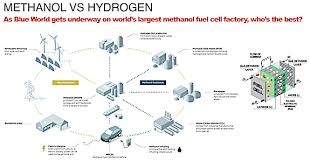
  • Mind you, I still think a biomethanol fuel cell is the transition to ultimately using hydrogen.  
    • Hydrogen today is too expensive, and biomethanol can be produced from biomass though gasification and utilization of an efficient catalyst for methanol.  This catalyst is not good enough today.  
    • Note that drag racers do best with methanol and space ships are launched using liquid hydrogen.
    • About the danger of hydrogen and memory of the Hindenburg, NASA and the rest of the world have found a way to safely use liquid hydrogen, which should improve with experience.  Remember that there have been 210 serious aircraft incidents and we still use jet fuel.
  • Our Sun and all stars consume hydrogen to produce energy through a process called fusion.
    • Uranium and plutonium for nuclear fission reactors are unsafe:  radioactive wastes with long half lives, potential to make dirty bombs and major catastrophes.  Fusion power using hydrogen, or Star Power, shows huge promise.
    • However, ITER using magnetic confinement and the Lawrence Livermore National Laboratory laser fusion process seem today stymied, it will be a matter of time when the urgency will bring results and utility.
  • Regarding the Search for Extraterrestrial Intelligence:
    • There is a quiet band of the electromagnetic spectrum between 1420 and 1652 megahertz called the waterhole, which radio telescopes use to see out into space.  The reason is that the hydroxyl radical spectral line and atomic hydrogen molecules absorb radio noises, making this band the logical extraterrestrial communication station site.
    • NASA Ames Research Center discovered this waterhole.
As a university professor, I am provided the freedom to do whatever I want during the summer months.  1974 was a particularly providential year, for I got involved with two projects at the University of Hawaii:
  • The First Energy Crisis occurred in Fall of '73, so that I ended up gaining leadership over the academic wind power program.  Funds were found to send me to DC to seek funds the following year.  
    • My interest in hydrogen spurred me to stop off first in Miami to attend the initial gather of Hydrogen Romantics, which led to the field journal and semi-annual World Hydrogen Energy Conference.  Nejat Veziroglu, who is now 97 years old, was the organizer.
    • In 1980, I found myself working in the U.S. Senate and recalled what I learned in Miami.  I was so inspired that I wrote the initial hydrogen legislation for the Senate, which led to the Matsunaga Hydrogen Act in 1989.
    • In 1990 I chaired the World Hydrogen Energy Conference in Hawaii.
    • Soon thereafter I became chairman of the Secretary of Energy's Hydrogen Technical Advisory Panel, which prepared The Green Hydrogen Energy Report, which served as the guide for a decade of Congressional hydrogen funding.  This led to selection of the Hawaii Natural Energy at the University of Hawaii to become a National Hydrogen Center for Education and Research.
  • During the summer of 1974 I co-directed a NASA-sponsored program on Earth 2020, directed by the Ames Research Center.  I got to know the people there, so in 1976 was among 20 faculty members to work at Ames on the Search for Extraterrestrial Intelligence, a subject that most interested me because I thought that beaming in from space could well be the Encyclopedia Galactica, provided by an advanced civilization to engender peace, generate fusion power and so on.  I like to think big.
In 1975, and again in 1979, I worked at the Lawrence Livermore National Laboratory on laser fusion.  More than 40 years ago I felt that the laser to do the job was nowhere near discovery, so I left the field.  I still think Livermore's future in developing fusion makes more sense than the ITER effort ongoing in France.

To repeat, while I was at Livermore in 1979, the world was suffering from the Second Energy Crisis, with gasoline lines throughout the world.  I was asked to work for Senator Spark Matsunaga in DC, so off I went to craft that original hydrogen bill.  I also participated in drafting the initial legislation for ocean thermal energy conversion, which has led to the Blue Revolution.

Moving on throughout the 80's, I closely followed the development of the National Aerospace Plane, which was moved into a black program, so very little information was released.  The Hawaii Natural Energy Research got heavily involved in the national hydrogen program, where we had an annual assessment for universities and companies vying for funding.  Being chairman of the Secretary of Energy's Hydrogen Technical Advisory Panel helped in this competition.  That original hydrogen bill I drafted creating this Panel did something unique on purpose:  we reported to the Secretary, and also to Congress.  This dual pathway enabled us to increase the hydrogen budget so that in the early 2000's when George Bush the Younger was president, hydrogen actually got more funds than solar technology.

By then, I had come to a conclusion that hydrogen was not for now.  Perhaps 2050 was more realistic.  Thus, as shown in a series of Huffington Post articles I wrote, you can track this shift in attitude:

What of the Hydrogen Economy, and when?  The term was coined by a close colleague of mine, John Bockris, just around the time the Romantics first convened in Miami.  And true, most adherents are impossibly optimistic. 

The Society of Electrical and Electronic Engineers is dismissive.  But there is a reason.  Electricity and hydrogen represent two competing energy interfacing alternatives.  I've long felt that both will be necessary and best.  Hydrogen can be complementary and should be more practical than batteries.  For example:

...hydrogen fuel cell buses typically have a range of 
approximately 500 km, versus 200 km for electric buses. With this range, hydrogen has both the potential to decarbonize rural transport and to offer a solution for uninterrupted services.
  

The ETC’s Mission Possible report, Shell’s Sky Scenario, and  the International Energy Association’s below 2 degrees Celsius scenario all show well-developed pathways to decarbonizing the hard-to-abate sectors, and those pathways all require substantial global hydrogen growth.

Power magazine reports on the bullishness of Siemens.  Read this for a fair statement about Green Hydrogen.  What are my views?  
  • In all the public hearings I chaired in the 1990's, most of the participants were too hopeful.
  • A quarter century till today, it has not surprised me that there has not been much progress.
  • A core of enthusiasts will always be around to provide a hopeful point of view.
  • Global warming could well provide that catalyst to minimize the transition period for arrival of the Hydrogen Economy.
  • If hydrogen airships and jetliners become prominent by 2050, the lowered cost of hydrogen should also favor fuel cell- over battery-powered vehicles.
  • 2050 should also be around when fusion-power should begin to become available.
  • Cold fusion?  Maybe never, but the concept is worthy of continued investigation.
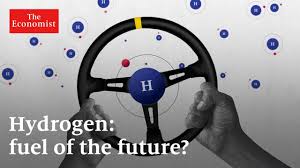
Some learn best watching videos.  If you are among them, here are a few you can consider.
-