Total Pageviews

Showing posts sorted by relevance for query hydrogen romantics, veziroglu,miami. Sort by date Show all posts

Tuesday, July 18, 2023

MY LATEST STORY OF HYDROGEN

I yesterday shared some depressing news showing a pathway for Donald Trump to regain the presidency.  Today, Trump revealed that he had on Sunday received an official letter from Jack Smith informing him he is a target of a grand jury probe into his efforts to overturn the 2020 election.  The whole salami, from the January 6 Senate attack to influencing seven states to coerce extra votes after the election.  The Department of Justice has declined to comment.  

But all that omens poorly for The Donald, as this latest beginning could lead to his ultimate end.  Be prepared, though, for a roller coaster political ride through next year.  Mind you, even if Trump is convicted and incarcerated, he can still run for the presidency, and if some way can be found (meaning Trump money of a billion dollars) for someone like Democratic Senator Joe Manchin to run as a third-party candidate, Trump could well win and theoretically pardon himself out of jail to run the country from 2025.

Now onto nostalgic Tuesday.  I recently received an email from a colleague in Israel, Benny Ron, about a hydrogen solution that's actually completely green.

  • Ashton Kutcher is working with an Israeli startup in a game-changing effort to produce hydrogen.
  • Kutcher, a follower of the Jewish mystic tradition of Kabbalah, is married to Jewish actress Mila Kunis.  And, incidentally, Ukrainan President Volodymyr Zelensky thanked the couple for raising almost $35 million to aid Ukrainian refugees.  
  • That article goes on to say that most of industrial hydrogen comes from fossil fuels.  
    • They admit that their product, and from other green hydrogen systems, currently costs five times more than from fossil fuels.  
    • Most clean hydrogen processes use simple electrolysis.
    • But the Israeli system utilizes nanoparticles radiated by sunlight to catalyze the separation of hydrogen from oxygen in water.
    • Concept was developed by Chief Scientist and Professor Lilac Amirav.
Over the past many decades, numerous researchers have sought my aid on developing a new and cheaper process to produce green hydrogen.  They ranged from thermochemical, electrolytic, biological and other ways.  All of them worked, but cost a lot more than steam methane reforming.  Turned out that for Hawaii, if there was sufficient geothermal energy, the cost of electricity could drop from 20 cents/kWh to 3 cents/kWh during the early hours of the morning.  At this price, hydrogen is close to being competitive with fossil fuels for fuel cell operation to power a vehicle.


Hydrogen has long been a passion of mine now for half a century.  Read my Story of Hydrogen.  To quote:

  • My interest in hydrogen spurred me (in 1974) to stop off first in Miami to attend the initial gather of Hydrogen Romantics, which led to the field journal and semi-annual World Hydrogen Energy Conference.  Nejat Veziroglu, who is now 97 years old, was the organizer.
  • In 1980, I found myself working in the U.S. Senate and recalled what I learned in Miami.  I was so inspired that I wrote the initial hydrogen legislation for the Senate, which led to the Matsunaga Hydrogen Act in 1989.
  • In 1990 I chaired the World Hydrogen Energy Conference in Hawaii. 
    (The most recent occurred in Istanbul, Turkey in 2022, and the next one will be held in Cancun, Mexico next year.)
  • Soon thereafter I became chairman of the Secretary of Energy's Hydrogen Technical Advisory Panel, which prepared The Green Hydrogen Energy Report, which served as the guide for a decade of Congressional hydrogen funding.  This led to selection of the Hawaii Natural Energy at the University of Hawaii to become a National Hydrogen Center for Education and Research.

The largest and oldest world gathering, the International Hydrogen Energy Conference, has been held every two years since 1976.   The first in Miami Beach because the organizer from the beginning was Nejat Veziroglu from the University of Miami.  

At one time WHEC was the only conference.  I can count 39 hydrogen-related conferences this year into 2024.  More specifically upcoming in 2023:

Next year, 2024:

One thing about my days with hydrogen.  I traveled a lot.


Did you know that every Tuesday is Taco Tuesday?  Started by Taco John 34 years ago to pick up a slow Mexican fast food day, Tuesday, they trademarked it.  Taco Bell filed a petition this past May with the U.S. Patent and Trademark office to cancel the trademark because everyone should be freely able to make, sell, eat and celebrate such a common term.  Taco John said it didn't have the resources to fight the challenge, so now, anyone can enjoy a taco on Tuesdays.

This could have cost TJ CEO Jim Creel a million dollars to defend, so he instead donated $40,000 to the Children of Restaurant Employees, and challenged other tacos sellers to also do the right thing.


Now, Lucy and Linus can live every day like it's Taco Tuesday.

-

Thursday, November 11, 2021

MY STORY OF HYDROGEN

      From Worldometer (new  COVID-19 deaths yesterday):

        DAY   USA  WORLD       Brazil    India    South Africa

June     9    1093     4732         1185        246       82
July    22     1205     7128         1293      1120     572
Aug    12     1504     6556        1242        835     130
Sept     9     1208      6222       1136       1168       82
Oct     21     1225      6849         571        703       85
Nov    25      2304    12025        620        518      118
Dec    30      3880    14748       1224       299      465
Jan     14      4142    15512        1151       189     712              
Feb      3       4005    14265       1209       107      398
Mar     2        1989      9490        1726       110      194
April   6          906     11787         4211       631       37
May    4         853     13667         3025     3786       59 
June    1         287    10637        2346      3205       95
 July   7          251      8440        1595        817      411
Aug    4          656    10120        1118        532      423 
Sept   1        1480    10470          703        505      235
          8        1700      9836          250        339      253
        14        1934      9001          709        281      300
        22        2228      9326          839        279      124
        29        2190      8859          643        309      108 
Oct    6        2102       8255         543        315        59
        12        1819       7544         201        249        37
        19        2005       7528         401        160        80 
        27        1594       8671         433        734        62
Nov   4         1207      7009         184        480        35 
          9         1524      7953         214        480        35
         10        1493      8366         264        362        48

Summary:  The World and USA seem to have plateaued in new deaths.  The countries with the most new cases yesterday were:
  • USA  94,376
  • Germany  45,416
  • UK  39,058
  • Russia  38,058
Today is Veterans Day, a Federal holiday always held on November 11.  First started at the end of World War I in 1918 as Armistice Day, Congress recognized it to become an official federal holiday.  In 1954, the name was changed to Veterans Day.  The Uniform Holiday Act of 1968 moved this day to the fourth Monday in October.  In 1975, President Gerald Ford returned it November 11.  In Europe, this is still Armistice Day, the end of World War I, and is a national holiday.


If you're wondering why we also have Memorial Day, this one had roots going back to the Civil War.  In 1971, Congress made the last Monday in May Memorial Day.  Both honor those who have died in wars.  15 Craigside gave me a lei today for being a veteran.  I was actually in the 442 during the Vietnam War period.

My focus on the Hydrogen Clipper yesterday brought back a lot memories.  Here is My Story of Hydrogen.

First a bit of history:
  • Name comes from Greek words hydro and genes, which together mean water forming.
  • Robert Boyle of Ireland first produced hydrogen in 1671.
  • Almost a century later, British scientist Henry Cavendish recognized it as a distinct element in 1766, and is the Father of Hydrogen.
  • Edward Teller is known as the Father of the Hydrogen Bomb, and I worked under him when he was director of the Lawrence Livermore National Laboratory.
Science of hydrogen:
  • Is at the head of the chemical table of elements with atomic number 1.
  • The lightest element.
  • 75% of normal matter and 90% of all the molecules in the Universe is hydrogen.
  • There were no elements immediately after the Big Bang, with hydrogen first coming into being about 370,000 years later.
  • Is mostly produced today through a process called steam reforming of natural gas.
  • Hydrogen can also be generated through the electrolyis of water and a variety of other ways, including using a catalyst in water onto which sunlight is beamed and biological options.
  • There are at least seven isotopes:  protium, deuterium, tritium and others synthesized in the lab.
    • Protium is 99.98% of all hydrogen, with a half life of 10 to the 34th power years
    • Deuterium has a neutron added to the proton, and is 0.015% of all hydrogen.  It is stable.
    • Tritium is only one billionth of a billionth percentage of hydrogen, with a half-life of 12.32 years.
For the longest time I've been enamored of hydrogen:
  • Being 75% of all known matter, this must be a clue that hydrogen must be the fuel of the future.
  • When combusted in air, the only product, if designed properly, is water vapor.
  • The infrastructure is largely in place.  Pipelines might need to be internally coated, but that expense is trivial compare to having to buy land, gain rights, satisfy permitting requirements and the like.
  • Is the best gas to be used in a fuel cell, which is two to four times more efficient than battery or fossil-powered vehicles.
  • Mind you, I still think a biomethanol fuel cell is the transition to ultimately using hydrogen.  
    • Hydrogen today is too expensive, and biomethanol can be produced from biomass though gasification and utilization of an efficient catalyst for methanol.  This catalyst is not good enough today.  
    • Note that drag racers do best with methanol and space ships are launched using liquid hydrogen.
    • About the danger of hydrogen and memory of the Hindenburg, NASA and the rest of the world have found a way to safely use liquid hydrogen, which should improve with experience.  Remember that there have been 210 serious aircraft incidents and we still use jet fuel.
  • Our Sun and all stars consume hydrogen to produce energy through a process called fusion.
    • Uranium and plutonium for nuclear fission reactors are unsafe:  radioactive wastes with long half lives, potential to make dirty bombs and major catastrophes.  Fusion power using hydrogen, or Star Power, shows huge promise.
    • However, ITER using magnetic confinement and the Lawrence Livermore National Laboratory laser fusion process seem today stymied, it will be a matter of time when the urgency will bring results and utility.
  • Regarding the Search for Extraterrestrial Intelligence:
    • There is a quiet band of the electromagnetic spectrum between 1420 and 1652 megahertz called the waterhole, which radio telescopes use to see out into space.  The reason is that the hydroxyl radical spectral line and atomic hydrogen molecules absorb radio noises, making this band the logical extraterrestrial communication station site.
    • NASA Ames Research Center discovered this waterhole.
As a university professor, I am provided the freedom to do whatever I want during the summer months.  1974 was a particularly providential year, for I got involved with two projects at the University of Hawaii:
  • The First Energy Crisis occurred in Fall of '73, so that I ended up gaining leadership over the academic wind power program.  Funds were found to send me to DC to seek funds the following year.  
    • My interest in hydrogen spurred me to stop off first in Miami to attend the initial gather of Hydrogen Romantics, which led to the field journal and semi-annual World Hydrogen Energy Conference.  Nejat Veziroglu, who is now 97 years old, was the organizer.
    • In 1980, I found myself working in the U.S. Senate and recalled what I learned in Miami.  I was so inspired that I wrote the initial hydrogen legislation for the Senate, which led to the Matsunaga Hydrogen Act in 1989.
    • In 1990 I chaired the World Hydrogen Energy Conference in Hawaii.
    • Soon thereafter I became chairman of the Secretary of Energy's Hydrogen Technical Advisory Panel, which prepared The Green Hydrogen Energy Report, which served as the guide for a decade of Congressional hydrogen funding.  This led to selection of the Hawaii Natural Energy at the University of Hawaii to become a National Hydrogen Center for Education and Research.
  • During the summer of 1974 I co-directed a NASA-sponsored program on Earth 2020, directed by the Ames Research Center.  I got to know the people there, so in 1976 was among 20 faculty members to work at Ames on the Search for Extraterrestrial Intelligence, a subject that most interested me because I thought that beaming in from space could well be the Encyclopedia Galactica, provided by an advanced civilization to engender peace, generate fusion power and so on.  I like to think big.
In 1975, and again in 1979, I worked at the Lawrence Livermore National Laboratory on laser fusion.  More than 40 years ago I felt that the laser to do the job was nowhere near discovery, so I left the field.  I still think Livermore's future in developing fusion makes more sense than the ITER effort ongoing in France.

To repeat, while I was at Livermore in 1979, the world was suffering from the Second Energy Crisis, with gasoline lines throughout the world.  I was asked to work for Senator Spark Matsunaga in DC, so off I went to craft that original hydrogen bill.  I also participated in drafting the initial legislation for ocean thermal energy conversion, which has led to the Blue Revolution.

Moving on throughout the 80's, I closely followed the development of the National Aerospace Plane, which was moved into a black program, so very little information was released.  The Hawaii Natural Energy Research got heavily involved in the national hydrogen program, where we had an annual assessment for universities and companies vying for funding.  Being chairman of the Secretary of Energy's Hydrogen Technical Advisory Panel helped in this competition.  That original hydrogen bill I drafted creating this Panel did something unique on purpose:  we reported to the Secretary, and also to Congress.  This dual pathway enabled us to increase the hydrogen budget so that in the early 2000's when George Bush the Younger was president, hydrogen actually got more funds than solar technology.

By then, I had come to a conclusion that hydrogen was not for now.  Perhaps 2050 was more realistic.  Thus, as shown in a series of Huffington Post articles I wrote, you can track this shift in attitude:

What of the Hydrogen Economy, and when?  The term was coined by a close colleague of mine, John Bockris, just around the time the Romantics first convened in Miami.  And true, most adherents are impossibly optimistic. 

The Society of Electrical and Electronic Engineers is dismissive.  But there is a reason.  Electricity and hydrogen represent two competing energy interfacing alternatives.  I've long felt that both will be necessary and best.  Hydrogen can be complementary and should be more practical than batteries.  For example:

...hydrogen fuel cell buses typically have a range of 
approximately 500 km, versus 200 km for electric buses. With this range, hydrogen has both the potential to decarbonize rural transport and to offer a solution for uninterrupted services.
  

The ETC’s Mission Possible report, Shell’s Sky Scenario, and  the International Energy Association’s below 2 degrees Celsius scenario all show well-developed pathways to decarbonizing the hard-to-abate sectors, and those pathways all require substantial global hydrogen growth.

Power magazine reports on the bullishness of Siemens.  Read this for a fair statement about Green Hydrogen.  What are my views?  
  • In all the public hearings I chaired in the 1990's, most of the participants were too hopeful.
  • A quarter century till today, it has not surprised me that there has not been much progress.
  • A core of enthusiasts will always be around to provide a hopeful point of view.
  • Global warming could well provide that catalyst to minimize the transition period for arrival of the Hydrogen Economy.
  • If hydrogen airships and jetliners become prominent by 2050, the lowered cost of hydrogen should also favor fuel cell- over battery-powered vehicles.
  • 2050 should also be around when fusion-power should begin to become available.
  • Cold fusion?  Maybe never, but the concept is worthy of continued investigation.
Some learn best watching videos.  If you are among them, here are a few you can consider.
-

Friday, August 23, 2013

THE ULTIMATE GROUND TRANSPORT FUEL


I love those colors, and there will be an explanation later related to quantum dots.  But what is the ultimate fuel for ground transport?  Some would argue that electricity will prevail and many, still, gasoline.  Very few of any sense would say ethanol, although federal governments, including mine, today continue to support this option.  There is a core of advocates for hydrogen, especially in Southern California and various automobile companies.

The Methanol Economy seemed to come and go with George Olah.  However, his concept was based on producing methanol from fossil fuels.

Let me start with the basics.  The first element in the chemical table, and the most abundant in the Universe, is hydrogen.  This gas is fused by our Sun and all the stars to produce solar energy.  But isotopes of hydrogen are the active ingredients for the Hydrogen Bomb.  Nevertheless, some say, this has got to be the ultimate fuel.  I was there when the Hydrogen Romantics first met at Nejat Veziroglu's 1974 gathering in Miami, in 1979 wrote the first hydrogen legislation in the U.S. Senate, which became the Matsunaga Hydrogen Act, and in the 90's chaired the Secretary of Energy's Hydrogen Technical Advisory Panel.  I even worked at the Lawrence Livermore National Laboratory on laser fusion.  My Huffington Post article on Starpower for Humanity is worthy of your click.  However, I irritate friends and Romantics when I say the Hydrogen Economy is at least a century away.  Controlled fusion for electricity will not be commercialized anytime soon, and there is no infrastructure, nor any approaching cost-effective technology, to be competitive for ground or air transport.  I still think that, someday, some next generation aircraft will be powered by hydrogen.


Anyway, let's get to the next level of simplicity, methane (left):  one carbon and four  hydrogen atoms.  This is the compound that is most of natural gas, which has suddenly become "cheap" through the process of hydraulic fracturing, or fracking.  Not only is methane dangerous for global warming, as one molecule is from 20-65 times worse than one molecule of carbon dioxide, but this is my featured villain in THE VENUS SYNDROME, which could well be the ultimate doomsday scenario.

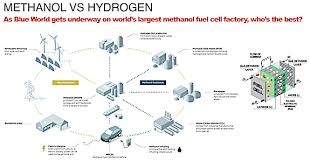
If you can find a way to insert oxygen, you have methanol (above right), the simplest hydrocarbon liquid.  I remain of the opinion that a liquid will dominate as the ground transport form of this century.  What is currently lacking is the direct methanol fuel cell (DMFC).  Well, not quite true, as Toshiba is said to be marketing a DMFC (left) for portable applications, so the concept is real.  Methanol is the only liquid which can be directly and efficiently utilized by a fuel cell.  The part that convinced me most about the sensibility of methanol is that one gallon of this fuel has 1.4, or 140% more accessible hydrogen atoms than one gallon of liquid hydrogen.  You know how much it costs to produce liquid hydrogen?  Anyway, there is no DMFC for automobiles, for reasons that befuddle me, although I sometimes think that the Farm Lobby had a lot to do with this tragedy to protect ethanol.  Many of my first ten articles for the Huffington Post features methanol.

The traditional way to make methanol is the steam reforming of natural gas.  Let us eliminate all fossil fuels from this process.  You can destructively distillate wood, which is why methanol is also called wood alcohol or methyl alcohol.  This process is too expensive, so the gasification and catalysis of biomass is how industry currently produces methanol.  Economic analysis will show that the resultant product for ground transport is cheaper than fermentation for methanol or ethanol.

However, I've led you this far to introduce you to an excitingly new concept:  combine carbon dioxide from the air and non-potable water to generate methanol using solar energy.  This way you also reduce global warming.  While not quite that, Jim Lane, editor and publisher of Biofuels Digest, reports on:


To summarize, the National Science Foundation provided a $2 million grant to a group of researchers at Lehigh, led by Steve McIntosh and Bryan Berger (to the left), to make methanol using only carbon dioxide, sunlight and water.  The key is to produce quantum dots using bacteria.  Huh?  Well, you can read the article.  They are nowhere close to commercializing their system, but it certainly makes sense to me.  Now, let's get on with, in parallel, perfecting the direct methanol fuel cell.  

-

Monday, September 19, 2011

CONVERSATIONS WITH BOCKRIS AND VEZIROGLU ON THE BIOMETHANOL ECONOMY


How this happened is still mystifying, but in 1974 I fortuitously participated in a gathering in Miami organized by Professor Nejat Veziroglu (left):

That trip in the previous paragraph was particularly monumental, for, while I don’t remember why, I first went to Miami to participate in the charter international hydrogen gathering chaired by Nejat Veziroglu. A couple of years ago I wrote a recommendation for him to the Swedish Nobel Prize Committee. Professor Veziroglu started and has been the continuing inspiration for the modern era of hydrogen. One of Nejat’s Romantics, John Bockris (above right), also was there, and is credited with coining The Hydrogen Economy. It is this group that has initiated a campaign to “save the world” from Peak Oil and Global Heating, as reported on in CHAPTER 3.

Mind you, this was more than 37 years ago, and the above quote came from my hydrogen chapter from SIMPLE SOLUTIONS for Planet Earth.  I have sporadically been in contact with both Professors Veziroglu and Bockris since then, but today sent John the following response to our interminable exchanges on the future of the BioMethanol Economy:

Dear John (cc: Nejat):

I generally agree with you on your current thoughts about carbon dioxide and methanol.  My overall thinking was provided three years ago in the Huffington Post.  A few points to consider for your future refinement:

1.  The optimal renewable ground transport fuel option is to gasify and catalyze biomass into methanol.  The problem is that the Department of Energy seems still influenced by the Farm Lobby to minimize research on the biomethanol economy.  This is America's best opportunity to capture world patents.  The Japanese control lithium battery technology, but that's okay because a fuel cell car can go five times further than one powered by a lithium battery, and that is the last battery.  The collateral problem is that hydrogen will be too expensive for a couple of generations, at least, so biomethanol will be this transition biofuel if only the DMFC can be commercialized for cars.   However, very little effort is being expended and a DMFC is at least a decade away from commercialization. 

2. There is no magic cost effective process to harvest carbon dioxide from the atmosphere.  The systems technology for a sustainable energy source that shows the best multi-mode opportunity in a timely manner, first because advocates indicate this pathway can be commercialized in a decade, but, too, the products are fuels and electricity, is something called heavy ion fusion.  Click on my latest Huffington Post article on STARPOWER.  The main product from this process is, surprisingly enough, synthetic fuel (where the carbon will come from the atmosphere), though, of course, electricity will also be an important revenue source.  The problem, and this sounds like a conspiracy (but is not--this is how human emotions work) is that governments and companies will do everything possible to promote their invested cause and subsequently try to prevent the development of this option, as might have happened in 1974 with the KMS fusion program.

3.  If only the USA had, in the 50's, selected thorium over uranium/plutonium, fission might today, actually, be okay.  Certainly, neither the Chernobyl nor Fukushima tragedies would not have happened, and there are only minimal terrorism and dirty bomb threats.  Of course, there was a good reason for this decision:  the Soviet Union and the Cold War dominated all our security priorities, and the military prevailed:

Why pick a bad design? In the early 1950s, the US Military wanted nuclear bombs. The fastest way they could do it was by building uranium reactors. That way, they would have an abundance of the raw material they wanted for bomb making – Plutonium-239; a nasty waste product of a normal uranium reactor. They also wanted a design that they could shoehorn into a nuclear powered submarine. The uranium reactor fit that bill. It really didn’t matter that uranium reactors were pretty inefficient, tended to overheat and relied on a rock that needed intensive mining and refining. They had a bigger agenda.

Now, the general public is so anti-nuclear, that thorium will not be given a chance.  The operative intelligence of public will is limited.

4.  Then more recently, beginning in the 80's, our U.S. Congress, smartly lobbied, took the incredibly stupid step of supporting the conversion of corn into ethanol over methanol from cellulose, and, worse, purposely preventing methanol as a competitive option.  This one track mentality extended to then use hydrolysis and fermentation of the whole plant into more ethanol, a faulty methodology, even with electricity as a by-product.   Methanol has one carbon, while ethanol has two.  That bit of logic should have convinced our braintrust to 40 years ago select methanol and the direct methanol fuel cell over ethanol, the key being that methanol is the only biofuel that can directly be fed into a fuel cell without going through reformation.  Ethanol can too, of course, but those two carbons make this very inefficient.  That a gallon of methanol has 140% more accessible hydrogen than LIQUID HYDROGEN is amazing enough, but the current infrastructure can also be easily retrofitted, an advantage to an entirely new and costly infrastructure required for hydrogen.


5.  This is getting even more comical, but just this year, the farm industry must determined ethanol was not worth the effort, for, as the oil companies were getting all the tax benefits anyway, the Farm Lobby backed off, and these credits will apparently be dis-continued at the end of the year because of that debt deficit matter.  Farmers have selected to focus on their surer and more traditional kind  of aid from Congress.  Surprisingly enough, very few realize that, subsequently, new and future ethanol investments will be placed in serious jeopardy.

6.  How we continue to head down the wrong path defies my common sense, but the private sector is still avoiding methanol (too low energy density to combust, plus a perceived and inaccurate concern about it being carcinogenic) by now plunging into the fermentation of biomass into an expensive  4-carbon fuel feedstocks, butanol and isobutanol (right), with the intent being to link them to synthesize 8-carbon gasoline and 12-carbon diesel substitutes.  I doubt if they will get under $3/gallon ($126/barrel), ever, for fermentation is just too slow and equipment bulky, meaning expensive.  Jetfuel is a mixture from 6 to 16 hydrocarbons, so there is a semblance of rationality here, as methanol will never be used for aviation, which is where, I think, hydrogen will someday bring advantages.

Aloha.

Pat

-
After being down by almost 250, the Dow Jones Industrials recovered to only drop 108, ending at 11,401.   World markets were also mostly down, especially Europe, for the Greek problem remained metastable.  Hopefully, after their stock exchanges closed, signs of substantive and productive discussions surfaced, rescuing the American bourse.  All common sense now should inspire the trader to go big tonight in anticipation of a major stock market recover tomorrow.  However, when it comes to the Greek debt matter, what is announced is not necessarily what is real nor realistic.

-
Oh, oh!  What looked like a weak tropical storm Roke has not suddenly become a Category 3 Typhoon, which is projected to strike Shikoku, Japan on Wednesday with near hurricane force strength, roll over Tokyo as a tropical storm:


with the eye almost directly over Fukushima by midnight on September 21.  People trying to recover in Tohuko must be wondering why them.


-